

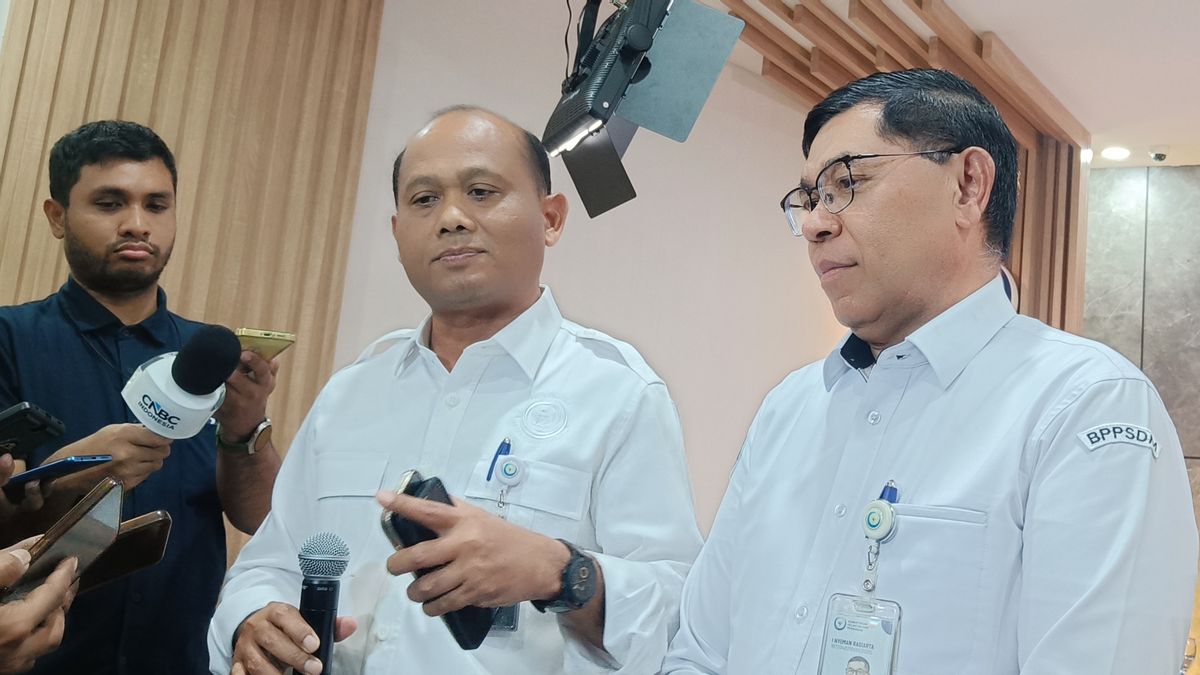


JAKARTA - The government through the Ministry of Maritime Affairs and Fisheries (KKP) has begun to disburse a large investment of IDR 7.2 trillion to build an integrated shrimp pond area in Waingapu, East Nusa Tenggara (NTT), which is projected to become a new model of environmentally friendly cultivation as well as a driver of the regional economy.
For your information, the project is located in Palakahembi Village as well as the Watumbaka and Watumbangga sub-districts, Pandawai District, which is generally known as the Waingapu area.
Director General of Fisheries and Aquaculture of the Ministry of Maritime Affairs and Fisheries, Tb. Haeru Rahayu, said that the area was designed as a pilot for shrimp cultivation integrated with the best operational standards at every stage of production.
"We are building this area as a model for environmentally friendly integrated cultivation, starting from the water intake process, processing in the tank, cultivation activities to waste management through wastewater treatment plants (IPAL) along the value chain," said the man who is familiarly called Tebe in a press conference at the KKP office, Jakarta, Wednesday, April 1.
Tebe emphasized that this approach was carried out to ensure that cultivation activities did not have a negative impact on the surrounding ecosystem.
In terms of investment, this project is considered to be a large budget with a value of IDR 7.2 trillion.
The cost includes construction management needs to the main physical development which reaches around IDR 7.1 trillion.
The pond area will be equipped with various supporting facilities, ranging from intake channels, tanks, mapping cultivation, waste treatment facilities to supporting industrial areas.
The success of this project, according to Tebe, depends heavily on the synergy between the central government, local government and the private sector.
The central government will play a role in the development of the area and the preparation of human resources, while the local government supports in terms of licensing, land provision, and the involvement of local communities.
"We want local people not only to be spectators, but to be an important part of supporting the sustainability of this pond area," he said.
In addition, the Ministry of Agriculture also opens opportunities for the private sector to be involved, both upstream and downstream, ranging from the provision of seedlings and feed to the processing of production results.
The development of the area is targeted to be completed in the next two years, with some areas expected to be operational soon.
"We invite the private sector or private companies to be able to fill in the upstream sector and in the downstream sector. For example, in the upstream sector, there is a need for fish seeds later, how many hundreds of millions of seeds are needed, then the feed," he said.
"At the downstream, there will be processing and so on. So, both of us at the center, at the local government, and also the private sector as investors are one unit that we cannot separate just like that. We must engage with each other," he concluded.
The English, Chinese, Japanese, Arabic, and French versions are automatically generated by the AI. So there may still be inaccuracies in translating, please always see Indonesian as our main language. (system supported by DigitalSiber.id)


