

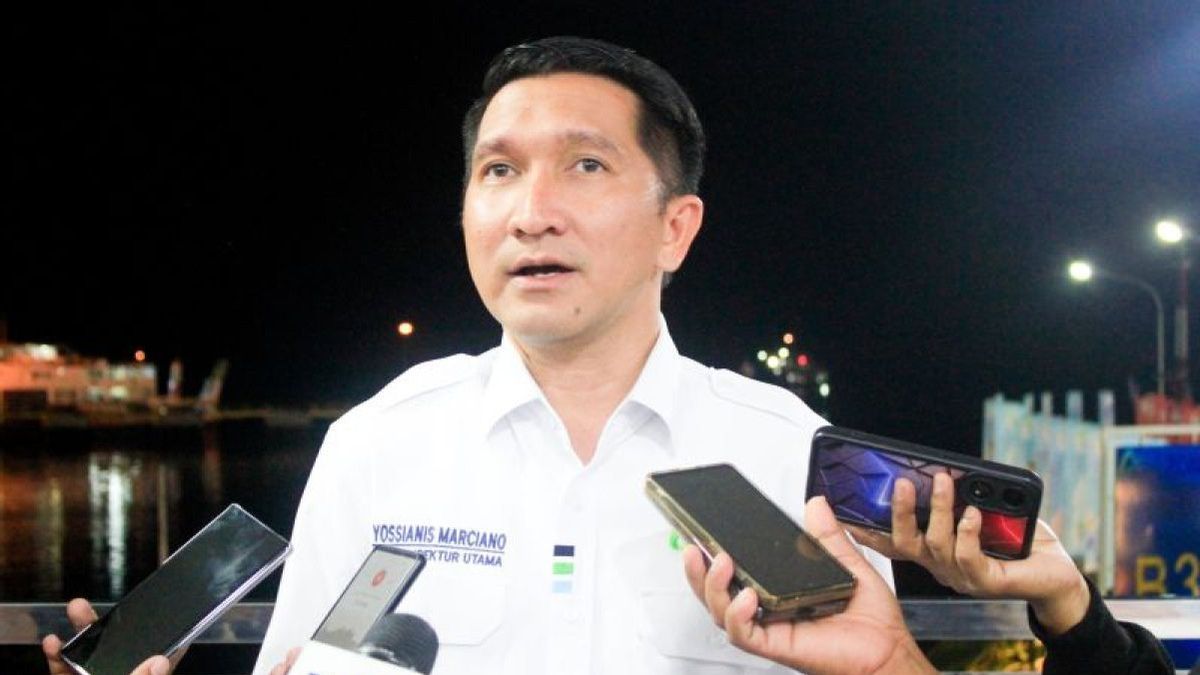


JAKARTA - PT ASDP Indonesia Ferry (Persero) ensures that the 2026 Lebaran return flow on the Ketapang-Gilimanuk route remains under control even though there is a spike in vehicles.
Acceleration of services at the pier is the main key to maintaining smooth movement without significant obstacles.
Deputy President Director of PT ASDP Indonesia Ferry (Persero) Yossianis Marciano emphasized that density control does not only depend on the number of ships, but on the speed of service at each operational point.
"Our focus is to ensure that the process runs quickly and continuously. Through the Tiba-Bongkar-Berangkat (TBB) pattern, the ship does not linger at the pier so that vehicles can be served immediately and continue to move," Yossianis said in an official statement, Monday, March 30.
To support this strategy, the time for loading and unloading ships is optimized with an average duration of around 35 minutes per service cycle.
With a shorter duration and maintained operational discipline, the rotation of ships can take place faster so that service capacity increases.
Furthermore, he added, queues may still occur during peak periods, but the most important thing is to keep vehicle movement from stopping.
"The most important thing is that the flow remains alive. Queues can happen, but they must not stop," he said.
Based on monitoring on Monday, March 30, 2026 at 14.00 WIB, the vehicle queue was recorded at around 5.8 kilometers from the Ketapang Port entrance. The queue is dominated by small vehicles, medium trucks, large trucks, and large buses that continue to move towards the port.
To anticipate the surge, ASDP together with other ship operators operate a total of 34 ships. A total of 22 ships, including those implementing the TBB pattern at a number of piers, are supported by four assistance ships to accelerate rotation and maintain a stable service rhythm.
In terms of demand, data on ticket reservations through Ferizy recorded as many as 164,881 vehicles have made reservations for the period H-10 to H+10 or March 11 to April 1, 2026.
Until H+7, a total of 154,313 vehicles had entered Ketapang Port, with a potential of 10,568 vehicles that are estimated to still be moving towards the port.
Meanwhile, ASDP Ketapang Branch General Manager Arief Eko said that the acceleration of services at the pier was also strengthened by arranging vehicle traffic from the land side.
"We control the rhythm of vehicles through the buffer zone, so that arrivals at the port remain measured and do not pile up," explained Arief.
The peak of the return flow was recorded on Sunday, March 29, 2026 (H+7), with a total of 56,365 passengers and 19,057 vehicles crossing from Java to Bali.
The composition of vehicles is dominated by motorcycles with 12,458 units and private cars with 4,995 units.
A number of buffer zones such as Grand Watudodol, Sri Tanjung Terminal, Bulusan, and PT Pusri have been optimized as parking pockets as well as traffic control points. Coordination with the police, Transportation Office, and other stakeholders continues to be strengthened to keep vehicle distribution under control.
ASDP also appeals to the public to buy tickets early through the Ferizy application, plan the trip well, and maintain physical condition during the trip.
The English, Chinese, Japanese, Arabic, and French versions are automatically generated by the AI. So there may still be inaccuracies in translating, please always see Indonesian as our main language. (system supported by DigitalSiber.id)


