



JAKARTA - The National Food Agency (Bapanas) emphasized that the increase in the Price Development Index (IPH) in a number of regions does not necessarily indicate that the price of food commodities has exceeded the Sales Reference Price (HAP) or the Highest Retail Price (HET).
The Secretary General of the National Food Agency, Sarwo Edhy, explained that the IPH basically only reflects the direction of price movements compared to the previous period, not the price position against the limits set by the government.
Edhy said that the increase in IPH could occur even though commodity prices were still below the government's reference price.
"IPH basically describes the direction of price movements compared to the previous period, so that an increase in the index can occur even though commodity prices are still below HAP or HET. Based on field monitoring, there are still a number of regencies/cities that have recorded food commodity prices below HAP/HET," said Edhy in his statement, Tuesday, March 10.
Edhy added that the increase in IPH does not always reflect a high price spike, but can occur because previously low prices have been adjusted to a more reasonable level.
"IPH describes the direction of price movements over time, not indicating that commodity prices are definitely above HAP or HET. In practice, an increase in IPH can occur because previously low prices have been adjusted to a more reasonable price," he said.
Based on data from the Central Statistics Agency (BPS) regarding the IPH level of regencies/cities in the first week of March 2026, the majority of areas still recorded commodity prices below HAP or HET.
In the case of sweet peas, for example, there are 164 regencies/cities or about 31.90 percent that recorded prices above the HAP, while 350 regencies/cities or about 68.10 percent are still below the reference price.
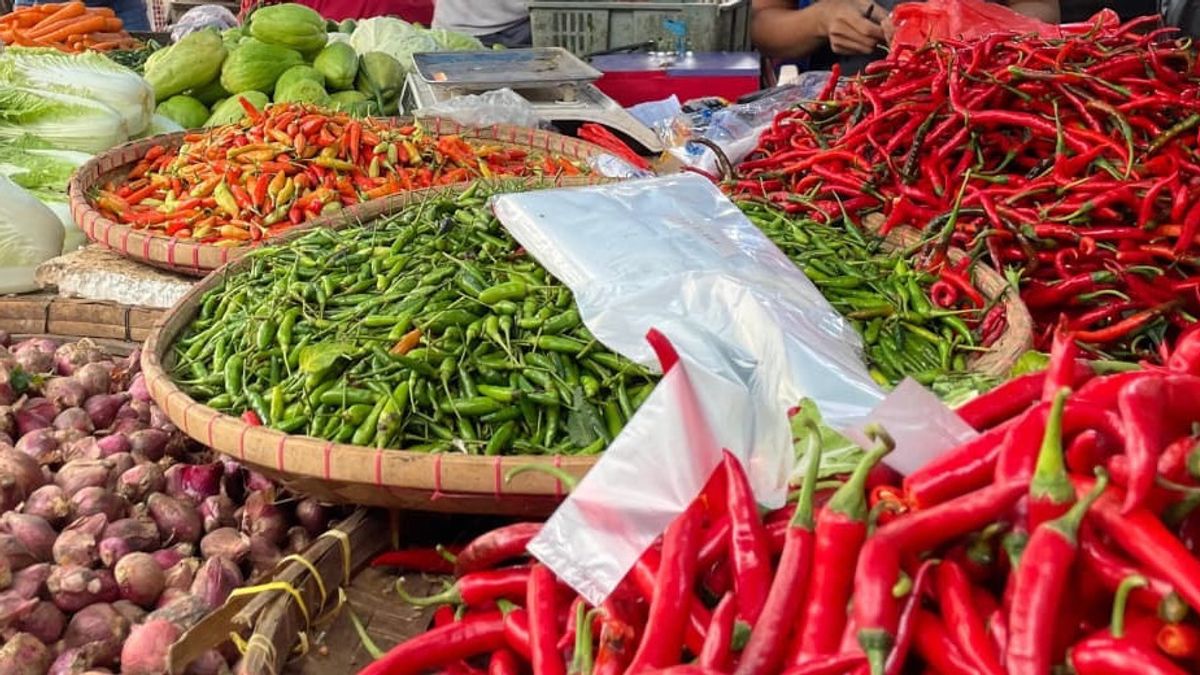
For curly red chilies, only 20 regencies/cities or around 3.89 percent recorded prices above the HAP, while 494 regencies/cities or around 96.11 percent were still below the reference. A similar condition also occurred in red onions, where 23 regencies/cities or around 4.47 percent were above the HAP, while 491 regencies/cities or around 95.53 percent were still below the reference.
In the garlic commodity, it was recorded that 47 regencies/cities or around 9.14 percent were above the HAP, while 467 regencies/cities or around 90.86 percent were still below the reference price.
Meanwhile, in the animal protein commodity, broiler chicken meat was recorded above the HAP in 80 districts/cities or around 15.56 percent, while 434 districts/cities or around 84.44 percent were still below the HAP. For broiler eggs, there are 48 districts/cities or around 9.33 percent that are above the reference, while 466 districts/cities or around 90.67 percent are still below the HAP.
In the beef commodity, only 38 regencies/cities or around 7.39 percent recorded prices above the HAP, while 476 regencies/cities or around 92.61 percent were still below the reference price.
As for other basic necessities, consumption sugar was recorded above HAP or HET in 60 regencies/cities or around 11.67 percent, while 454 regencies/cities or around 88.33 percent were still below the reference price.
For Minyakita cooking oil, there are 48 regencies/cities or around 9.34 percent that recorded prices above HET, while 466 regencies/cities or around 90.66 percent are still below the established price limit.
Meanwhile, Deputy for Food Availability and Stabilization of Bapanas I Gusti Ketut Astawa reminded the importance of vigilance by local governments in maintaining food price stability ahead of Eid al-Fitr, when community demand for food materials usually increases.
"We appeal to the Governor, Regent, and Mayor, this week is a crucial week because people's needs tend to increase closer to Lebaran. Of course this is a heavy task for us to work together to maintain and control food prices," said Ketut.
Ketut emphasized the need for active involvement of local governments by assigning related services to strengthen monitoring in the field with the Food Violation Saber Task Force, especially in public markets and major distribution channels.
"Please be monitored and assigned by the Head of the Office to go directly to the field in these weeks, because this is a crucial period for the potential fluctuation of food prices," he said.
Previously, the Head of the National Food Agency who also served as Minister of Agriculture Andi Amran Sulaiman ensured that the stability of the supply and price of national food during the fasting period until Eid al-Fitr was maintained.
This condition is supported by the strengthening of distribution and supervision that continues to be carried out in various regions.
"I've checked it, it's still relatively stable. There is an increase in purebred chicken meat. That is a little stronger, according to the inflation meeting. It's relatively safe," Amran said in a press statement in Jakarta, Friday, March 6, 2026.
The English, Chinese, Japanese, Arabic, and French versions are automatically generated by the AI. So there may still be inaccuracies in translating, please always see Indonesian as our main language. (system supported by DigitalSiber.id)
Popular


