

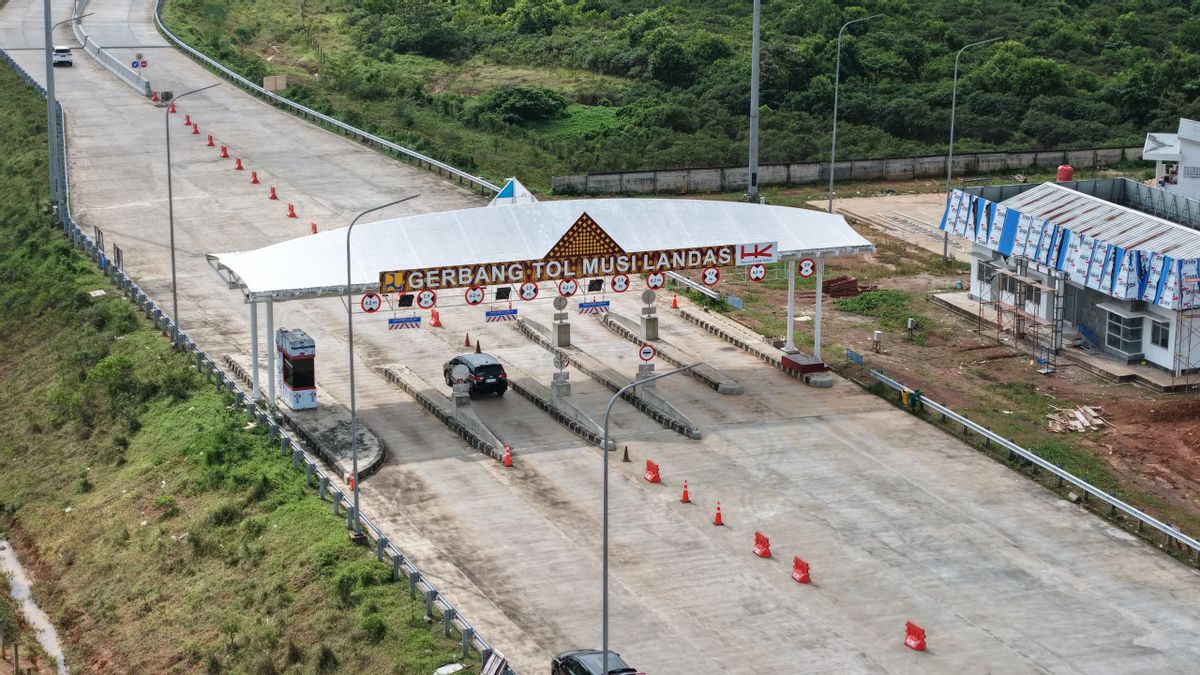


JAKARTA - PT Hutama Karya (Persero) or HK will operate the Palembang-Betung Toll Section 1 and 2 functionally during the homecoming and return period of Lebaran 2026.
The Palembang-Betung toll section 1 Palembang-Rengas and Section 2 Rengas-Pangkalan Balai are part of the Trans Sumatra Toll Road (JTTS) network with a total length of 54.5 kilometers.
The project has two Toll Gates (GT), namely GT Rengas and GT Pangkalan Balai and includes main road works, interchanges and main structures in the form of Musi V Bridge with a length of 1,684 meters.
The company together with the Indonesian Toll Road Association (ATI) has reviewed the readiness of service and safety aspects of the functional toll road Palembang-Betung Section 1 and 2 on Friday, February 27.
The review was carried out by ATI Secretary General Kris Ade, ATI Supervisory Board Chairman Adhi Resza, Director of Operations III Hutama Karya Iwan Hermawan, EVP of Operations & Maintenance of Toll Roads Dwi Aryono Bayuaji, to the Palembang-Betung Project Director, Dinny Suryakencana.
Director of Operations III of Hutama Karya, Iwan Hermawan, said that the review was carried out to ensure that the functional toll road that was prepared had a measurable service standard, especially in terms of road user safety and operational readiness at critical points.
"This check ensures that the service elements in the field, ranging from line readiness, safety devices to supporting facilities at rest areas and toll gates, are in line with operational standards," said Iwan as quoted from a written statement, Monday, March 2.
According to Iwan, all field evaluations carried out will be followed up through strengthening the readiness of personnel, improving safety equipment and improving the quality of facilities at strategic points.
"We hope that the functional toll road Palembang-Betung Section 1 and 2 can provide optimal benefits for the community, with safety as the main priority," he explained.
Meanwhile, ATI Secretary General Kris Ade assessed that the joint review was important to ensure consistency in service standards and safety on the functionalized lines, as well as to maintain the quality of travel information for road users.
"Operational readiness needs to be supported by discipline in the application of standards, the readiness of personnel, and clarity of information at service points so that road users feel safe and helpful," he explained.
The English, Chinese, Japanese, Arabic, and French versions are automatically generated by the AI. So there may still be inaccuracies in translating, please always see Indonesian as our main language. (system supported by DigitalSiber.id)


