

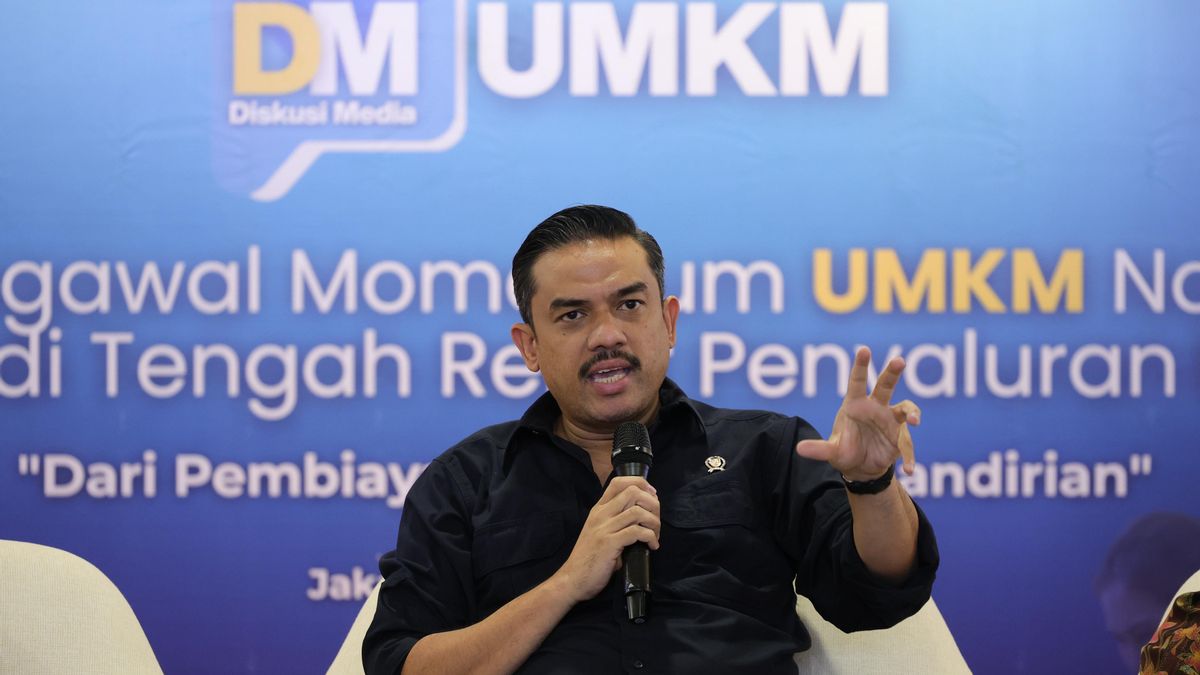


JAKARTA - Minister of Micro, Small and Medium Enterprises (UMKM) Maman Abdurrahman revealed that the government targets the distribution of KUR of IDR 295 trillion in 2026 with 1.37 million new debtors. This target is increased from 2025 with a realization of IDR 270 trillion where distribution to the productive sector reaches IDR 163.9 trillion.
Maman explained that although the ceiling of KUR distributors has increased, unfortunately the quality of the increase in the class of MSMEs is not optimal. He assessed that the fundamental problem is not in the financing channel or access to assistance (incubation) for MSMEs, but in market access which is disrupted by imported products.
As a result of the prevalence of imported products, all efforts to increase the capacity of MSMEs provided by the government are not optimal.
"The Indonesian market is dirty, dirty, and dirty. As good as they are helped today so that they can produce but they can't sell goods. Our market is filled with imported goods," said Maman to the media crew in a Media Discussion with the UMKM Journalists Forum, quoted Saturday, February 28.
The flooding of imported products, continued Maman, is the root of the difficulty of SMEs to rise in class. For this reason, it is time for the problem of imports that are so massive to be restricted by involving all parties.
Maman encourages the existence of an integrated policy across ministries, such as the Ministry of Trade and the Coordinating Ministry for Economic Affairs and other related parties to sterilize the domestic market so that local products can regain space.
On the other hand, this Golkar Party politician also touched on the high cost of digital platform services which are one of the main channels for marketing MSMEs. The high charging fee for MSMEs when selling products online makes their competitiveness even smaller.
"For this reason, we continue to encourage policies with cross-ministries/institutions to secure the domestic market, so that the interventions that have been carried out by the government can have a more optimal impact," he said.
Maman also highlighted the large inequality between loans for the MSME sector and non-MSME sector outside KUR. Total national banking credit reached Rp8.149 trillion, but Rp6.569 trillion of which or 80.6 percent actually flowed to around 50 large corporations. He noted that the contribution of MSME loans to total national banking credit was only 19.4 percent, far from the target of 25 percent.
"We note that today, credit for MSMEs has only reached 19.4 percent. There are still about six percent that have not been able to be met," he concluded.
Meanwhile, the Director of the Digital Economy Center of Economic and Law Studies (Celios), Nailul Huda, emphasized that the challenges faced by MSMEs in Indonesia are not only related to imports, but also serious financing problems.
According to him, capital is the main obstacle because of high bank interest rates and burdensome collateral requirements, so many MSME actors are forced to use their own capital.
"In 2015, the distribution of new KUR reached 15 percent, and although this figure is not a record, in macro terms the distribution of KUR and non-KUR financing for MSMEs has actually decreased, especially in the period from October to December," he said on the same occasion.
Specifically for the distribution of KUR in 2025, Nailul assessed that the reality was not the highest record, because in 2022 the distribution of KUR had reached a higher figure. Even so, KUR is recognized to have a positive impact on increasing economic and credit activities in villages where 72.3 percent of villages in Indonesia have been served by KUR.
"The distribution of KUR which is still heavy to the trade sector and less to the industry shows an imbalance. This is different from the retail sector which is actually growing high," he said.
The Secretary General (Sekjen) of the Indonesian MSME Association (Akumindo), Edy Misero, said that the realization of the distribution of KUR was still far from expectations and caused a number of problems for MSME actors in the field.
One of the causes of the slow absorption is the strict administrative requirements, especially regarding collateral, even though government regulations state that loans under IDR 100 million do not require collateral.
"When the administration and financial statements are in order, but then the certificate (collateral) is asked. So, the government regulation in the sky: 100 million without collateral, but in the field it is still asked for collateral," said Edy.
Edy also criticized the attitude of banks that are members of the State-Owned Bank Association (Himbara), which he said had not fully provided convenience in accordance with regulations. He assessed that acceleration of distribution was needed more than just cheap interest.
"We need acceleration, not just cheap interest. If there is cheap interest, thank God, but Himbara wants no obstacles. If it is not possible to provide ease according to the rules, then honestly," he added.
With all the complexities in accessing financing at banks, he encourages that MSMEs cannot continue to rely on banking flexibility. He also asked the bank to be more honest and flexible regarding the limits of their ability to channel unsecured credit. He gave an example, if the ceiling without collateral cannot be given in full, the bank should be open.
He also reminded that the difficulty of accessing KUR made many MSMEs eventually turn to fintech institutions and online loans, which have much higher interest rates.
"The difficulty of KUR makes many MSMEs take from fintech or pawnshops. Everything is taken because it is desperate," he said.
This DM FWUMKM was held thanks to the support of various parties, including PT Pertamina (Persero), PT Perusahaan Listrik Negara (Persero) / PT PLN, PT Bank Central Asia Tbk (BCA), PT Sarana Multigriya Finansial (Persero) / PT SMF, PT Jaminan Kredit Indonesia (Jamkrindo), Aqua, Shopee.
Dok. FW UMKM
The English, Chinese, Japanese, Arabic, and French versions are automatically generated by the AI. So there may still be inaccuracies in translating, please always see Indonesian as our main language. (system supported by DigitalSiber.id)
Most Popular Tags
#Prabowo Subianto #donald trump #2026 World Cup #Febrie Adriansyah #8791Popular


