

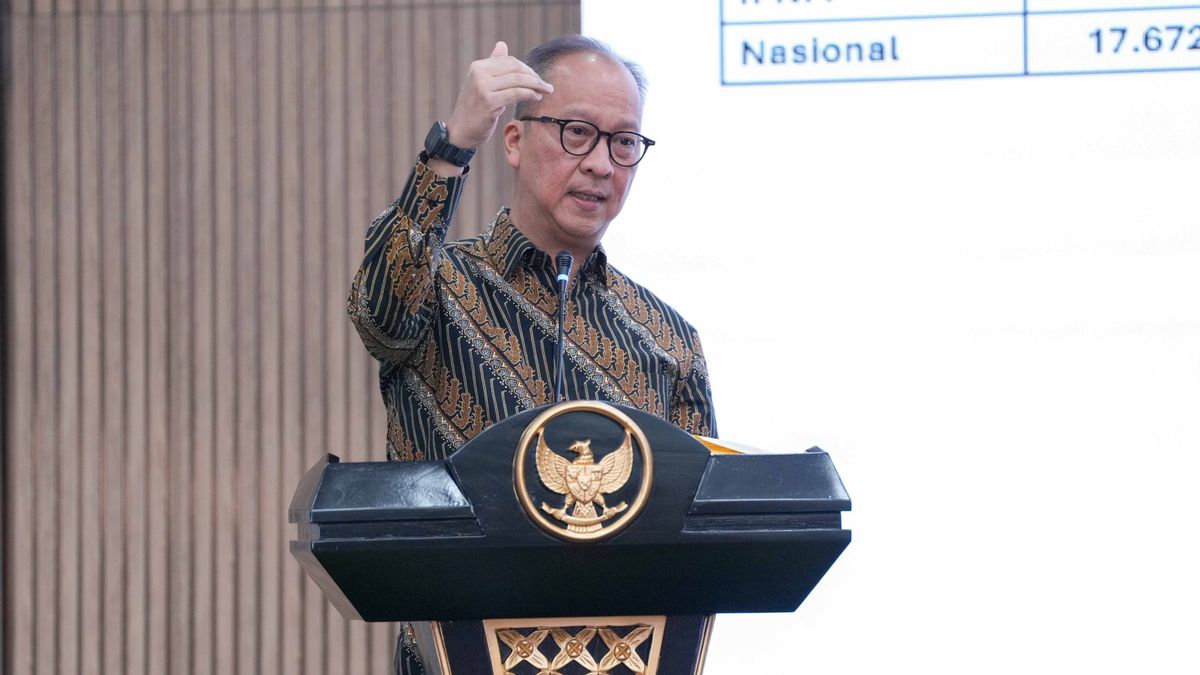


JAKARTA - Minister of Industry (Menperin) Agus Gumiwang Kartasasmita emphasized that Indonesia is a self-sufficient country that has an automotive industry with the ability to produce pickups on a large scale.
Agus said that strengthening the production of domestic pickup trucks has a significant economic impact for Indonesia.
As an illustration, Agus said, if the procurement of 70,000 pickup trucks (4x2) is met by domestic products, it will have a positive economic impact (backward linkage) of around Rp. 27 trillion.
"So the added value of the economy and the absorption of labor will be enjoyed by Indonesia.
Then, the sub-sectors directly related to the production of pickup vehicles are the tire industry, glass industry, wet battery industry (accu), metal industry, leather industry, plastic industry, cable industry, electronic industry and so on.
"If all the needs of pickup trucks are met through imports, economic added value and employment absorption will be enjoyed by industries abroad. However, if these needs can be met by the domestic industry, economic benefits, job creation and strengthening of national industries will also be felt in the country," said Agus in a written statement, Friday, February 20.
Agus' statement is allegedly referring to the steps of one of the SOEs, Agrinas Pangan Nusantara, which chose to import 105,000 pickup trucks from India in full during 2026 for the needs of the Red and White Village Cooperative.
Even so, Agus did not mention it directly in the official statement.
The national automotive industry currently has the ability to produce pickup trucks with a significant capacity of around 1 million units per year.
The manufacturers involved include PT Astra Daihatsu Motor, PT Isuzu Astra Motor Indonesia, PT Mitsubishi Motor Krama Yudha Indonesia, PT Suzuki Indomobil Motor, PT SGMW Motor Indonesia, and PT Sokonindo Automobile.
"With this capacity, the national pickup truck industry is considered capable of meeting domestic market needs while strengthening the competitiveness of the Indonesian automotive industry at the global level," he said.
According to Agus, the standards and quality of domestic production pickup trucks (4x2) are very competitive compared to imported products.
In addition, the local product has been able to meet operational needs in various regions of Indonesia with diverse road infrastructure conditions.
Domestically produced commercial vehicles have also been well received by the public and business actors because their performance is considered reliable and able to serve the needs of distribution and goods mobility.
However, Agus admitted that Indonesia has not produced a type of pickup truck with a four-wheel drive (4x4) specification that is specifically designed for very heavy terrain, especially mining and plantation areas.
On the other hand, Agus emphasized that in terms of economic efficiency, the maintenance cost of a pickup truck (4x4) is relatively more expensive, the availability of spare parts and after-sales service is limited, in addition to the low resale price.
In terms of economic efficiency, the maintenance cost of a pickup truck (4x4) is relatively more expensive, the availability of spare parts and after-sales service is limited in addition to the low resale price.
The former Minister of Social Affairs added that the government has consistently maintained the sustainability of the national automotive industry, including by appealing to automotive industry players to maintain labor stability in the midst of global and domestic dynamics and challenges faced by the automotive sector.
So, said Agus, the procurement of vehicles through imports is feared to disrupt these efforts.
"We continue to invite automotive industry players to maintain business continuity while maintaining labor, so that there is no termination of employment in the midst of existing industry challenges," he added.
The English, Chinese, Japanese, Arabic, and French versions are automatically generated by the AI. So there may still be inaccuracies in translating, please always see Indonesian as our main language. (system supported by DigitalSiber.id)


