

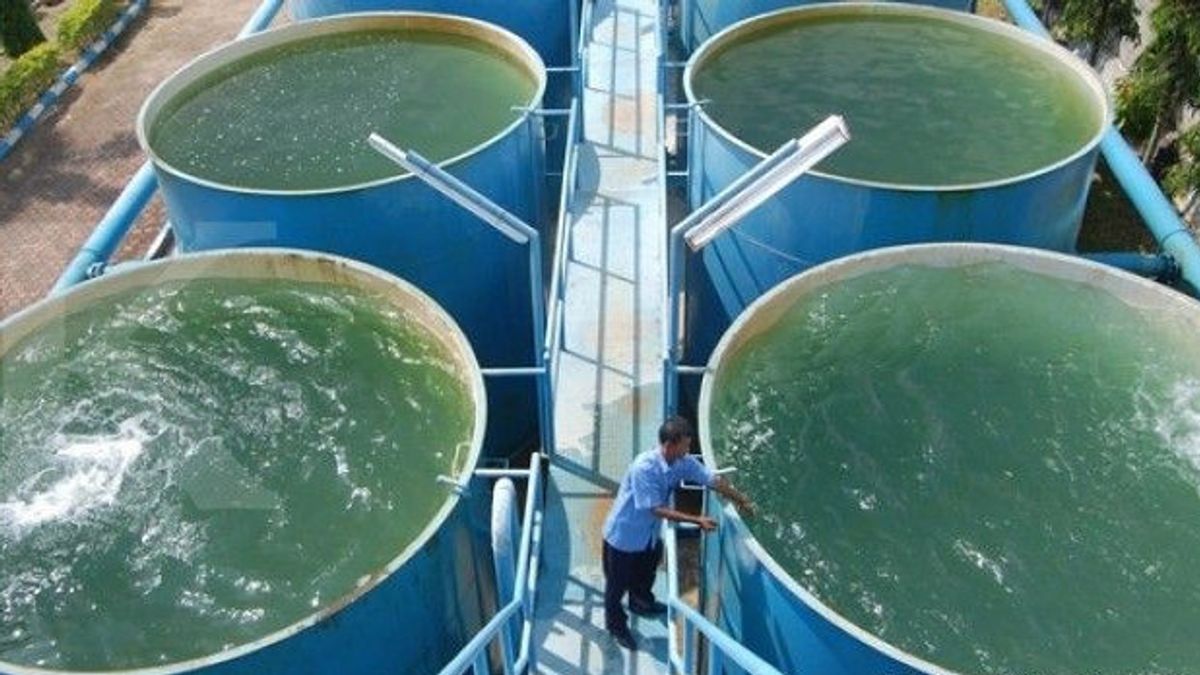


JAKARTA - The Bekasi Regency Government, West Java, is asked to go to the field to trace the use of groundwater by a number of companies.
This is to follow up on the findings of the community which said that many companies are users but have not been recorded as objects of regional taxes.
The Chairman of the NGO Sniper Gunawan said that the results of field investigations found thousands of companies in the Bekasi Regency area using groundwater for production operations without being recorded in the local government tax object, so that the local original income (PAD) was suspected of evaporating.
"Our investigation results show that there are thousands of companies that use groundwater. However, it is not recorded as a tax object or a new potential for regional income," he said in Cikarang, Sunday, quoted by Antara.
As the implementation of Law Number 1 of 2022 concerning Financial Relations between the Central Government and Regional Governments, the authority to manage Land Water Tax (PAT) is now entirely in the hands of the district and city governments.
This policy replaces Law No. 28 of 2009 concerning Regional Taxes and Regional Retributions. In the latest regulation, groundwater tax is set as one type of regional tax with a maximum rate of 20 percent of the basic price of groundwater.
According to him, local governments must dare to go directly to the field to follow up on the findings. In addition to enforcing rules, this step is considered to have the potential to increase local tax revenue.
Gunawan considered it ironic that Bekasi Regency, which is known as the largest industrial area, has a relatively small target for land water tax revenue. This condition should encourage the local government to conduct an audit and work harder to optimize revenue potential.
Referring to data from the Regional Revenue Agency (Bapenda) Bekasi Regency, the number of groundwater taxpayers in 2023 was recorded as 167 active companies. In 2025, the number increased to 183 companies. However, this figure is considered not to reflect the actual conditions in the field.
The gap between the number of groundwater users and registered taxpayers shows the weakness of data collection. However, local governments often justify the difficulty of collecting groundwater taxes because of licensing issues that are still the responsibility of the central government.
"Our results are the reason for the audience, which is always a licensing issue. This should not be an excuse or obstacle in optimizing the collection of groundwater taxes," he explained.
He emphasized that the main focus of the local government should be on the aspect of data collection of companies that use groundwater. From there it will be seen which companies should be included as taxpayers and which ones are not.
He gave an example, hotels, hospitals and a number of industrial companies are relatively easy to identify from the use of PDAM meters or water treatment installations provided by industrial areas.
"It's easy to see, companies that use groundwater and don't. There can be PDAM meters or WTP meters from the industrial area," he explained.
Responding to this condition, the Head of the Regional Tax Division at the Bekasi Regency Tax Office, Hendra, said that his party plans to carry out a sudden inspection of companies that use groundwater but have not been registered as taxpayers.
"We will make sure to go to the field, but later after there is a West Java Governor's Regulation that regulates the groundwater tax rate," he said.
The Bekasi Regency Tax Office is currently still focusing on the mass printing of the Tax Due Notification Letter (SPPT) for Rural and Urban Land and Building Taxes (PBB-P2).
"In the first quarter, we focus on printing mass SPPT as a whole. After that, all tax sectors including groundwater will be our work program to pursue the regional revenue target," said Hendra.
The English, Chinese, Japanese, Arabic, and French versions are automatically generated by the AI. So there may still be inaccuracies in translating, please always see Indonesian as our main language. (system supported by DigitalSiber.id)


