
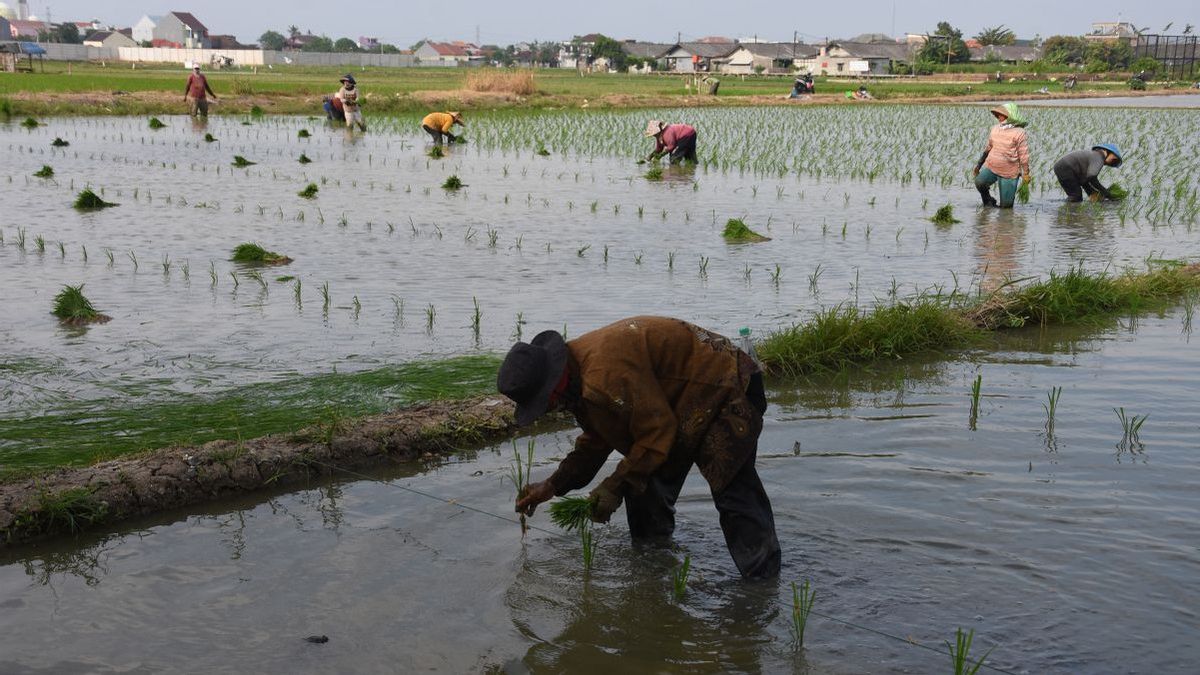


JAKARTA - The Directorate General of Land and Irrigation of the Ministry of Agriculture (Ditjen LIP) stated that the construction, improvement, rehabilitation, and operation and maintenance of agricultural irrigation networks continue to be carried out in realizing national rice self-sufficiency in a sustainable manner.
"Proper water management is not just a technical matter, but also has a direct impact on food security," said Director General of Land and Irrigation of the Ministry of Agriculture Hermanto in a statement in Jakarta, quoted by Antara, Thursday, January 1.
He emphasized that with accurate calculations, farmers can maximize the use of water, reduce the risk of supply shortages in the dry season, and increase the productivity of the agricultural sector.
Therefore, said Hermanto, the Directorate General of Irrigation continues to implement the principle of sustainable agricultural irrigation management through intensive coordination and synchronization with the Ministry of Public Works through the Directorate General of Water Resources and BBWS/BWS in the region.
"Through the improvement of tertiary irrigation networks and coordination with the Association of Farmers Using Water (P3A), the distribution of water to agricultural land can be maintained well," he said.
He said that this effort was also in line with Presidential Instruction Number 2 of 2025 concerning the Acceleration of Development, Improvement, Rehabilitation, and Operation and Maintenance of Irrigation Networks to Support National Food Self-sufficiency, which was established on January 30, 2025 by President Prabowo Subianto to strengthen national food security.
With the Inpres, the government has accelerated the repair and rehabilitation of irrigation infrastructure in the Irrigation Area (DI) which is 60 percent less optimal in providing irrigation water for rice fields.
According to Hermanto, the development of the implementation of Presidential Instruction (Inpres) Number 2 of 2024 in Phase 1 which is targeted at 280,880 hectares has reached 99.93 percent of the implementation, and this has also fulfilled the target set.
Meanwhile, the Inpres in phase 2 with a target area of 225,775 hectares, with achievements including 83.46 percent on the main irrigation network; 98.66 percent on the tertiary irrigation network; and 92.25 percent on the construction and rehabilitation of the Tanah Air Irrigation Network (JIAT).
As for the Inpres in the third phase of activities, with a target area of 146,503 hectares with the realization of the implementation of the main irrigation network reaching 67.67 percent; the realization of the implementation of the tertiary irrigation network reached 87.57 percent and for the construction and rehabilitation of JIAT reached 93.91 percent.
"This is the result of hard work and collaboration with the Ministry of PU, including strong support from the local government," added Hermanto.
As the latest data from the Central Statistics Agency (BPS), national rice production in 2025 reached 34.77 million tons, an increase of 13.54 percent compared to the previous year.
The increase was driven by an increase in harvest area of almost 13 percent, with the potential production of rice reaching 60.34 million tons of milled dry paddy (GKG).
This achievement confirms the role and contribution of strengthening agricultural irrigation as an important foundation in providing water for agriculture so that in the end it has a major impact on increasing rice production for food security and realizing national rice self-sufficiency in a sustainable manner.
"This year and in the years to come, the implementation of Inpres 2/2025 will continue, which will also be strengthened by other strategic activities such as Land Optimization (Opla) and People's Rice Cultivation (CSR)," he said.
"These activities will continue to be implemented throughout Indonesia as a manifestation of the Ministry of Agriculture's commitment to food self-sufficiency," added Hermanto.
The English, Chinese, Japanese, Arabic, and French versions are automatically generated by the AI. So there may still be inaccuracies in translating, please always see Indonesian as our main language. (system supported by DigitalSiber.id)
Most Popular Tags
#Prabowo Subianto #donald trump #firearm #8791 #giias 2026Popular


