

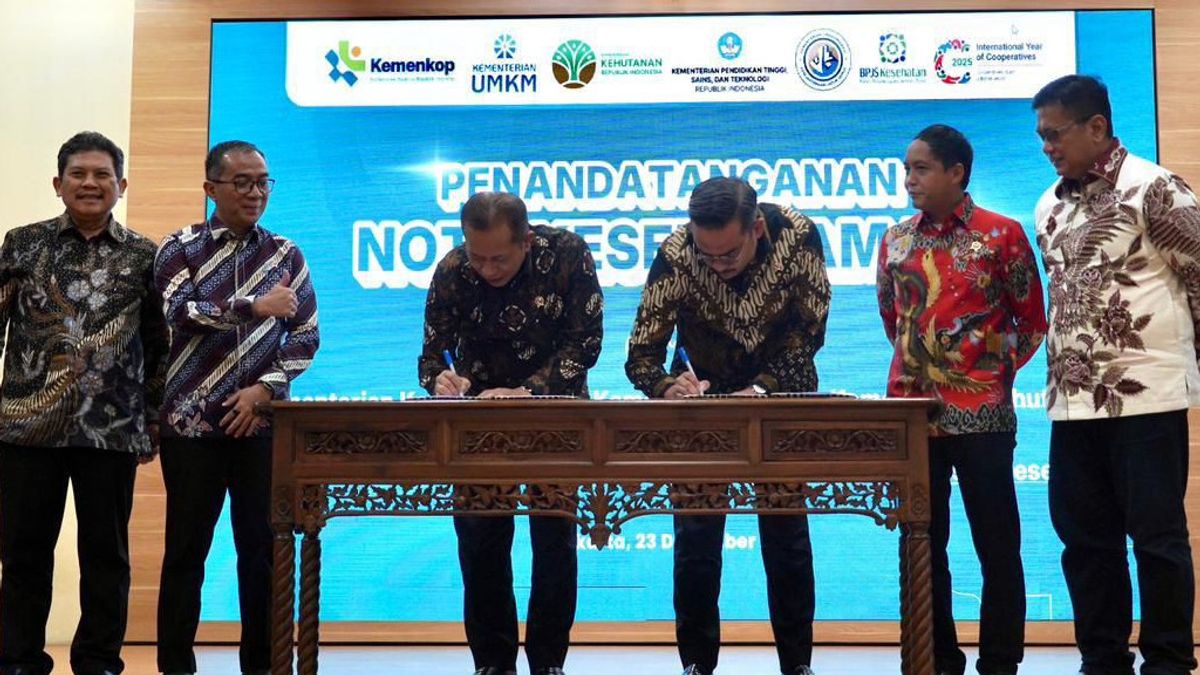


JAKARTA - The Ministry of Cooperatives (Kemenkop) has collaborated with the Ministry of Micro, Small and Medium Enterprises (UMKM), the Ministry of Forestry (Kemenhut), the Ministry of Higher Education, Science and Technology (Kemendiktisaintek), the Ministry of Transmigration and BPJS Health to build an integrated and competitive ecosystem for people's businesses.
The cooperation was realized in the signing of a Joint Memorandum of Understanding (MoU), as a manifestation of commitment to strengthen cross-ministry and agency (K/L) synergy in the development of cooperatives and the people's economy.
Minister of Cooperatives (Menkop) Ferry Juliantono said that next year is an important target with plans to develop and develop 80,000 village cooperatives equipped with supporting facilities such as outlets and training for managers.
"We hope that this village cooperative can become the main platform for accommodating and marketing UMKM products in a modern and organized manner, through cross-ministry/agency cooperation," said Ferry, Tuesday, December 23.
In detail, he explained, the MoU has a scope, namely, cooperation with the Ministry of MSME is focused on human resource (HR) capacity building and development, cooperative institutions, MSMEs, and entrepreneurship.
In addition, this synergy also includes strengthening and developing business and sharing data and information.
"Cooperatives are holding and large houses for MSMEs, so this synergy is very important to build a strong and competitive people's business ecosystem," said Ferry.
The Minister of MSME, Maman Abdurrahman, said that the Kopdes Merah Putih can play a role as an aggregator for MSMEs in various regions.
"Cooperatives can be an aggregation for MSMEs in their areas. We encourage the strengthening of medium-sized businesses that will be clustered in each area, especially through red village cooperatives," he added.
With the Ministry of Industry, the cooperation includes the utilization of research, innovation, and community service for the development of cooperatives, the improvement of human resources and institutional capacity, and the strengthening of literacy and dissemination of information on cooperatives.
"Kemendiktisaintek also encourages the formation of student cooperatives at universities as an example for other cooperatives in the region, so that they become a new economic force," said Minister of Education and Culture Brian.
Meanwhile, with the Ministry of Cooperatives, the emphasis on cooperation is directed at strengthening the institutional, business, and human resources capacity of cooperatives in the forestry sector.
This includes facilitating infrastructure facilities and strengthening business networks so that cooperatives can provide economic added value, while maintaining forest sustainability without damaging it.
Menhut Raja Juli stated that currently 8.3 million hectares of land have been allocated for the community in the form of social forestry. "The land has been given to around 1.4 million families who form 15,000 Social Forestry Business Groups (KUPS)," he explained.
Furthermore, cooperation with the Ministry of Transmigration focuses on strengthening cooperatives in the transmigration area. Starting from data integration, synchronization of policies and programs, the formation and strengthening of cooperative institutions, to the development of partnerships and the improvement of human resources capacity.
The Minister of Transmigration Viva revealed the importance of cooperative development in the transmigration area, which has formed 1,560 business entities and 466 transmigration villages in 116 regencies/cities and three provinces.
"Through cooperatives, it is hoped that it can increase economic and social movement in the transmigration area," he said.
Ferry also hopes that cooperatives can become a driving force for an inclusive and sustainable transmigration area economy. Cooperation is also carried out with BPJS Kesehatan, which focuses on data and information exchange, literacy improvement and socialization of the National Health Insurance (JKN) Program, increasing active participation of cooperative people, and encouraging cooperatives to become strategic partners in the implementation of the JKN Program.
This cooperation also supports the development of the Red and White Village/Neighborhood Cooperative (Kopdes), especially in the utilization of health service outlets such as cooperative pharmacies and clinics so that they are integrated and participate in the JKN service ecosystem in accordance with the provisions of laws and regulations.
"This cooperation also aims to reactivate the live pharmacy program and provide social security for Red and White Kopdes actors throughout Indonesia," said Ali Gufron.
The English, Chinese, Japanese, Arabic, and French versions are automatically generated by the AI. So there may still be inaccuracies in translating, please always see Indonesian as our main language. (system supported by DigitalSiber.id)
Popular


