

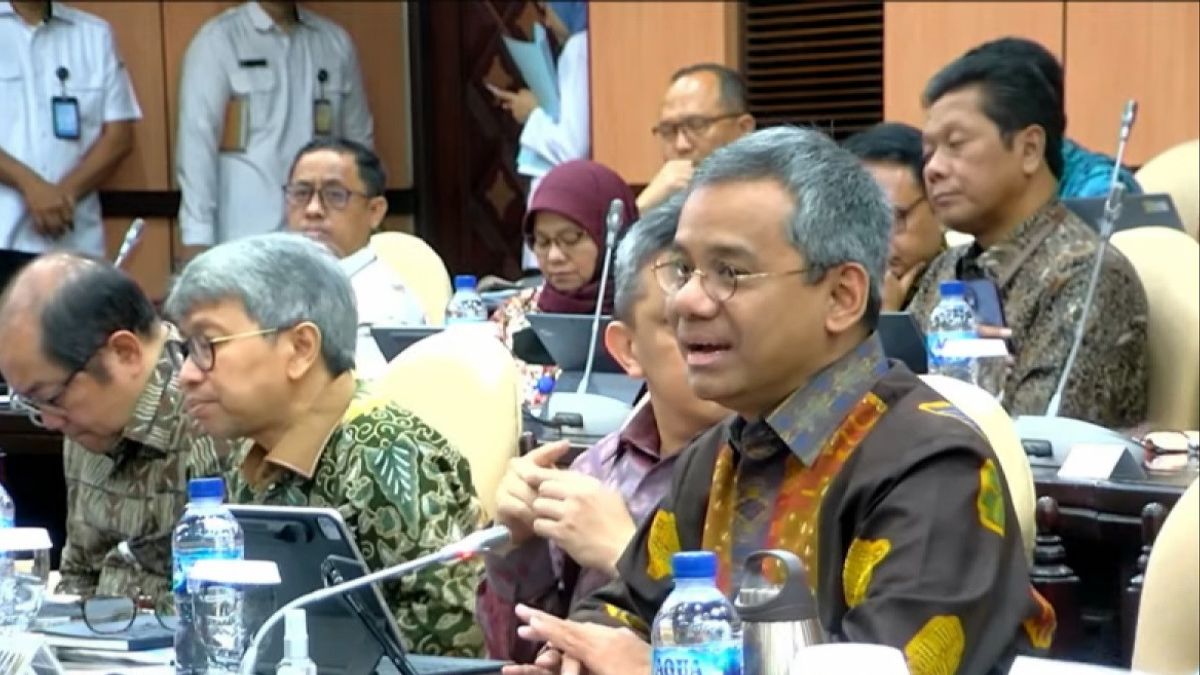


JAKARTA - The Ministry of Finance (Kemenkeu) officially launched a State Property Insurance (BMN) program funded through the Disaster Management Joint Fund (PFB) scheme.
Deputy Minister of Finance (Wamenkeu) Suahasil Nazara said that until 2025 the total BMN that had been insured through the ministry and institution budget reached Rp61 trillion.
He added that with the presence of a new scheme that utilizes disaster pooling funds, this year's coverage will increase by IDR 30 trillion from three pilot ministries, namely the Ministry of State Secretariat, the Ministry of Health, and the Ministry of Religion.
Suahasil said that the total BMN that was insured in 2025 increased to IDR 91 trillion.
"This year, I can convey, the cover of state property that has been covered by insurance covers is Rp. 61 trillion through the ministry and institution budget, and Rp. 30 trillion through disaster pooling funds which have started to run," he said Tuesday, December 2.
He hopes that this step will continue in 2026, and asks the Directorate General of State Assets to ensure that all ministries and institutions insure manageable assets, so that protection can be provided optimally.
Suahasil also noted that the total value of BMN in the education, health and office sectors is estimated at IDR 250 trillion.
Therefore, he encourages the insurance industry to increase service capacity in order to be able to meet greater coverage needs.
This year, what has been covered by insurance is around Rp. 61 trillion, a quarter. There are three more quarters that must be insured. I want to challenge all ministries and institutions, I want to challenge the insurance industry to think about how to accelerate insurance for these state-owned goods," he said.
Suahasil emphasized that the national insurance industry must be ready to provide healthy and sustainable products and services.
In addition, he also mentioned the role of the Financial Services Authority (OJK) as a regulator, which needs to understand the development of the BMN insurance program, especially because the APBN also spends funds on premium payments.
"OJK must also understand because the state budget spends money on the insurance industry directly in the form of premiums," he said.
Meanwhile, disaster fund pooling itself is a mechanism for raising funds from various sources ranging from the APBN, APBD, grants, investments, to insurance claims to ensure fast, precise, and sustainable disaster management funding.
SEE ALSO:
-
 | EKONOMI
Bakal Ada Kejutan Kebijakan dari Prabowo, Nusron Wahid: Tunggu Tanggal Mainnya
07 November 2025, 16:06 -
 | EKONOMI
Nusron Serahkan Sertifikat Aset Kemenlu demi Punya Kepastian Hukum Jelas
06 November 2025, 23:23 -
 | EKONOMI
Profil Handojo S. Muljadi, Salah Satu Pengusaha yang Beli Patriot Bonds Danantara
09 Oktober 2025, 08:11
These funds can be distributed to ministries/agencies, local governments, and community groups.
In addition, the main goal of disaster pooling funds is to provide a public asset protection scheme, including financing for the recovery of BMN damage, so that public services can continue without obstacles.
In the future, he said that the government targets local governments to participate in insurance through this scheme so that Regional Property (BMD) can also be protected.
According to him, if it is successfully implemented, Indonesia will have an asset management system with a modern and internationally recognized risk mitigation approach.
This is a big goal. If we can do it, then we will become a country that manages our assets much more modernly and we will emerge at the world level as a country that manages these assets in much more modern ways," he concluded.
The English, Chinese, Japanese, Arabic, and French versions are automatically generated by the AI. So there may still be inaccuracies in translating, please always see Indonesian as our main language. (system supported by DigitalSiber.id)
Most Popular Tags
#Prabowo Subianto #donald trump #Febrie Adriansyah #8791 #giias 2026Popular


