

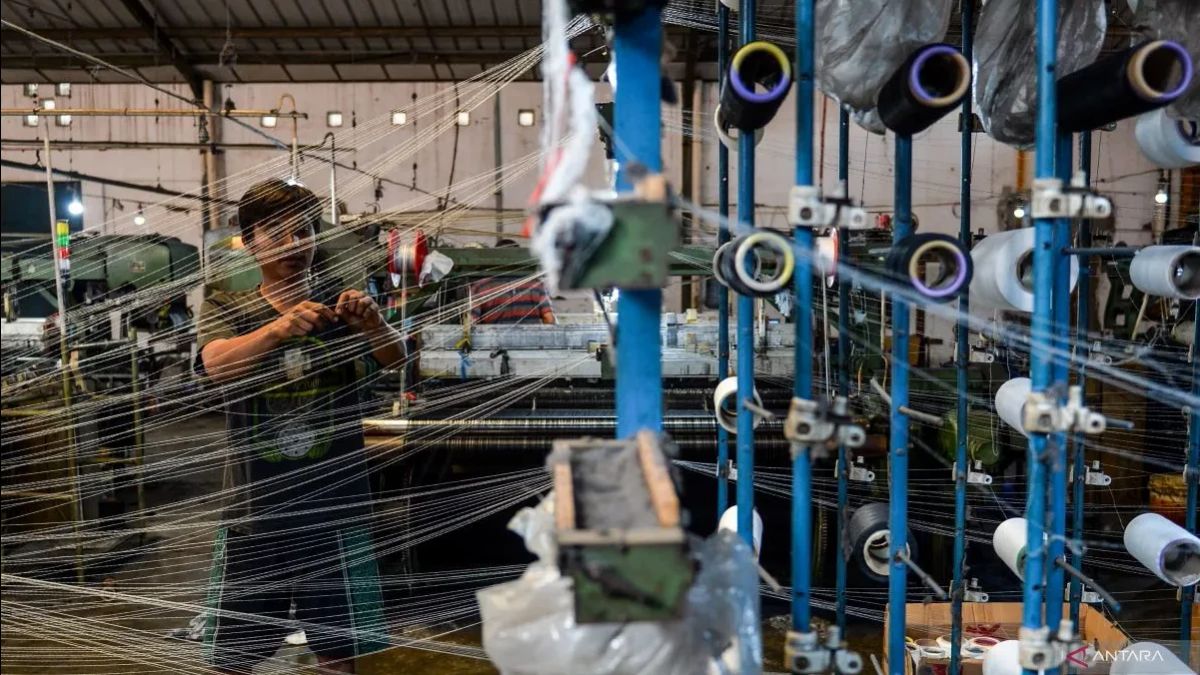


JAKARTA - The performance of the national textile industry has certainly not recovered to date.
The reason is, factory closures continue to occur and the trend of termination of employment (PHK) is unavoidable.
The Association of Indonesian Filament Serat & Benang Producers (APSyFI) noted that at least five textile factories had stopped production and closed their businesses.
The five factories are PT Polychem Indonesia in Karawang and Tangerang, PT Asia Pacific Fibers in Karawang, PT Rayon Utama Makmur which is part of the Sritex Group and PT Susilia Indah Synthetics Fiber Industries (Sulindafin) in Tangerang.
"The closure of the five companies was due to serious losses due to non-maximum sales in the domestic market," said APSYFI Secretary General Farhan Aqil Syauqi in a written statement received by VOI, Friday, November 28.
Not only the factory closure, but APSYFI noted, at least 3,000 people have been laid off so far.
According to Farhan, the condition of the textile industry is increasingly depressed due to the rise of illegal imported products from China at dumping prices in the form of fabrics and threads.
"Currently, the other six factories have production below 50 percent. In fact, there are already on-offs. Five polymerization machines have stopped, not production anymore," he said.
Farhan does not deny that the trend of closing the textile factory will continue to occur until next year.
Especially if the government cannot control and provide transparency to the public regarding which recipients of the most import companies have caused the current flood of imported products in the domestic market.
"Of course, the government knows this data because every import product enters through a large port, it will be recorded in the customs system," said Farhan.
He is worried that if there are no corrective actions, the six other companies mentioned earlier will go bankrupt because they cannot sell their products in the domestic market.
In addition, according to Farhan, his party could not determine the production plan next year because there was no transparency of the imports given by the government. "Deindustrialization really happened," said Farhan.
However, APSYFI appreciates the actions of the Minister of Finance (Menkeu) Purbaya Yudhi Sadive who is committed to stopping illegal imports.
SEE ALSO:
-
 | EKONOMI
Sumbang Investasi hingga Rp207 Triliun, Industri Minuman Serap 15.943 Tenaga Kerja
27 November 2025, 21:28


The investigation into imports of Thrifting is believed to be able to uncover fraudulent practices in the mechanism of import trading.
This is because in importing Thrifting, the importers can find out who the importers are and those who protect behind them.
"Law enforcement can also be investigated who caused state losses, we believe bureaucrats are involved equally and have been fully affiliated," he concluded.
The English, Chinese, Japanese, Arabic, and French versions are automatically generated by the AI. So there may still be inaccuracies in translating, please always see Indonesian as our main language. (system supported by DigitalSiber.id)
Most Popular Tags
#Prabowo Subianto #donald trump #earthquake #independence day #8791 #hut riPopular


