

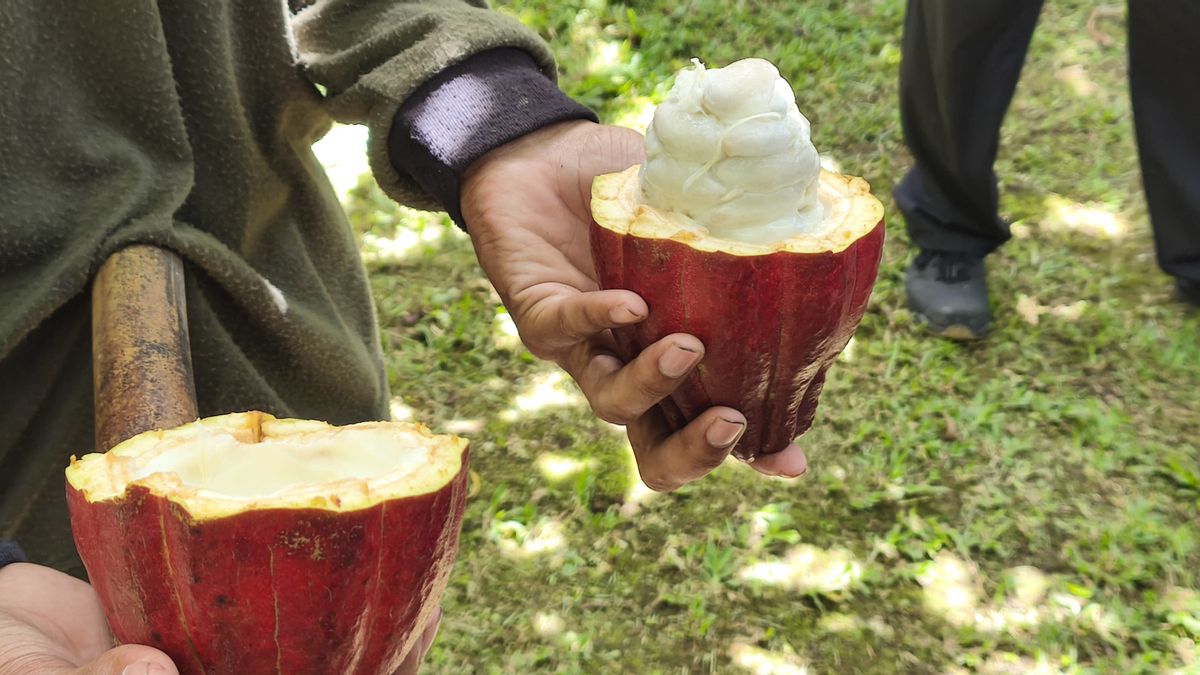


JAKARTA - The placement of government funds of IDR 276 trillion is considered to have not had a real impact on the real sector, including the cocoa industry.
The reason is, this step has not succeeded in reducing the interest rate on bank credit.
CEO of Cau Chocolates, I Kadek Surya Prasetya Wiguna revealed that the credit interest rate is still at a high level and the loan interest offered to his company even reaches 12 percent per year.
"Today we still receive very high interest rates (credit), between 8 percent-12 percent" he said when met at the Cau Chocolates production facility, quoted Wednesday, November 26.
He said he could accept this condition from the company's side, but the high credit interest rate ultimately made the price of cocoa products in the market also increase.
"For example, God will give me a way, thank you. But, if we say it's down, who wants to help?" he said.
Therefore, Surya hopes that the government can provide greater support to the cocoa industry.
"We hope that the BPDP (Perkebunan Fund Management Agency) will also focus on labor-intensive industries such as we get interest intensive," he said.
Surya revealed that throughout 2025 his company had delivered 10 tons of products to Australia and Poland, respectively.
Previously, Cau Chocolates had also exported products to a number of neighboring countries.
The commodities sent are organic dark chocolate which is ready for consumption.
"Previous years have been to other places, to Malaysia and Singapore," he said.
He explained that the main challenge in exporting is the difference in regulations and entry rates in each country.
"We need to study that. Let's say China, they have standardization starting from the warehouse, registration in their area and so on," he explained.
Furthermore, Surya said that currently companies are still exporting in small volumes and prioritizing countries that have high demand for their products.
For example, Australia is a potential market due to the high consumption of chocolate in the country.
In addition, the number of Australian tourists who come to Bali is quite large, so cocoa products can be sent via Australian aircraft cargo that land in Bali to reduce shipping costs.
Furthermore, Surya targets that in the future 50 percent of the Cau Chocolate turnover will come from exports. "Now it's only 5 percent, it's still small," he said.
Currently, the Cau Chocolates can absorb 7 8 tons of dried cocoa beans per month.
To increase capacity, the company is building a new factory capable of producing up to 2 tons, much larger than the previous factory which only had a capacity of 500 kilograms.
With this new capacity, he said, the Cau Chocolates is estimated to accommodate 700 '800 tons of cocoa beans per year from farmers.
"That's the future, we build our upstream. Now the question is, the government wants to help not build upstream with the quality of this standard," he said.
Meanwhile, Bank Indonesia (BI) has lowered the BI Rate to 125 basis points in 2025, a slow reduction in lending rates.
BI Governor Perry Warjiyo explained that the existence of special rates for large deposits prevented credit interest and deposits from immediately following the decline in the BI Rate.
"The deposit interest rate is still slow and why the credit interest rate (has not decreased slowly) has not yet dropped, which we call the special rate third party fund (DPK)," Perry said, during a working meeting with Committee IV DPD, monitored Tuesday, November 18.
SEE ALSO:
-
 | EKONOMI
Rosan Sebut Target Investasi Rp13.000 Triliun dalam Lima Tahun Realistis
26 November 2025, 20:09 -
 | EKONOMI
Pendapatan JECC Melonjak 24,6 Persen, Tembus Rp2,99 Triliun di Kuartal III-2025
26 November 2025, 19:45

SEE ALSO:
-
| EKONOMI
Rosan Sebut Target Investasi Rp13.000 Triliun dalam Lima Tahun Realistis
26 November 2025, 20:09 -
| EKONOMI
Pendapatan JECC Melonjak 24,6 Persen, Tembus Rp2,99 Triliun di Kuartal III-2025
26 November 2025, 19:45
Until September 2025, the special rate still contributed 31.1 percent of the total third party funds (DPK), or around Rp2,540.8 trillion.
The interest given through the special rate reached 5.53 percent, higher than the average deposit interest rate of 4.52 percent.
The English, Chinese, Japanese, Arabic, and French versions are automatically generated by the AI. So there may still be inaccuracies in translating, please always see Indonesian as our main language. (system supported by DigitalSiber.id)
Most Popular Tags
#Prabowo Subianto #donald trump #earthquake #independence day #8791 #hut riPopular


