


JAKARTA - Bank Indonesia (BI) has set an average inflation target of 2.62 percent and an rupiah exchange rate of IDR 16,430 per US dollar in the 2026 Bank Indonesia Annual Budget Plan (RATBI).
Governor of Bank Indonesia (BI) Perry Warjiyo estimates that this inflation target will increase compared to the 2025 Bank Indonesia (ATBI) Annual Budget which is 2.50 percent, although it is projected that real inflation will decrease to 2.01 percent.
Perry emphasized that the 2026 inflation target is still within the BI target range, which is 2.5 percent plus minus 1 percent.
"We estimate that the inflation as ATBI's basis is 2.62 percent, and it is still within the target limit of 2.5 percent plus minus 1 percent," he said during a working meeting with Commission XI of the DPR, Wednesday, November 12.
Perry said that with a fairly large economic capacity, BI estimates that import inflation in 2026 will remain under control, supported by the acceleration of digitalization.
Meanwhile, he said that food inflation or volatile food is expected to be stable, thanks to the coordination of inflation control by the Central/Regional Inflation Control Team (TPIP/TPID) and the implementation of the National Food Control Movement (GNPIP).
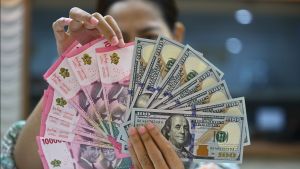
Perry said that in RATBI 2026, BI targets an rupiah exchange rate of Rp. 16,430 per US dollar. This figure is weaker than the ATBI 2025 target of Rp. 15,285 per US dollar, but is almost equivalent to the rupiah projection in 2025.
The average rupiah exchange rate is IDR 16,430 per US dollar, almost the same as the 2025 prognosis of IDR 16,440 per US dollar. I think this is realistic because as we said earlier, global conditions in 2026 are still the same as high volatility, the risk of capital flow abroad is still large," he said.
Perry also emphasized that the global economic condition in 2026 is predicted to not change much compared to this year, especially after the announcement of the US reciprocal rate in April 2025.
SEE ALSO:
-
 | EKONOMI
Perry Warjiyo: Redenominasi Rupiah Butuh Waktu dan Persiapan Matang
12 November 2025, 14:03 -
 | EKONOMI
Rupiah Diprediksi Melemah Terbatas di Tengah Minimnya Sentimen Ekonomi
12 November 2025, 09:04

He added that the main challenges faced include high volatility, large outflows of capital, and BI efforts to maintain the stability of the rupiah exchange rate.
BI affirms its commitment to maintaining rupiah stability through intervention, including the non-delivery forward (NDF) mechanism in the domestic and international markets.
He added that spot intervention is also still being carried out, which has an impact on the position of foreign exchange reserves. This stabilization policy is one of the basis for the preparation of the 2026 Bank Indonesia Assumption and Target (ATBI).
Despite facing challenges, Perry remains optimistic that the rupiah will be relatively stable in 2026 supported by BI's commitment to maintaining exchange rates, yields, controlled inflation, and still good economic growth prospects.
The English, Chinese, Japanese, Arabic, and French versions are automatically generated by the AI. So there may still be inaccuracies in translating, please always see Indonesian as our main language. (system supported by DigitalSiber.id)


