
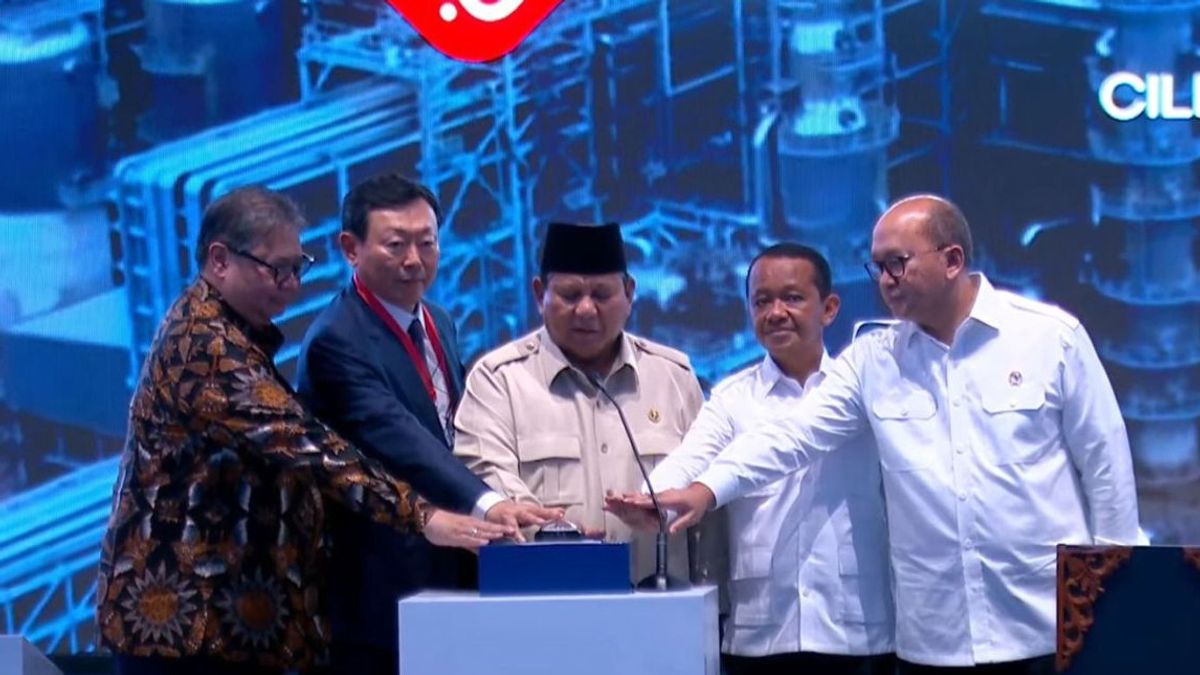


JAKARTA - Minister of Energy and Mineral Resources (ESDM) Bahlil Lahadalia said the presence of the Lotte Chemical Indonesia (LCI) factory in Cilegon, Banten, is an important step in efforts to reduce dependence on imports of petrochemical raw materials.
Of the total LCI production capacity, Bahlil said that around 70 percent of the production yields will be marketed domestically, and the remaining 30 percent will be exported. In other words, most of LCI production will be used to replace imports.
So far, we have imported (pedrochemical raw materials). With this factory, we no longer import on a large scale like the previous year. 70 percent is import substitution, we export 30 percent," said Bahlil at the factory inauguration ceremony, as monitored by Antara online in Jakarta, Thursday, November 6.
Bahlil added that the total sales value of this integrated petrochemical factory is estimated at around US$2 billion per year, with around US$1.4 to 1.5 billion of them coming from the domestic market, while the rest from exports.
The new ethylene project LCI factory is part of an interrelated petrochemical complex in Cilegon, Banten, which is included in the national strategic project (PSN). This project cost an investment of US$3.98 billion, making it one of the largest petrochemical investments in Southeast Asia.
The 110-hectare petrochemical complex in Cilegon is designed with a production capacity of naphtha crackers of up to 3 million tons per year.
From these facilities, various main products were produced, such as 1 million tons of ethylene, 520 thousand tons of propylene, 350 thousand tons of polypropylene, 140 thousand tons of butadiene, and 400 thousand tons of BTX (benzene, toluene, and xilena) every year.
The factory started commercial operations in October 2025 and is integrated with a polyethylene (PE) facility with a capacity of 450 thousand tons per year that has already operated.
This facility is also designed to use up to 50 percent of LPG other than naphtha as the main raw material, enabling significant cost and operational efficiency.
"So today proves that Indonesia's downstreaming is not only built from mineral and coal downstreaming, but has also begun to move on downstream oil and gas," said Bahlil.
In terms of employment, Bahlil noted that during the construction period to date, the total number of workers reaches a total of 17 thousand people. If calculated by indirect workforce, this project absorbs around 40 thousand workers.
He also revealed that this project had stalled for 5-6 years before it could finally be completed.
Bahlil said that the last large-scale petrochemical project in Indonesia was built about 30 years ago, namely the Chandra Asri project during the Soeharto Presidential Government. Since then, Indonesia has not yet implemented similar projects on a large scale.
SEE ALSO:

He added that in the era of President Prabowo Subianto's Administration, Indonesia was finally able to execute and inaugurate large petrochemical projects such as LCI, which became an important milestone in the revival of the national downstream industry.
According to Bahlil, the existence of the LCI project does not only provide great economic value, but also has a strategic meaning in the framework of national development. This project is a clear proof of the success of downstream policies that have been directed by the President.
"That Indonesia's natural resources and energy are no longer exported in the form of raw goods, but are processed domestically to produce higher added value and create jobs and strengthen national industrial competitiveness at the global level," said Bahlil as well.
The English, Chinese, Japanese, Arabic, and French versions are automatically generated by the AI. So there may still be inaccuracies in translating, please always see Indonesian as our main language. (system supported by DigitalSiber.id)
Most Popular Tags
#Prabowo Subianto #donald trump #2026 World Cup #Febrie Adriansyah #8791Popular


