
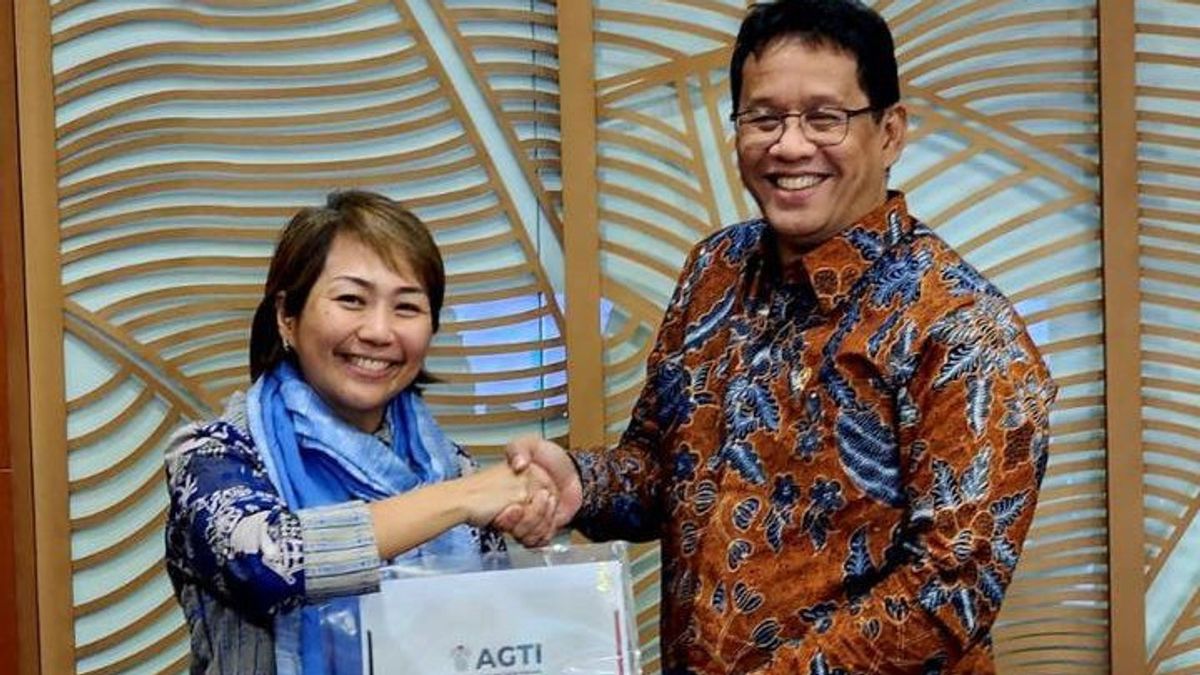


JAKARTA - Minister of Finance Purbaya Yudhi Sadive received an audience with the Indonesian Garment and Textile Association (AGTI). In the hearing of the General Chairperson of AGTI, Anne Patricia Sutanto emphasized her commitment to strengthening the competitiveness of the national garment and textile industry based on the values of the Pancasila Economy. This step is believed to be able to create a balance between industrial productivity, environmental interests, and labor welfare.
In its hearing, AGTI has conveyed a roadmap for strengthening competitiveness with an approach to SWOT Analysis of National TPT Industrial Competitiveness Improvement and its Ecosystems to map the opportunities and challenges of the textile industry going forward and in the next two weeks AGTI will detail several challenges and proposals for debottlenecking.
"The AGTI audience and the response of the Minister of Finance and the ranks of the Ministry of Finance provide fresh air for the country's garment and textile industry. AGTI believes that building the TPT industry is not only efficient and competitive, but also social justice, according to the principles of Pancasila's economy. The approach is not just business, but creates added value and new jobs together with the government and workers as business partners and academics in AGTI," said Anne, in her statement, quoted Wednesday, November 5.
Anne revealed that AGTI together with the government, through coordination with the Financial Sector Impact Handling Committee (KSSK) led by Purbaya Yudhi Sadive, are preparing concrete steps to strengthen the labor-intensive industrial sector.
"Further meetings with KSSK are scheduled to discuss various strategic aspects, including simplifying industrial licensing, especially in the implementation of PP Number 28 related to environmental licensing," he explained.
AGTI also highlighted the import policy of used textile products (thrifting). Anne assessed that the government's firm decision to limit the circulation of thrifting goods in local markets is very appropriate and provides a positive opportunity for clothing producers to be market-oriented.
"We strongly support Pak Purbaya's decision. Goods that have gone through customs should not be circulating in the domestic market. Local industries must receive protection in order to grow. On the other hand, we are also developing polyester recycling-based solutions to stay competitive and environmentally friendly," added Anne.
On that occasion, Anne also revealed that several AGTI members are currently increasing their production capacity, even opening new job recruitment.
SEE ALSO:


"There are no layoffs. In fact, some have retired and we are recruiting again. Even one of our members will immediately inaugurate a new factory. This means that this industry continues to grow," he said optimistically.
In the future, AGTI will continue roadshows to various regions to strengthen networks and consolidate with business actors, workers, and local governments.
"We believe that if all elements - the government, employers, and workers - unite in the spirit of the Pancasila economy, then the competitiveness of the national textile industry can double, even exceed competing countries," said Anne.
The English, Chinese, Japanese, Arabic, and French versions are automatically generated by the AI. So there may still be inaccuracies in translating, please always see Indonesian as our main language. (system supported by DigitalSiber.id)
Most Popular Tags
#Prabowo Subianto #donald trump #Febrie Adriansyah #8791 #giias 2026Popular


