

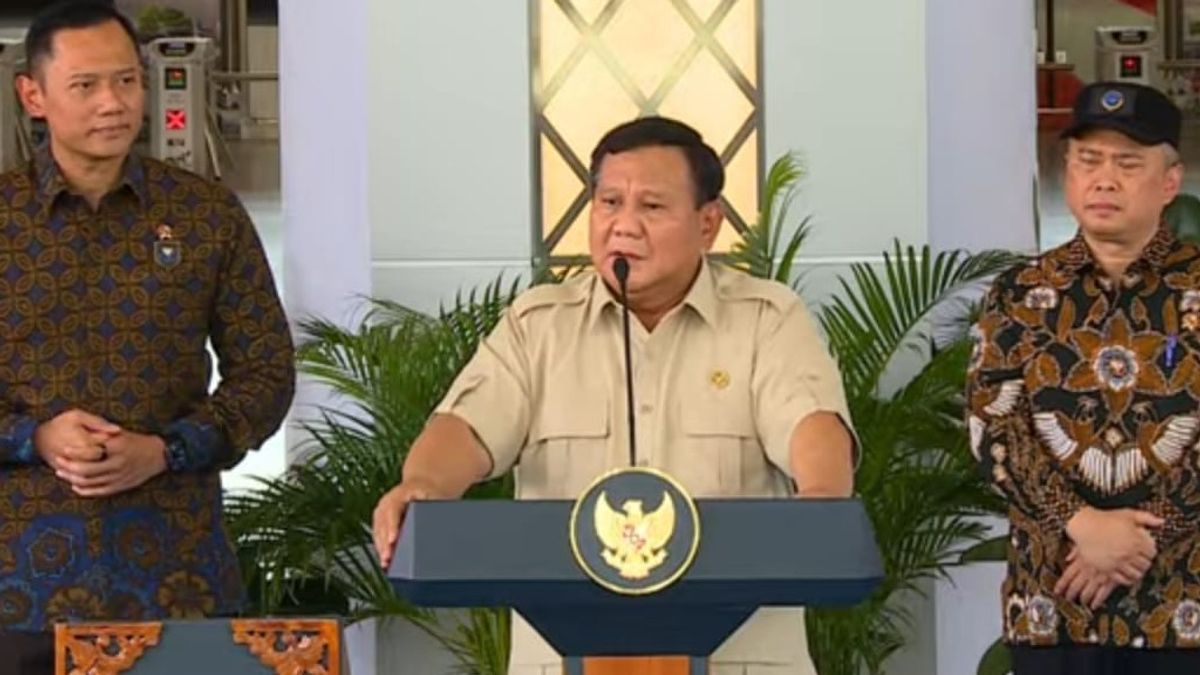


JAKARTA - President Prabowo Subianto asked the polemic of the debt for the Fast Train project not to be calculated from profit and loss. He said, transportation in the world can be seen from its benefits to the people.
Prabowo said, all transportation presented for the common interest is the responsibility of the government. Because, there is a public service obligation (PSO) mechanism or public service obligations in it.
"Whoosh, all public transport around the world, don't count profit and loss, no. Calculate the benefits for the people? Around the world that way. This is called public service obligation. Some are running it," he said when inaugurating Tanah Abang Station, quoted from the Presidential Secretariat YouTube, Tuesday, November 4.
Therefore, Prabowo asked the public not to make a fuss regarding the polemic of the Fast Train debt. He said the government would take responsibility for this.
"Don't worry, what's a fuss over your debt? I've studied the problem. There's no problem, I'll take responsibility for all the debts," he said.
Prabowo admitted that he had calculated the problem. Therefore, he asked the President Director of PT Kereta Api Indonesia (Persero) or KAI not to worry.
For your information, PT Kereta Api Indonesia (Persero) is the head of the Indonesian consortium who is a member of PT Pilar Sinergi BUMN Indonesia (PSBI) which is a partner of Beijing Yawan HSR Co Ltd on PT Kereta Cepat Indonesia China (KCIC).
PSBI's shareholder composition consists of PT Kereta Api Indonesia (Persero) 58.53 percent, PT Wijaya Karya (Persero) Tbk 33.36 percent, PT Perkebunan Nusantara I 1.03 percent, and PT Jasa Marga (Persero) Tbk 7.08 percent.
"Indonesia is not just a country. We count, there is no problem with that. So PT KAI doesn't have to worry, everyone doesn't have to worry, people, we serve our people. We fight for our people," he said.
Debt Problems Not Too Complicated
Previously, Danantara Chief Operation Officer (COO) Dony Oskaria saw that the debt problem for the railway project was not complicated. He also targets the solution to this debt problem to be completed in 2025.
"It has to be finished, and we make sure it's finished (this year). That's a problem that I think is not too difficult actually after the corporation," he told reporters in Jakarta, Thursday, October 23.
Dony said that in terms of financial and operational performance, PT Kereta Cepat Indonesia China (KCIC) is fairly positive. He said, currently it is only hampered by debt problems.
"In my opinion, it's not too difficult, actually, the company's EBITDA is positive. It's just a matter of how the installments go, right? So it's not complicated and we will definitely solve it," he said.
Although it is not a difficult problem to resolve, Dony admitted that he is still looking for the best option as an effort to settle the project's debt.
He said, a number of options for resolving theseqsh debts are being studied. He ensured that later the final decision taken would certainly benefit the high-speed train.
"Of course there are several options in the study. Of course there are pluses and minuses, respectively. Well, we will present all these alternatives later and which one is the best," he said.
For your information, the Jakarta-Bandung high-speed rail project, known as MAYh, cost up to USD 7.2 billion in jumbo investments. The investment value experienced a cost overrun of USD 1.2 billion from the initial target of project costs of USD 6 billion.
SEE ALSO:
-
 | EKONOMI
Beberkan Isi Pertemuan dengan Jonan, Prabowo Akui Ada Pembahasan soal Whoosh
04 November 2025, 17:05 -
 | EKONOMI
Utang Tetap Dibayar, Prabowo Ungkap Proyek Kereta Cepat Simbol Kerja Sama dengan Tiongkok
04 November 2025, 15:05
Of the 1.2 billion US dollars, 60 percent is charged to the Indonesian consortium or around 720 million US dollars. Meanwhile, the remaining 480 million US dollars will be charged to the Chinese consortium.
The financing structure consists of 25 percent through KAI's State Capital Participation (PMN) worth IDR 3.2 trillion. Meanwhile, the remaining 75 percent were sourced from loans to China Development Bank (CDB) amounting to USD 542.7 million.
The project is run by PT Kereta Cepat Indonesia China (KCIC) as an operator company. KCIC is a joint venture between a consortium of Indonesian SOEs and a company from China.
The Indonesian consortium, which is part of PT Pilar Sinergi BUMN Indonesia (PSBI), owns 60 percent of the shares, while China through China Railway International Co. Ltd. (CRI) holds 40 percent of the shares.
The English, Chinese, Japanese, Arabic, and French versions are automatically generated by the AI. So there may still be inaccuracies in translating, please always see Indonesian as our main language. (system supported by DigitalSiber.id)
Most Popular Tags
#Prabowo Subianto #donald trump #Febrie Adriansyah #8791 #giias 2026Popular


