
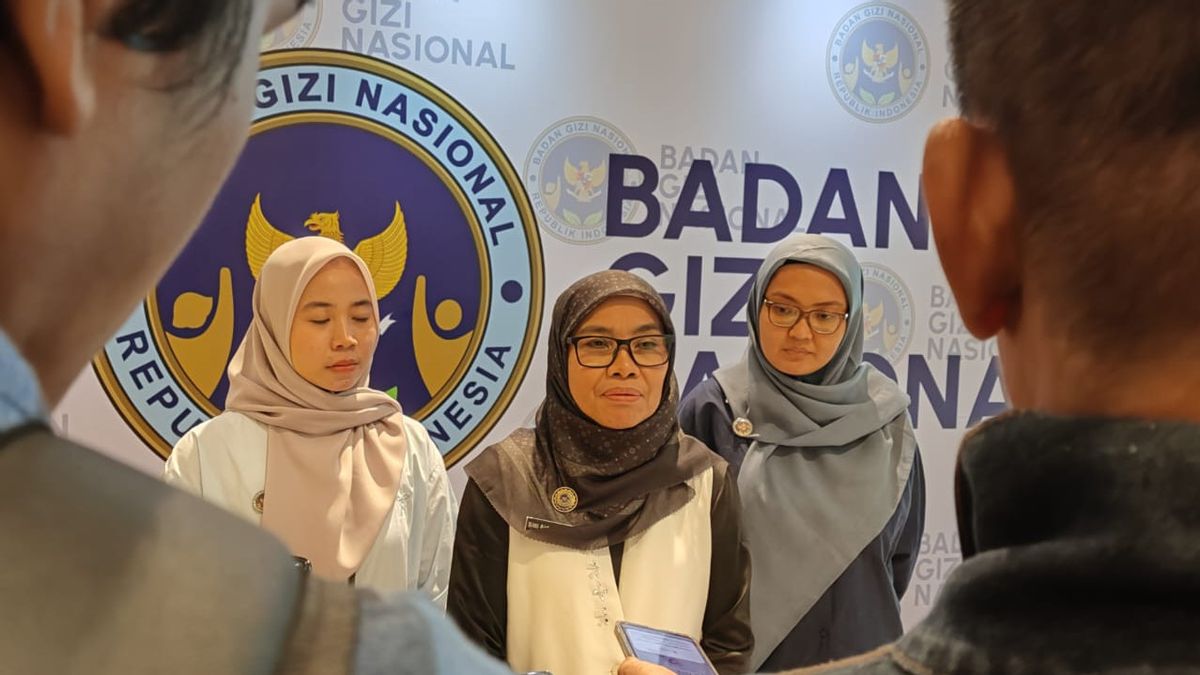


JAKARTA - Efforts to strengthen the implementation of the Free Nutrition Food (MBG) program continue to be carried out by the National Nutrition Agency (BGN) of the Republic of Indonesia. Through socialization at the Mercure Hotel Batavia, North Jakarta, Saturday 1 November, BGN emphasized that the success of the program is not only determined by the number of beneficiaries, but also by the governance and nutritional standards applied in each region.
Director of Governance for Fulfilling BGN Nutrition, Dr. Ir. Sitti Aida Adha Taridala, M.Si., said the activity was part of a series of national socialization initiated by the Deputy for Systems and Governance. The goal is that all parties involved understand the rules and responsibilities in the implementation of the program.
This activity is carried out by the Deputy for Systems and Governance. The goal is to socialize various regulations related to the MBG program so that all parties involved have the same understanding," explained Sitti Aida.
This activity was attended by foundation partners, Regional Heads (Kareg), Regional Coordinators (Korwil), Heads of Nutrition Fulfillment Service Units (SPPG), nutritionists, and accountants. According to Sitti, the presence of cross-election is important to build synergies between the central and regional governments so that the implementation of the program is more consistent.
He also explained that a number of provisions in the MBG program are now adjusted to the current conditions in the field and the results of evaluations from various regions.
"We want the implementation of the MBG program to be carried out properly and properly, so that the food served is safe, healthy, nutritious, and beneficial for the beneficiaries," he said to the media crew present.
In addition to highlighting the technical aspects of food presentation, BGN also strengthens supervision of food safety. In every socialization activity, this institution involves BPOM and the Health Office to provide guidance on safe food processing and distribution procedures.
BGN also added a training session on financial governance, so that program budget management is more accountable and free from potential irregularities. Sitti assessed that the MBG program not only had an impact on improving children's nutrition, but was also able to revive the regional economy.
The MBG program is also expected to be able to drive the local economy. Therefore, as much food as possible is obtained from local production in order to create jobs and business opportunities in the regions," he said.
However, he admits that this approach cannot be applied uniformly in all areas. In urban areas such as Jakarta, where there is minimal agricultural land, some foodstuffs need to be imported from outside.
"In economic theory, it doesn't matter if it comes from outside when the price is more efficient," he added.
To overcome land constraints in big cities, BGN is also working on solutions through the development of urban farming. Sitti said that the concept of vertical agriculture is an alternative that urban communities can run.
"With minimal land, we can vertically farm, take advantage of the existing space," he said.
Even so, he emphasized that the implementation of urban farming was not carried out directly by the SPPG, but by community groups who had capacity in this field.
SEE ALSO:


In the long term, BGN seeks to strengthen collaboration with various ministries and institutions to form local farmer groups throughout Indonesia. Their production will later become a source of raw materials for the implementation of MBG programs in the regions, as well as create a sustainable food ecosystem.
Sitti also responded to the existence of a number of elite schools that chose not to participate in the program. According to him, the decision is legal as long as the school already has a good nutritious food supply system.
The free food program is intended for all children. But if there is a school that refuses because it already has its own mechanism in providing nutritious food, that's fine. There is no coercion," he said.
Through strengthening socialization, cross-sectoral coordination, and community support, BGN hopes that the Free Nutrition Food program can become a national movement that not only nourishes Indonesian children, but also strengthens the economy at the local level.
The English, Chinese, Japanese, Arabic, and French versions are automatically generated by the AI. So there may still be inaccuracies in translating, please always see Indonesian as our main language. (system supported by DigitalSiber.id)


