

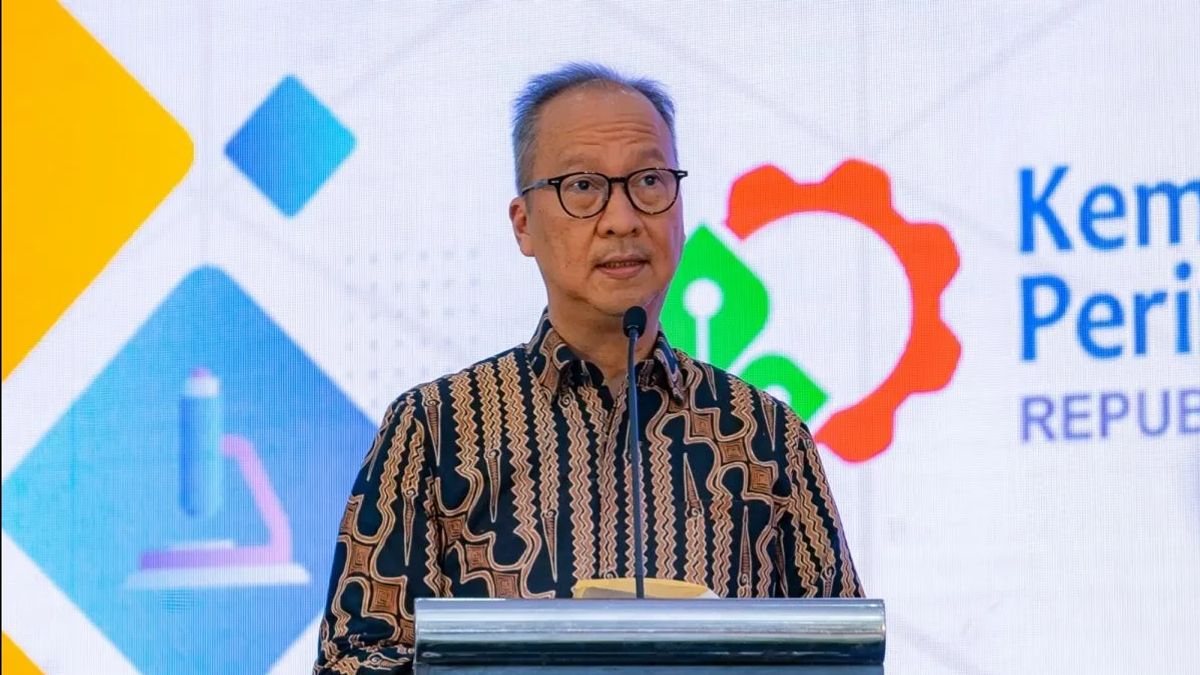


Minister of Industry (Menperin) Agus Gumiwang Kartasasmita emphasized the importance of digital technology in improving work safety standards in the industrial sector.
The implementation of data-based smart and monitoring systems is considered to be the main foundation for a safer, more efficient and highly competitive industrial ecosystem.
This commitment is realized through strengthening the Smart Industrial Safety (SIS) program which was developed with the Indonesia-Japan Consortium for Smart Industrial Safety (IJCSIS).
According to Agus, industrial technology 4.0 such as artificial intelligence (AI), machine learning, internet of things (IoT), big data to cyber security will strengthen work safety governance or K3.
"By utilizing digital technology and smart systems, SIS not only plays an important role in maintaining K3, but is also able to increase the efficiency of industrial processes," Agus said in a written statement, quoted on Saturday, November 1.
The focus of SIS implementation is currently being directed to the chemical industry, which is known to have a high level of risk. The Ministry of Industry (Kemenperin) was also present at the Seminar and the signing of the SIS Implementation Agreement for the chemical sector at the Science Techno Park Building, University of Indonesia, Depok. The government's presence was represented by the Director of Chemical Upstream Industry of the Ministry of Industry, Wiwik Pudjiastuti.
Wiwik said that the chemical industry has a strategic role in the national and regional supply chains. Indonesia is listed as one of the largest chemical industry centers in Southeast Asia, with production capacity that supports domestic needs as well as the global market.
"Indonesia currently occupies a strategic position as a center of the chemical industry in the Southeast Asia region, with production capacity not only meeting domestic needs, but also supporting the global supply chain," he said.
The sector's performance also recorded a positive trend. In the first half of 2025, the chemical, pharmaceutical and textile industry sector grew 6.70 percent with a contribution of 3.82 percent to the national GDP. Export value reached 25.89 billion US dollars and investment realization of Rp93.93 trillion.
Although it continues to grow, Wiwik reminded that the chemical sector has a big challenge in managing hazardous materials. Therefore, increasing productivity must go hand in hand with strict and sustainable safety standards.
"Work security must be the foundation in every industrial activity," he stressed.
Indonesia-Japan cooperation in IJCSIS involves governments, academics and industry players. From Indonesia, the collaboration involved the University of Indonesia (UI), the Bandung Institute of Technology (ITB), the Federation of The Indonesian Chemical Industry (FIKI) and the Indonesian Response Care (RCI).
From Japan, participants include the Tokyo University of Agriculture and Technology (TUAT), Yokohama National University (YNU), Japan Electric Measuring Instruments Manufacturers Association (JEMIMA) and the Japan Electronics and Information Technology Industries Association (JEITA).
The English, Chinese, Japanese, Arabic, and French versions are automatically generated by the AI. So there may still be inaccuracies in translating, please always see Indonesian as our main language. (system supported by DigitalSiber.id)
Popular


