

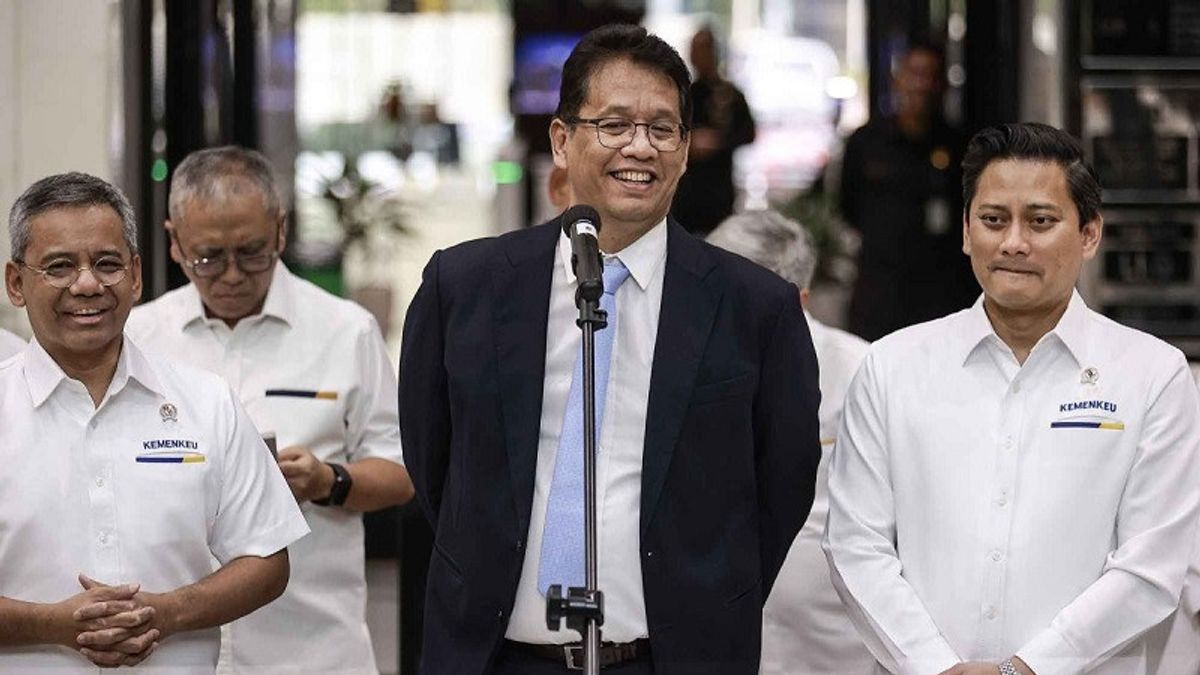


JAKARTA - Minister of Finance Purbaya Yudhi Sadive admitted that the construction of the Jakarta "Bandung" High Speed Rail (KCJB) or bettersh project was not solely aimed at seeking financial benefits, in line with the statement of the 7th President of the Republic of Indonesia, Joko Widodo (Jokowi).
As is known, Jokowi previously emphasized that the high-speed rail project was not a project aimed at earning profits, but had long-term development missions.
This statement arose in the midst of a polemic of debt for thefewsh project which suppressed the financial condition of PT Kereta Api Indonesia (Persero) and encouraged the need for restructuring with creditors from China.
"There is also a little truth, because there is actually a regional development mission, right," said Purbaya after attending the Indonesian Economist 100 Sarasehan event, Tuesday, October 28.
However, Purbaya considered that although this project was not profit-oriented, the impact of social and economic development expected from the government investment had not yet been fully realized.
According to him, the area around the route and flight station has not been optimally developed to encourage regional economic growth.
"The region has not yet been developed, maybe where there is a stop around the Danash route, so that the basic economy grows. That must be developed in the future. So there is a truth," he said.
Previously, former President Joko Widodo revealed the reasons behind the construction of the Jakarta Fast Train "Bandung" while he was still in office.
He said the project was born from the need to overcome economic losses due to severe congestion in the Jabodetabek and Bandung areas that have occurred for decades.
"From traffic jams, the state has lost a lot. In Jakarta it is around Rp. 65 trillion per year, and if it is added to Jabodetabek and Bandung it can be more than Rp. 100 trillion," said Jokowi in Solo, Sunday, October 26.
Jokowi explained that the construction of various mass modes of transportation such as KRL, MRT, LRT, Airport Train, and warehousing aims to encourage people to switch from private vehicles to public transportation. According to him, mass transportation is a public service, not profit-oriented business.
SEE ALSO:
"Public transportation is not measured from financial benefits, but from social benefits such as reducing emissions, increasing productivity, and time efficiency," he said.
He gave an example of MRT Jakarta, which is subsidized by the DKI Provincial Government, is around Rp. 400 billion per year for the Lebak Bulus route HI, and can reach Rp. 4.5 trillion if all routes are completed.
Jokowi admits that changing people's habits from private vehicles to public transportation is not an easy thing, but the impact is starting to be felt. MRT has transported 171 million passengers, and bettersh is more than 12 million," he said.
In addition to unraveling congestion, he emphasized, mass transportation development also encourages economic growth. "Vehicles quickly grow new economic growth points," he said.
Jokowi's statement came a few weeks after former Coordinating Minister for Political, Legal and Security Affairs Mahfud MD said there were allegations of budget inflations (marks ups) on theASH project.
In a video uploaded on October 14, Mahfud stated that the calculation ofPORTsh costs in Indonesia reached 52 million US dollars per kilometer, while in China it was around 17'18 million US dollars, so it is suspected that there was an increase of up to three times.
Mahfud requested that the difference in costs be investigated to find out who raised the price and where the flow of funds went.
The English, Chinese, Japanese, Arabic, and French versions are automatically generated by the AI. So there may still be inaccuracies in translating, please always see Indonesian as our main language. (system supported by DigitalSiber.id)


