


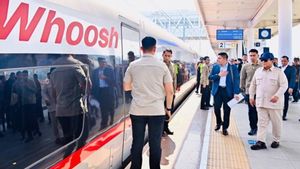
JAKARTA - Program Director of the Institute for Development of Economics and Finance (INDEF) Eisha M. Rachbini assesses that the Jakarta Fast Train (KCJB) project or known as bettersh should be a symbol of Indonesia's new economic progress and connectivity.
"When viewed from the ideal planning, having a fast transportation infrastructure between cities is a symbol of new connectivity, where high modernization and connectivity will definitely boost national economic transactions. Which way the economy will grow, along with the welfare of the community will be higher," he said in an official statement, Thursday, October 23.
However, Eisha added, this condition is different when the development, management and financing process is not going well.
"When there is an increase in connectivity, the economy and the growth of welfare, the debt arising from the development process should be able to increase growth even higher. So acceptance will also be higher so that you can pay the debt," he said.
"But when the management fails, the calculation that should be borne by business to business (B to B) ends up having an impact on the state budget that has to bear the burden of the debt," he continued.
Eisha explained that the KCJB project was initially borne by a consortium of Indonesian SOEs and Chinese railway companies. The funding scheme consists of a China Development Bank (CDB) loan of 75 percent, and an equity of Chinese consortium of 25 percent.
Meanwhile, Indonesia is part of the Indonesian SOE Synergy Pillar (PSBI) led by PT Kereta Api Indonesia (Persero) along with several other SOEs. Meanwhile, China is represented by China Railways and the companies that uphold it.
"Judging from the loan figure of 75 percent of CDB and 25 percent of China's consortium entities, an estimated figure of 5 to 6 billion US dollars emerged, and the loan could reach around 4.5 billion US dollars with long-term interest rates," he explained.
However, on its way, continued Eisha, the cost of the project swelled, a cost overrun or an increase from 5 to 6 billion US dollars to 7.5 billion US dollars, not to mention the increase in the rupiah exchange rate.
"So practically it has an impact on the total value of debt. Moreover, the COVID-19 pandemic is sure to slow down work and increase costs," said Eisha.
Eisha also mentioned changes to project financing policies. He said, the initial promise was only borne by B to B, but the pressure changed and was supported fiscally by the state budget.
"Perpres 172/2015 which explains B to B funding without involving the state budget, is then evaluated in 2021 which opens up space for fiscal support for the state budget," he explained.
In 2023, continued Eisha, the government will also conduct state capital participation (PMN) worth IDR 2.3 trillion to PT KAI, which is a government guarantee for additional loans from CDB.
"The financial impact is that the amount of PSBI losses in 2023-2025 is indeed a loss of 0.97 trillion in 2023 and 2024 minus IDR 4.2 trillion. There are consistent losses that continue to increase, even in 2025 it has been seen minus IDR 1.6 trillion," he said.
Eisha said the condition shows KCIC is still facing unresolved financing pressures, and has an impact on companies that are members of the consortium.
SEE ALSO:
-
 | EKONOMI
Transfer Knowledge Whoosh Terus Meningkat, 513 SDM Indonesia Siap Operasikan Whoosh
23 Oktober 2025, 12:28 -
 | EKONOMI
Keputusan Purbaya Tak Pakai APBN Bayar Utang Whoosh Sudah Tepat, Ini Alasannya
23 Oktober 2025, 06:04
"60 percent of PSBI losses are attributes from PT KAI as the majority shareholder in the consortium. The fiscal risk in SOEs is also an impact on state finances," he explained.
Eisha also highlighted the steps taken by the Ministry of Finance to refuse to use the State Budget to cover the project's debt.
"It should have been resolved by B to B which did not involve the state budget. So there was a direction towards restructuring the project debt, whether some debts should be converted into equity, then handing over assets to the government while continuing to negotiate with the CDB," said Eisha.
In addition, Eisha also reminded that additional funds through Danantara did not cause new problems. "For the Danantara, it must still be seen how the feasibility and governance are, don't dig the hole to cover the hole," he said.
The English, Chinese, Japanese, Arabic, and French versions are automatically generated by the AI. So there may still be inaccuracies in translating, please always see Indonesian as our main language. (system supported by DigitalSiber.id)


