
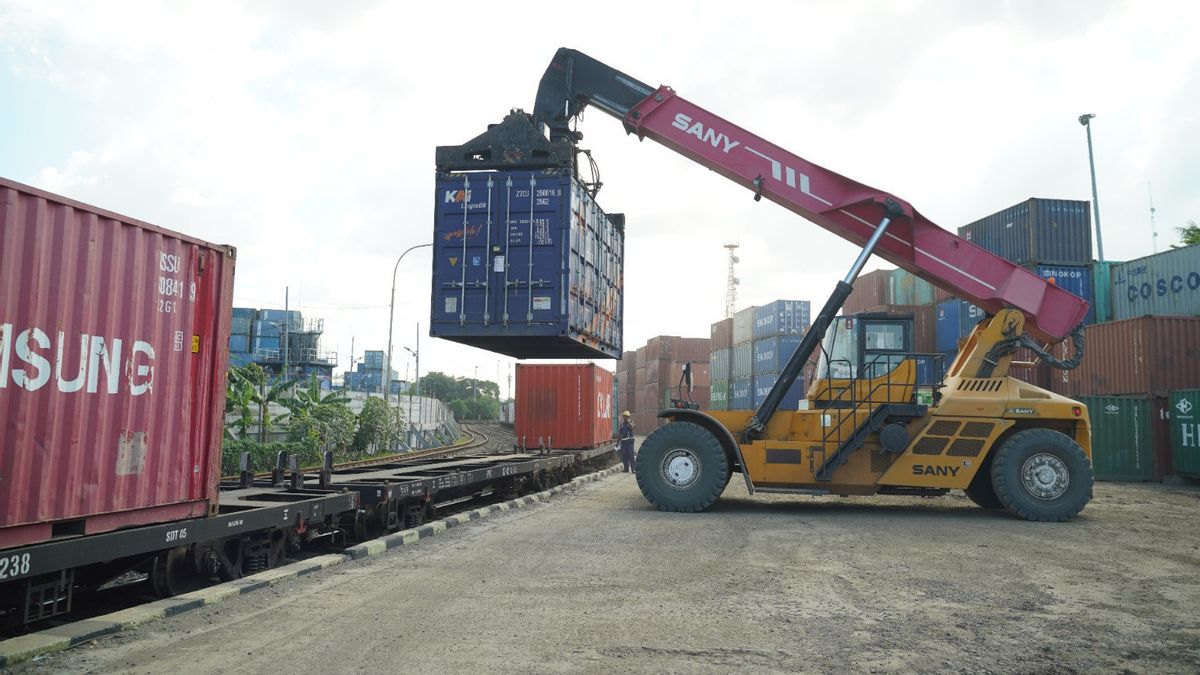


JAKARTA - As part of the commitment to provide sustainable and environmentally friendly logistics services, KAI Logistics launched the latest innovation in the form of carbon footprint information or carbon footprint which is now listed directly in each customer's invoice. Through this innovation, customers can find out the amount of carbon (CO2) emissions produced from goods delivery activities through rail modes.
This step is a tangible manifestation of KAI Logistics' responsibility in supporting the implementation of Green Logistics in Indonesia and strengthening the role of SOEs in encouraging efficient and environmentally friendly transportation systems.
Riyanta, Director of Business Development of KAI Logistik revealed that the presence of the carbon footprint information feature is part of the company's efforts to promote environmental awareness in every business activity. Transparency is the first step towards a more sustainable change.
"Through the carbon footprint feature in the invoice, we want to invite customers to understand the impact of emissions from each delivery activity. This is not just data, but a reflection of our responsibility in managing energy efficiency and sustainability-oriented businesses," he said, in a written statement, Thursday, October 23.
Utilization of rail modes itself is an important key in carbon efficiency strategies. Train modes are transportation with much lower carbon emissions than other land modes. Thus, every shipment of goods using train modes contributes directly to reducing traces of transportation emissions and helping national efforts to suppress the impact of climate change. By providing information on emissions openly to customers, KAI Logistics wants to raise awareness that any delivery decision can be part of joint efforts to ensure sustainability.
The commitment to implement green logistics is not only limited to the inclusion of emissions in customer invoices, but is further strengthened by the calculation of GRK tier 3 emissions and GRK emission reporting in accordance with the ISO 14083 framework, and KAI Logistics becomes a pioneer in the implementation. This step is a strategic initiative that is in line with the long-term vision, especially in the implementation of green logistics," Riyanta continued.
In line with the increasing awareness of energy efficiency and sustainability, industry players' interest in switching to train modes also continues to increase. This growth is reflected in a significant increase in container train transport services. Throughout the second quarter of this year, the volume of KAI Logistics container transport grew by 14 percent compared to the previous First Quarter. This positive trend continued in the third quarter with a growth of 6 percent compared to the performance of Quarter II, with total transportation volume reaching more than 650 thousand tons, up from around 610 thousand tons in the previous TW II period.
BACA JUGA:
-
 | EKONOMI
IFG Tunjuk Leonardo Henry Gavaza jadi Direktur Keuangan PT Askrindo
22 November 2024, 20:47
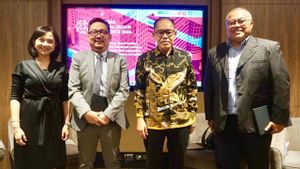

As of September 2025, KAI Logistics has recorded total container transport reaching 1.8 million tons, an increase of 7 percent compared to the achievement in the same period last year of 1.68 million tons. This achievement is proof that the use of rail modes by the industrial sector is increasing, along with growing awareness of cost efficiency, timeliness, and lower environmental impacts.
"Through this step, KAI Logistik hopes to strengthen industrial awareness of the importance of transitions to greener modes of transportation, as well as encourage a sustainable transition to more efficient and low-emission rail modes," Riyanta concluded.
The English, Chinese, Japanese, Arabic, and French versions are automatically generated by the AI. So there may still be inaccuracies in translating, please always see Indonesian as our main language. (system supported by DigitalSiber.id)
Most Popular Tags
#Prabowo Subianto #donald trump #Febrie Adriansyah #8791 #giias 2026Popular


