




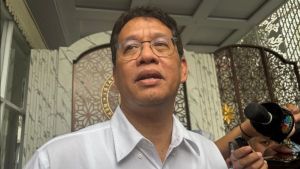
JAKARTA - Head of the Communication Department of Bank Indonesia Ramdan Denny Prakoso opened his voice regarding information circulating about Bank Indonesia which is said to have sold 11 tons of gold.
He emphasized that information related to Bank Indonesia which had sold 11 tons of gold until August 2025 was not true.
"We convey that Bank Indonesia does not sell gold as mentioned," he told VOI, Monday, October 6.
In addition, he also appealed to always refer to official sources in obtaining information about the development of Indonesia's foreign exchange reserves, which can be accessed through the official Bank Indonesia website.
Previously, amid the trend of gold accumulation by world central banks, Bank Indonesia recorded a different step by releasing 11 tons of gold from its reserves until August 2025.
This step makes Indonesia one of the few countries that sell gold when the majority of global central banks actually increase their ownership.
Quoted from Kitco News, Senior Analyst of the World Gold Council (WGC)ung Gopaul, revealed central banks collectively added 15 tons of net gold into global reserves in August 2025, based on report data from the International Monetary Fund (IMF) and each central bank.
"This is generally in line with monthly net purchases between March and June 2025, and marks a return to the purchase pattern after global reserves stagnant in July (we revised the decline in estimates in early July by +10 tons after Bank Indonesia reported sales of 11 tons)," said Gopaul.
He added that the gold price rally that continues to strengthen is a factor that affects the purchase rate of precious metals by a number of central banks.
"This can also be a factor in more tactical sell-offs. However, the recent slowdown in purchases does not necessarily indicate the central bank as a whole loses interest in gold. In fact, the latest developments, which we will discuss below, show the central bank remains excited to continue to increase their exposure," he explained.
According to Gopaul, seven central banks recorded adding more than one ton of gold to their reserves in August, while only two reported declines.
He said that the National Bank of Kazakhstan became the largest buyer with an additional 8 tons of gold and made consecutive purchases for six months.
"The gold ownership now reaches 316 tons, 32 tons higher than the end of 2024," he said.
Meanwhile, the Bulgarian National Bank also recorded a purchase of 2 tons of gold and this is the largest monthly increase since June 1997, bringing Bulgaria's total gold reserves to 43 tons.
"In January 2026, Bulgaria will become the 21st member country in the euro zone and may transfer some gold to ECB as part of the accession procedure," he said.
Then, the Central Bank of Turkey, which has also been actively buying gold this year, added 2 tons to its reserves with the addition, Turkey's total official gold reserves this year increased 21 tons to 639 tons.
He conveyed that China's People's Bank continued its monthly purchase trend with an additional 2 tons of gold.
"The total gold ownership has now exceeded 2,300 tonnes, but still covers 7 percent of the total international reserves," he explained.
In addition, the Central Bank of Uzbekistan also recorded purchases of 2 tons, bringing the total reserves to 366 tons, or down 17 tons compared to the end of 2024,
In Europe, the Czech National Bank (CNB) continues its gold accumulation program with an additional 2 tons purchase.
"This extends the bank's record monthly purchases to 30 months, and increases the total gold reserves to 65 tons. CNB targets to store 100 tons of gold as part of its international reserves by the end of 2028," he said.
Next, the Ghana Bank also added 2 tonnes of gold, bringing the total purchase this year to 5 tonnes, and the national gold reserves increased to 36 tonnes.
"Based on the available data at the time of writing, the Central Bank of Russia (3 trillion) and Bank Indonesia (2 trillion) are the only gold sellers," he wrote.
Gopaul said the decline in Russia's gold reserves was allegedly related to the country's flagship of precious metal coins program.
Meanwhile, Poland, which became the largest gold buyer in 2024, has shown a sustainable commitment to this asset
"In September, the National Bank of Poland (NBP) confirmed that it would increase the target of gold portion in its international reserves from 20 percent to 30 percent," said Gopaul.
SEE ALSO:
-
 | EKONOMI
Cabai Merah-Hijau dan Daging Ayam jadi Penyumbang Utama Inflasi September 2025
06 Oktober 2025, 18:55 -
 | EKONOMI
Naik 41 Persen, Pengguna LRT Jabodebek Tembus 57.993 Orang di Akhir Pekan
06 Oktober 2025, 18:37 -
 | EKONOMI
Purbaya Sidak Bank Mandiri, Pantau Penyaluran Dana Pemerintah Rp200 Triliun
06 Oktober 2025, 18:16
Dia menyampaikan setelah sebelumnya berhasil mencapai target 20 persen berkat pembelian besar-besaran dan penguatan harga emas, NBP berencana untuk melanjutkan akumulasi emas secara bertahap, tergantung pada kondisi pasar.
Dengan tambahan 67 ton emas sepanjang 2025 hingga akhir Agustus, total cadangan emas Polandia kini mencapai 515 ton menjadikannya pembeli emas terbesar tahun ini.
Sementara itu, Bank Sentral El Salvador juga melaporkan pembelian emas sebesar 13.999 ons atau kurang dari 0,5 ton pada September.
"Dalam pengumuman pembelian tersebut, bank tersebut mencatat akuisisi ini merupakan posisi jangka panjang yang didasarkan pada keseimbangan kehati-hatian dalam komposisi aset yang membentuk Cadangan Internasional, Bank sentral tersebut kini memiliki kurang dari 2 ton emas dalam cadangannya," pungkasnya.
SEE ALSO:
-
| EKONOMI
Cabai Merah-Hijau dan Daging Ayam jadi Penyumbang Utama Inflasi September 2025
06 Oktober 2025, 18:55 -
| EKONOMI
Naik 41 Persen, Pengguna LRT Jabodebek Tembus 57.993 Orang di Akhir Pekan
06 Oktober 2025, 18:37 -
| EKONOMI
Purbaya Sidak Bank Mandiri, Pantau Penyaluran Dana Pemerintah Rp200 Triliun
06 Oktober 2025, 18:16
He said that after previously reaching the target of 20 percent thanks to the massive purchase and strengthening the price of gold, NBP plans to continue the gold accumulation gradually, depending on market conditions.
With an additional 67 tons of gold throughout 2025 until the end of August, Poland's total gold reserves have now reached 515 tons, making it the largest gold buyer this year.
Meanwhile, the Central Bank of El Salvador also reported the purchase of gold of 13,999 ounces or less than 0.5 tonnes in September.
"In the announcement of the purchase, the bank noted that this acquisition is a long-term position based on the precautionary balance in the composition of assets that make up international Reserves, the central bank now has less than 2 tons of gold in its reserves," he concluded.
The English, Chinese, Japanese, Arabic, and French versions are automatically generated by the AI. So there may still be inaccuracies in translating, please always see Indonesian as our main language. (system supported by DigitalSiber.id)
Popular


