
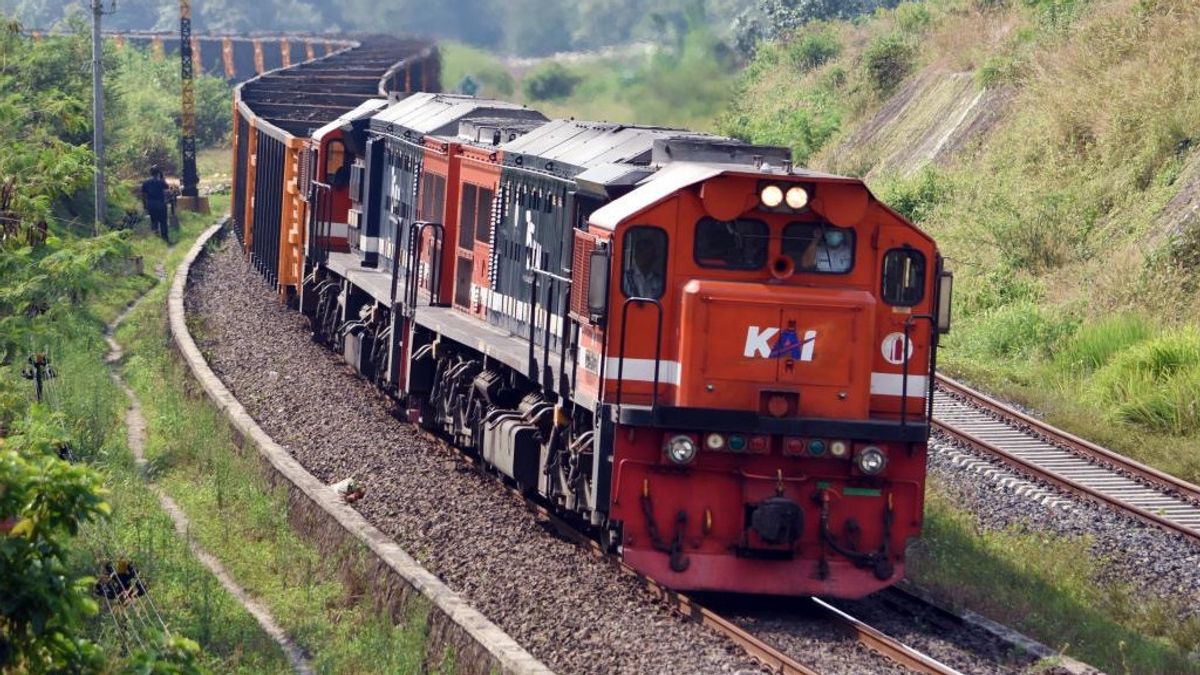


JAKARTA - PT Kereta Api Indonesia (Persero) recorded a positive achievement in goods transportation services. Throughout the period January to September, KAI transported 51,182,139 tons of goods. This cargo is dominated by coal commodities.
KAI Vice President Public Relations Anne Purba explained that the figure increased compared to the same period the previous year of 50,959,825 tons. This figure confirms the role of KAI as the backbone of national logistics that is reliable, efficient, and sustainable.
Of this amount, Anne said coal commodities were still the majority with a volume of 42,398,070 tons or 82.84 percent of total transportation.
"Most of it is used to supply Steam Power Plants (PLTU) in Java and Bali, which flow energy to around 158 million people," he said in an official statement, Thursday, October 2.
Anne said each series of coal trains carries more than just a payload, but the energy that turns on the lights at home, turns on the MSME production engine, ensures learning classes stay bright, and keeps medical equipment in the hospital functioning.
However, Anne emphasized that KAI's role does not stop at energy transportation. A number of other strategic commodities are also transported every day, ranging from cement and clinics for infrastructure development, containers containing consumer goods, fuel oil (BBM) for transportation and industry, to plantation products, retail products, and fertilizers to support national food security.
"All of this makes KAI a vital node in the logistics chain that supports various sectors of life," he said.
In addition to presenting benefits, continued Anne, trains are also a more environmentally friendly solution for goods transportation. With the ability to carry large and lower emission traces, KAI also strengthens the government's commitment to the energy transition agenda and sustainable development.
SEE ALSO:

In the future, KAI will continue to transform through strengthening infrastructure, developing digitization of logistics services, and increasing the capacity of facilities.
"This step will make the distribution of goods more efficient, timely, and highly competitive to support the national economy," he explained.
The English, Chinese, Japanese, Arabic, and French versions are automatically generated by the AI. So there may still be inaccuracies in translating, please always see Indonesian as our main language. (system supported by DigitalSiber.id)


