


The Ministry of Industry (Kemenperin) emphasized the importance of transparency, administrative compliance and strategy consistency for the national textile industry in maintaining competitiveness, especially in the upstream sector under the Association of Indonesian Filament and Filament Producers (APSYFI).
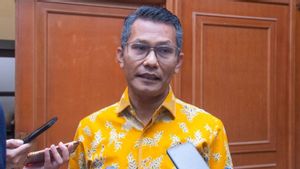
Based on data from the National Industrial Information System (SIINAs), compliance with the APSYFI member industry reporting is still low. Spokesperson for the Ministry of Industry Febri Hendri Antoni Arif said, of the 20 member companies, only 15 reported their industrial activities, while 5 other companies were absent or negligent.
"There are still large APSYFI member companies that do not report their performance at all. In fact, this reporting obligation is a form of industrial accountability to the state. At least administrative commitments actually weaken the position of associations claiming to be the vanguard of national textiles," said Febri as quoted from his written statement, Monday, August 25.
In the data from the Ministry of Industry, said Febri, there was an anomaly in the performance of the APSYFI member industry. In the midst of the request for associations to tighten imports, there was a significant increase in imports by its own members.
Data shows that the import volume of yarn and fabrics by APSYFI member companies increased by more than 239 percent in one year, from 14.07 million kilograms (2024) to 47.88 million kilograms (2025).
"There are members of the APSYFI who use the facilities of the tied area and the General API, so they are free to carry out massive imports. On the one hand, they demand protection, but on the other hand they are active as importers. This is clearly contradictory to the spirit of industrial independence," he said.
So far, according to Febri, the government has provided various forms of protection and fiscal instruments for the upstream textile industry, including Polyester Polyple Fiber (PSF) Anti-Dumping Import Duty (BMAD) which has been running since 2010 and is valid until 2027.
In addition, BMAD Spin Drawn Yarn (SDY) which is valid until 2025, Benang Safeguard Measure Import Duty (BMTP) from synthetic fiber is valid until 2026 and there is still BMTP Fabric valid until 2027.
"This means that the APSYFI member industry has been enjoying double profits, namely tariff protection as well as import facilities. However, unfortunately, it is not balanced with new investment or modernization of technology," he explained.
The Ministry of Industry emphasized that the policy of import recommendations and protection of the industry is always based on the principle of justice and balance between upstream, intermediate and downstream.
Export-oriented downstream industries provide convenience to be competitive in the global market, while domestic markets are directed to import substitution according to the verification of national industrial capabilities.
SEE ALSO:
-
 | EKONOMI
Kemenperin Imbau Industri Tekstil Lebih Transparan dan Tertib Soal Administrasi
24 Agustus 2025, 10:55 -
 | EKONOMI
Menteri PKP Serah Terima Kunci Rumah Subsidi untuk Buruh Pabrik Kahatex
23 Agustus 2025, 10:26 -
 | EKONOMI
Pemerintah Dorong Pembiayaan Sektor Produktif lewat Kredit Alsintan dan KIPK
21 Agustus 2025, 19:16
Febri assessed that if the BMAD proposal with a rate of 45 percent is applied according to the KADI calculation, the risk is layoffs of up to 40,000 workers in the downstream industry.
"This will be a national tragedy. Meanwhile, the potential for layoffs in the upstream sector is much smaller, it can still be mitigated through optimizing local absorption," he said.
Furthermore, Febri said, the textile sector itself in the first and second quarters of 2025 still grew above four percent. This is a positive achievement that must be maintained.
"The Ministry of Industry hopes that industry associations can see government policies objectively. Precisely in the midst of this growth, what is needed is collaboration and compliance, not narratives that mislead the public," he concluded.
The English, Chinese, Japanese, Arabic, and French versions are automatically generated by the AI. So there may still be inaccuracies in translating, please always see Indonesian as our main language. (system supported by DigitalSiber.id)
Most Popular Tags
#Prabowo Subianto #donald trump #Febrie Adriansyah #8791 #giias 2026Popular


