

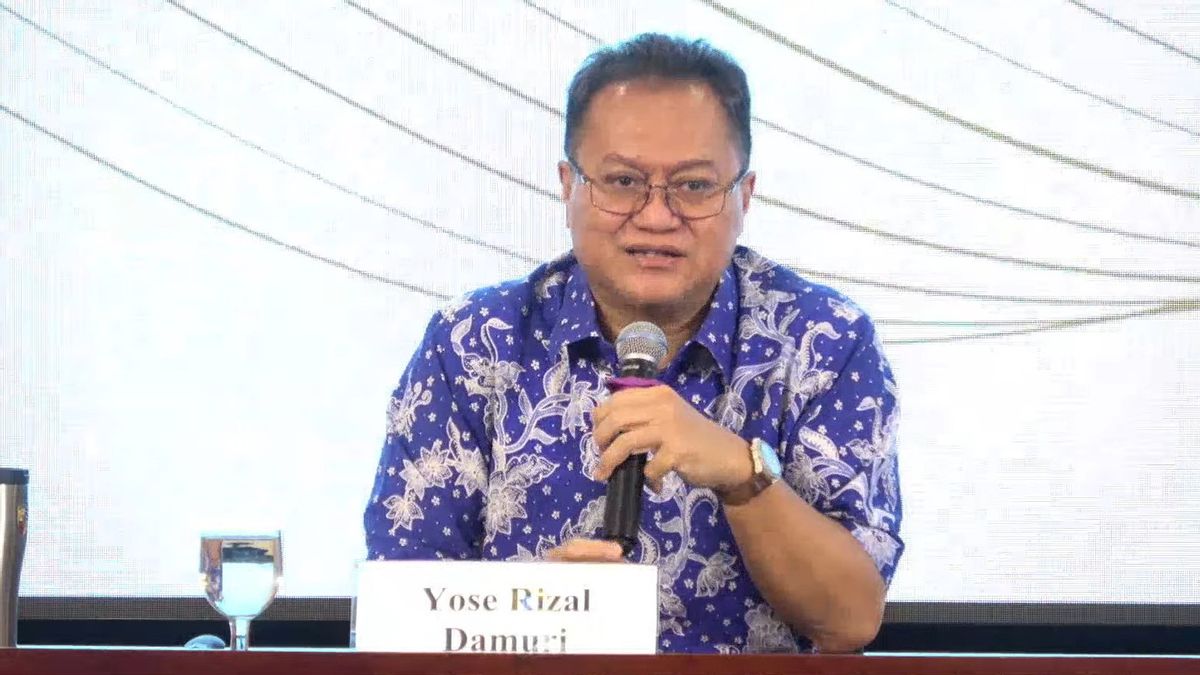


JAKARTA - The Center for Strategic and International Studies (CSIS) assesses that the government's fiscal burden in 2026 will be increasingly heavy in line with the high global interest rate and the increasing debt interest payments, as stipulated in the 2026 RAPBN.
CSIS Executive Director Yose Rizal Damuri explained that the United States (US) monetary authority aka The Fed is likely to still maintain high interest rates until the first quarter of 2026.
This condition, said Yose, will limit space for Bank Indonesia (BI) to reduce interest rates even lower without causing turmoil in the financial market.
"What are the implications for the Indonesian State Budget? Here we can see that Indonesia's debt costs will also be high and will further increase the fiscal burden in 2026," Yose said in a media briefing entitled RAPBN 2026: Considering Political Promises in the Midst of Fiscal Restrictions, monitored online, Monday, August 18.
On the same occasion, Senior Researcher of the Department of Economics CSIS Deni Friawan reminded that the trend of government debt payments has increased again in the last three years, in line with the widening of the budget deficit.
According to his records, most debt payments are used for debt interest. In 2024, for example, from total debt financing of IDR 558.1 trillion, IDR 488.4 trillion of which is used for debt interest payments.
SEE ALSO:
-
 | EKONOMI
CSIS Soroti Lonjakan Belanja Pertahanan: Apakah Kita Sedang Tidak Aman?
18 Agustus 2025, 16:56 -
 | EKONOMI
Mentan Amran Optimistis Swasembada Pangan Tahun Ini: Hilalnya Sudah Ada
18 Agustus 2025, 14:50 -
 | EKONOMI
Soroti Kenaikan Harga Beras, KPPU Dorong Urgensi Peran Bulog Stabilisasi Pasar
18 Agustus 2025, 15:02
As a result, the spread or difference between debt financing and debt interest payments is getting smaller. In 2024, the difference is only IDR 69.7 trillion.
"No wonder that the portion of debt continues to increase and debt to GDP also increases. By the end of the year it was almost Rp. 9,000 trillion and the ratio was almost 39 percent of GDP," he said.
The government's fiscal space is increasingly narrowing due to debt interest payments, which are mandatory expenditures, attracting a large portion of the state budget. In 2026, Deni said, the debt due to the central government was no less than Rp800 trillion.
This is exacerbated, according to Deni, because President Prabowo Subianto prioritizes superior programs that require a budget of hundreds of trillions
As for the 2026 RAPBN, the government has budgeted IDR 335 trillion for a free nutritious food program (MBG); IDR 181.8 trillion for the Red and White Village Cooperative; IDR 57.7 trillion for the three million home program; IDR 402.4 trillion for the energy security program; and IDR 164.6 trillion for the food security program.
"Restrictions on fiscal space and the government's efforts to maintain the state budget deficit are below 3 percent, in this case the deficit is 2.48 percent, it makes the implementation of these programs have the potential to "force" an increase in state revenues and/or sacrifice (trade-offs) other expenditures," said Deni.
With the rigid shopping structure, Deni concluded that the 2026 RAPBN would be squeezed by two heavy pressures, namely between maintaining fiscal sustainability and fulfilling the political promises of the Head of State.
The English, Chinese, Japanese, Arabic, and French versions are automatically generated by the AI. So there may still be inaccuracies in translating, please always see Indonesian as our main language. (system supported by DigitalSiber.id)


