


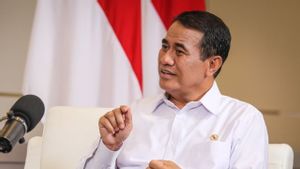
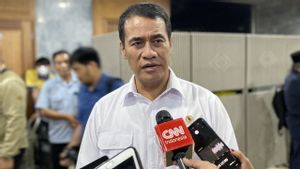
JAKARTA - Head of the National Food Agency (Bapanas), Arief Prasetyo Adi, opened his voice about the practice of mixing rice that was widely discussed. Arief said that this practice is usually done by traders. However, mixing must refer to regulations related to rice standards and quality.
Furthermore, Arief said that this quality depends on the level of water until the level of rice breaks or broken rice in a rice package.
For your information, the practice of mixing rice or oplos itself was revealed by the Ministry of Agriculture (Kementan), which stated that 212 brands were involved in mixing rice. Meanwhile, the National Police's Criminal Investigation Unit said there were 13 premium rice brands produced by four well-known companies suspected of violating the quality provisions and the packaging dose.
Premium rice, the spec product is 14 percent water content, a maximum broken 15 percent. If the water level is 16 percent, can't it? No, because the maximum is 14 percent. Can 13 percent not have water levels? Yes," said Arief at the office of the Coordinating Ministry for Food, Jakarta, Tuesday, July 15.
Arief admits that the term oplos is often considered negative, as happened in the supply of fuel oil (BBM). The oplos itself is defined as mixing a product with other products that are cheaper, then selling it again at a higher price.
"So oplos is usually negative in connotation because in the past it was called diopolis fuel and oil, mixed with diesel. That means it is mixed with cheaper goods, then the price is increased," said Arief.
Meanwhile, in rice, continued Arief, the practice is different. Because, in one package, the whole rice (head rice) is still mixed with rice, it's just that the mixing rice is in the form of broken rice and according to the levels regulated by the government.
In the past, the term oil was the same as diesel, one was more expensive, one was lower and kept mixed. If this is rice and rice anyway?," he said.
Arief emphasized that the practice of oplos rice is prohibited if traders or producers mix or mix rice outside of these provisions. For example, in premium rice packaging, producers mix rice breaking up by 30 percent.
"If it has been labeled premium rice, the maximum broken is 15 percent, can it break 30 percent? No, whatever the reason," he explained.
SEE ALSO:
-
 | BERITA
Puan Maharani Soroti 212 Merek Beras Oplosan: Bentuk Pembohongan Publik
15 Juli 2025, 08:15
For your information, rice quality regulations are contained in the Indonesian National Standard (SNI) 6128:2020. Premium rice, a maximum water level of 14 percent is set, a head point of at least 85 percent, and a broken item (broken) a maximum of 14.5 percent.
Then, it was strengthened by the National Food Agency Regulation Number 2 of 2023 concerning Quality and Rice Label Requirements, as well as Regulation of the Minister of Agriculture Number 31/PERMENTAN/PP.130/8/2017 concerning Rice Quality Class.
Regarding the issue of Bulog's SPHP rice being used as a mixture with premium rice, Arief emphasized that the practice was prohibited. He said the rice was presented to stabilize supply and food prices.
"But what is not allowed is SPHP rice, for example, the price is Rp. 12,500, then there are other rice mixed, and the price is Rp. 14,000, that's what you can't mean, because the SPHP rice shouldn't be mixed," said Arief.
The English, Chinese, Japanese, Arabic, and French versions are automatically generated by the AI. So there may still be inaccuracies in translating, please always see Indonesian as our main language. (system supported by DigitalSiber.id)
Most Popular Tags
#Prabowo Subianto #donald trump #2026 World Cup #Febrie Adriansyah #8791Popular


