

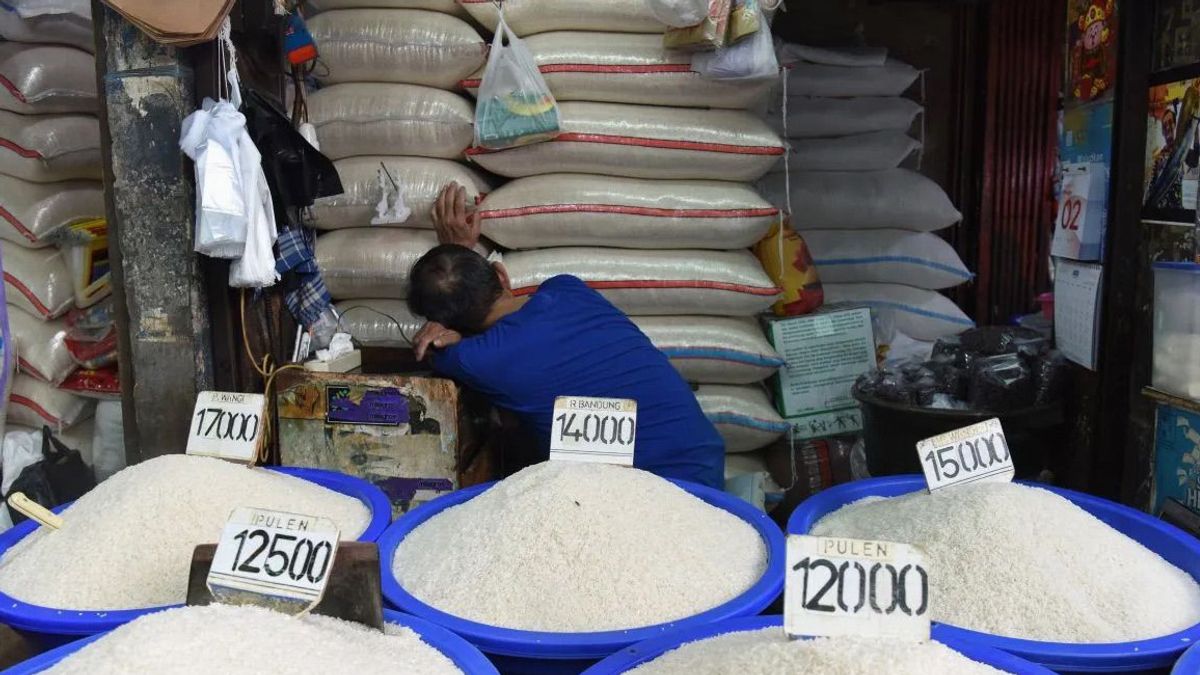


Agricultural observer from the Indonesian Political Economy Association (AEPI), Khudori, assessed that the government needs to introspect national food policies, following findings from the National Police's Food Task Force regarding rice quality that is not in accordance with market standards.
He said that the imbalance in price policy between the farmer level and downstream business actors had prompted the occurrence of "majority crimes".
"If we read the findings again, that's if I do, there's something strange. Where is it? Surprisingly, this violation is the majority. For example, premium rice, which does not match the quality, is 85.56 percent. Very big. That means, most of the brand owners sell not according to quality. For the medium rice, it's 88 percent. Very big," he said when contacted by VOI, Monday, July 14.
"If we consider this a crime, it means this is a crime in congregation. Is it something normal, there are crimes in congregation like this? In my opinion, how come it's not normal, it's not normal," he continued.
Khudori suspects that business actors are forced to commit violations because of the unbalanced price policy between the purchase price of the government (HPP) of unhulled rice and the highest retail price (HET) of rice.
He explained, since the formation of the National Food Agency (Bapanas) in 2022, the government has raised the HPP of harvested dry unhulled rice three times from 2023 to 2025, with an accumulation of 47.3 percent increase.
Meanwhile, the highest retail price (HET) is said to have only increased twice (2023-2024), medium rice only rose 30 percent, and premium rice 16 percent. This inequality is considered to create heavy burdens at the level of milling and rice traders.
"That the policies that apply to this day, including the increase in the HPP of any quality of IDR 6,500 (per kilogram), are very profitable for farmers. But by not adjusting the HET and the HET increase is far behind the increase in the price of raw materials, it makes those who move downstream in milling, the rice trader is pinched," said Khudori.
This condition, according to Khudori, made a number of brand owners choose to stop or reduce production volume because they are unable to bear the risk. In fact, according to him, some actors are encouraged to decline in quality as the only way to continue to obtain profit margins.
Again, Khudori suggested to the government to review the national food price structure, especially regarding the balance of incentives between upstream (farm) and downstream (giling and distributor) sectors so that the policies made do not create distortions that trigger massive violations in the field.
"There are already many producers who sell or have rice brands, both medium and premium, one, stop production. Second, reduce production. Because it does increase the current stock by buying grain in the market, it is not without risk. Earlier, if you sell above HET, the risk of dealing with the Food Task Force. If you sell according to the HET, their boncos. So I think the government is trying to correct it," he said.
The government gives ultimatums to rice entrepreneurs to immediately comply with applicable regulations, especially regarding quality, price, and suitability of information on product packaging.
The Ministry of Agriculture (Kementan) revealed the results of a national investigation that shows anomalies in rice products circulating in the market and has the potential to harm consumers up to IDR 99.35 trillion per year.
"We tried to check, together with the Food Task Force, the National Food Agency, the Police, and the Prosecutor's Office. There was an anomaly that prices at the milling level fell, but prices in consumers rose. We found that the quality was not appropriate, prices exceeded HET, and the weight was not right," said Minister of Agriculture Andi Amran Sulaiman at a press conference in Jakarta, Thursday, June 26.
SEE ALSO:


The investigation, which took place on June 6-23, 2025, involved 268 rice samples from 212 brands in 10 provinces. As a result, 85.56 percent of premium rice did not meet quality standards, 59.78 percent were sold above HET, and 21.66 percent did not match packaging weight.
For medium rice, 88.24 percent do not meet quality, 95.12 percent exceed HET, and 9.38 percent have weight less than packaging claims. "This is very detrimental to consumers. If left unchecked, losses can reach IDR 99 trillion per year. Therefore, we ask the Food Task Force to decrease, and in the next two weeks, all producers and traders must make adjustments," said Amran.
The Minister of Agriculture also asked the Food Task Force of the National Police Headquarters and the Attorney General's Office to explore indications of violations and take firm action against parties who are proven to manipulate the quality and price of food.
The English, Chinese, Japanese, Arabic, and French versions are automatically generated by the AI. So there may still be inaccuracies in translating, please always see Indonesian as our main language. (system supported by DigitalSiber.id)


