

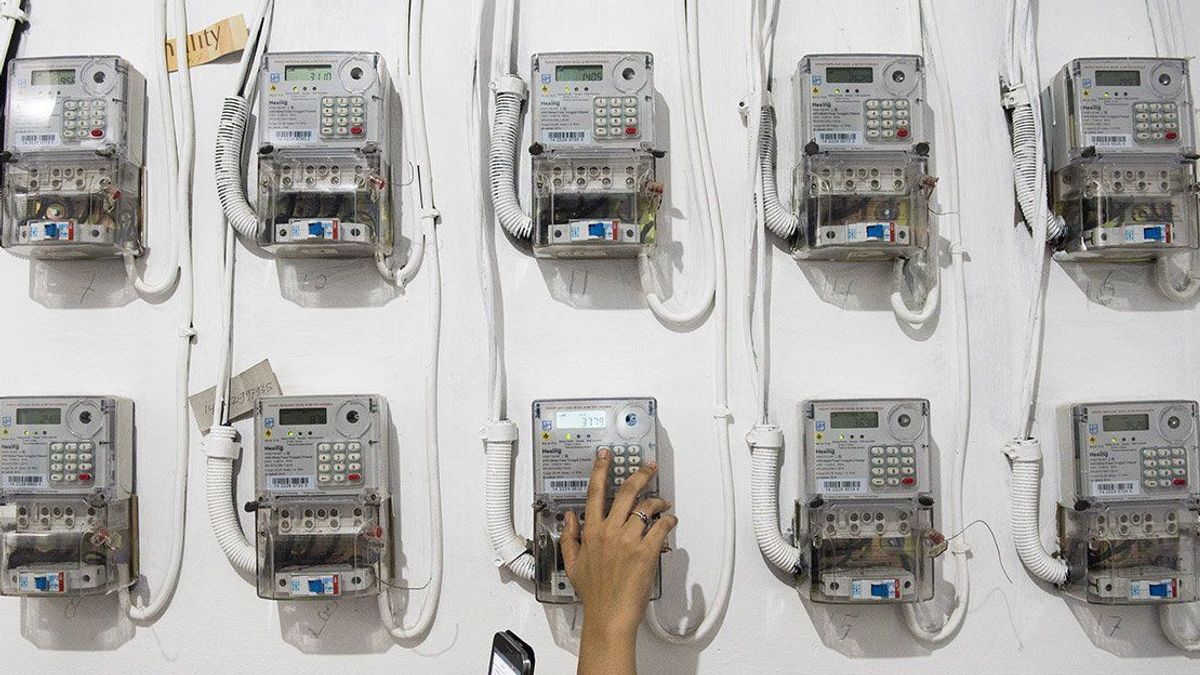


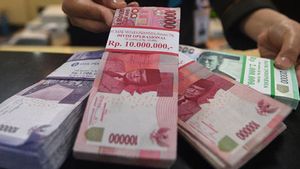
JAKARTA - The Ministry of Energy and Mineral Resources (ESDM) proposed the allocation of electricity subsidies between IDR 97.37 trillion to IDR 104.97 trillion in 2026 which will be distributed to 44.88 million customers.
In a hearing with Commission XII of the DPR RI in charge of energy, environment, and investment in Jakarta, Monday, June 30, the Director General of Electricity Jismin P Hutajulu said the electricity subsidy was prioritized for poor and vulnerable households.
"This is to encourage a more efficient and fair energy transition by considering economic, social, physical and environmental aspects," he said, quoted by Antara.
Jismin said there are several macroeconomic parameters that form the basis for this subsidy calculation, including the rupiah exchange rate which is assumed to be at Rp16,500 to Rp16,900, the price of Indonesian crude oil (ICP) is between US$60 and US$80 per barrel, and inflation is 1.5 percent to 3.5 percent. percent.
He said the target household recipients of subsidies reached 44.88 million customers, including households with 450 volt-ampere (VA) and 900 VA power, as well as small businesses and industries, and the social sector.
Jismin said several steps to control the burden of electricity subsidies. One of his efforts is to manage the cost of providing electricity (BPP), considering that subsidies are the difference between BPP and the rates charged to the community.
For this reason, the government has set a roadmap specific fuel consumption and certain exceptions for power plants, to ensure that the operation of the plant is more efficient and well-maintained.
In addition, the government is also pushing for the implementation of certain natural gas prices (HGBT) of 7 US dollars per Million British Thermal Units (MMBtu), setting the highest price for electricity purchases from private power generation companies (IPP), and creating roadmaps to reduce loss or electricity supply during distribution, especially in frontier, remote, underdeveloped (3T) areas that have technical challenges.
SEE ALSO:


Finally, the coal domestic market obligation (DMO) policy of US$70 per ton is also implemented to reduce the cost of generating fuel.
The Ministry of Energy and Mineral Resources reports that most electricity subsidies are currently being distributed to households. Data shows there are 24.75 million customers of R-1/450 VA and 10.49 million customers of R-1/900 VA unable of a total of 85.40 million household customers.
The proportion of electricity subsidies for the household sector is quite large, reaching 67.49 percent in 2024 and is estimated at 64.41 percent in 2025. Meanwhile, the realization of electricity subsidies throughout 2024 reached IDR 77.05 trillion.
The English, Chinese, Japanese, Arabic, and French versions are automatically generated by the AI. So there may still be inaccuracies in translating, please always see Indonesian as our main language. (system supported by DigitalSiber.id)
Most Popular Tags
#Prabowo Subianto #donald trump #firearm #8791 #giias 2026Popular


