

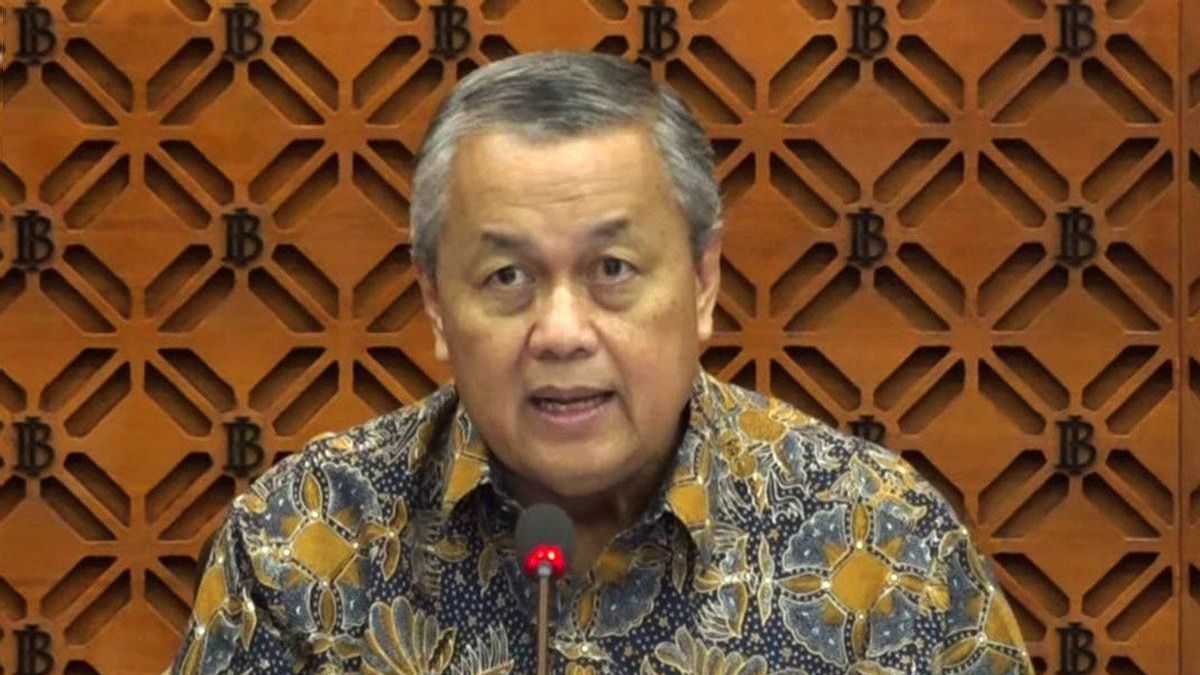


JAKARTA - Bank Indonesia (BI) stated that the Rupiah exchange rate was strengthened, supported by BI's stabilization policy and increased supply of foreign exchange by residents and non-residents.
BI Governor Perry Warjiyo said the Rupiah exchange rate against the US dollar until June 17, 2025 strengthened by 0.06 percent (ptp) compared to the position at the end of the previous month.
"The strengthening of the Rupiah also occurred against the developing state currency group, Indonesia's main trading partner and the currency group of developed countries outside the US dollar," Perry said at a press conference, Wednesday, June 18.
According to him, this development is influenced by foreign capital inflows, especially state securities instruments (SBN) and foreign exchange supplies from residents, especially corporations, in line with the increase in the conversion of foreign currency to rupiah by exporters after the implementation of strengthening government policies related to Natural Resources Export Result Foreign Exchange (DHE SDA).
In the future, he said that the Rupiah exchange rate is predicted to be stable, supported by Bank Indonesia's commitment to maintaining the stability of the Rupiah exchange rate, attractive returns, low inflation, and a good prospect of Indonesia's economic growth.
Perry added that Bank Indonesia will continue to strengthen its stabilization policy response, including measurable interventions in the off-shore NDF market and triple intervention strategies in spot, DNDF, and SBN transactions in the secondary market.
"All monetary instruments are also continuously optimized, including strengthening the pro-market monetary operations strategy through optimizing SRBI, SVBI, and SUVBI instruments, to strengthen policy effectiveness in attracting foreign portfolio investment inflows and supporting the stability of the Rupiah exchange rate," he explained.
Similarly, Deputy Senior Governor of Bank Indonesia Destry Damayanti said that Indonesia should be grateful because in the midst of high global risks, our country is still able to offer yields that are attractive to financial instruments.
According to him, this is reflected in the flow of foreign capital (inflow) to Government Securities (SBN), which in June showed a significant increase, reaching around Rp. 11 trillion.
Meanwhile, for the stock market, although there is still an outflow, the amount is relatively small, which is around Rp. 3 trillion. The same thing happened to the SRBI instrument with an outflow of around Rp. 5 trillion.
However, overall, the inflow to SBN since the beginning of the year to date has reached IDR 43.5 trillion.
"So this is also enough to increase our supply class in the market and this is also reflected in daily transactions in our foreign exchange market which continue to increase, where if we look at April, the daily average is below 6 billion US dollars, which is around 5.76 billion US dollars. But in June, on June 16, June 16, it was already above 6 billion US dollars, which is around 6.22 billion US dollars," he said.
Destry said that the increase in the supply of foreign funds and the entry of foreign funds was one of the factors in strengthening the Rupiah exchange rate on a quarterly basis.
He noted that the Rupiah exchange rate rose by 1.72 percent compared to the previous quarter and this movement was also in line with the trend in other emerging markets (peers group) countries.
"So our movement is aligned with the movement of our peer groups, we will continue to optimize our pro-market market operations, our pro-market open operations, why? Because we still see that there are several risks that we should be aware of. , "he explained.
Destry said that Bank Indonesia will continue to optimize its pro-market open market operations policy to maintain stability.
SEE ALSO:



Dia menambahkan, BI secara konsisten melanjutkan kebijakan triple intervention, yaitu intervensi di pasar spot, DNDF, dan pembelian SBN dalam menjaga stabilitas nilai tukar sekaligus memperkuat likuiditas pasar.
"Kita juga terus melakukan triple intervention, di mana kita masuk apakah itu di pasar DNDF, ataupun spot, ataupun di SBN, dalam rangka juga selain menjaga stabilitas Rupiah, tentunya kita juga ingin menambah likuiditas di pasar, yaitu melalui pembelian SBN kita yang sudah mencapai Rp124 triliun," tegasnya.
SEE ALSO:
He added that BI consistently continues its triple intervention policy, namely intervention in the spot market, DNDF, and the purchase of SBN in maintaining exchange rate stability while strengthening market liquidity.
"We also continue to carry out triple interventions, where we enter whether it is in the DNDF market, or spots, or in SBN, in order to also maintain Rupiah stability, of course we also want to increase liquidity in the market, namely through the purchase of our SBN which has reached Rp124 trillion," he said.
The English, Chinese, Japanese, Arabic, and French versions are automatically generated by the AI. So there may still be inaccuracies in translating, please always see Indonesian as our main language. (system supported by DigitalSiber.id)


