



JAKARTA - The World Bank reports that the poverty rate in Indonesia has increased significantly where it was recorded to have increased from 15.6 percent to 19.9 percent on the lower-middle-Income Class (LMIC) line of middle-income countries and from 60.3 percent to 68.3 percent on the upper-middle-Income Class (UMIC) line.
The World Bank emphasized that the increase was measured based on the international poverty line and did not mean that poverty in Indonesia had actually increased, but because of the increased global poverty threshold.
"Poverty in Indonesia has not increased, the poverty rate reported at the new LMIC and UMIC poverty lines is higher because the threshold for not being poor has increased at the global level," the World Bank wrote in a report on the UPdated Global Potential Lines: Indonesia, quoted on Sunday, June 15.
The World Bank explains that for low-income countries, this change is mainly because the quality of available surveys has increased and several countries have adjusted their poverty line to take advantage of more accurate data.
Meanwhile, in medium-income countries such as Indonesia, the increase in the national poverty line shows that many countries are becoming more ambitious in determining the minimum standard of living that is acceptable.
"As a result of higher thresholds, most countries are experiencing an increase in their international poverty rate, as is the case with Indonesia," he explained.
For information, the World Bank has changed the poverty line calculation method from the 2017 purchasing power parity (PPP) standard to PPP 2021 so that the number of poor people in Indonesia has increased significantly.
SEE ALSO:
-
 | BERITA
Korban Tewas Pesawat Air India Jatuh di Ahmedabad Bertambah Jadi 274 Orang
15 Juni 2025, 11:31

In addition, the World Bank uses an official household survey with data from the National Socio-Economic Survey (SUSENAS) to measure poverty in the international poverty line and the same source used by the Indonesian government to calculate national poverty statistics. However, both parties apply different measurement methods.
In its approach, the World Bank measures poverty based on international poverty lines that are adjusted to three types of price differences, namely price differences over time (using the Consumer Price Index/CPI), inter-district (Regency/City) price differences, using local cost measures), and price differences between countries (using adjustments related to PPP).
Meanwhile, the definition of national poverty does not use CPI to adjust price differences over time.
Meanwhile, the approach to calculating spatial differences in Indonesia also has a different approach, which officially results in a separate poverty line for every rural and urban area in each province, so in the end, because the official poverty line is intended to be used in Indonesia alone, it does not require adjustments related to PPP.
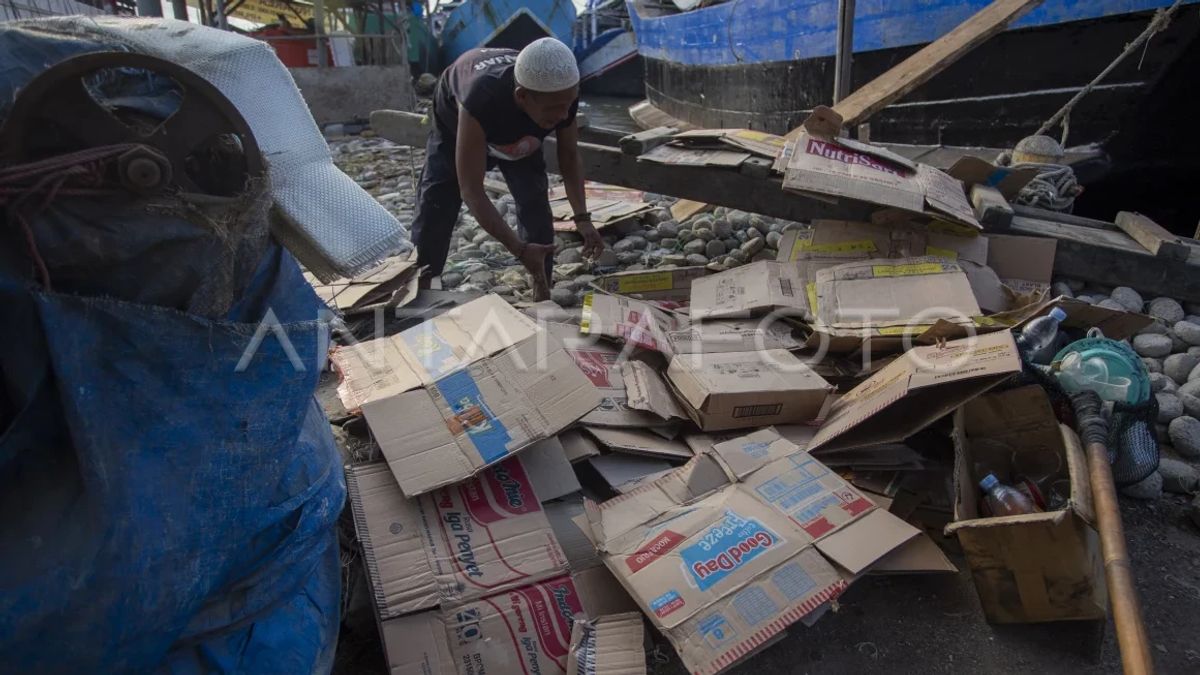
Pic : Residents collected used cardboard boxes in the fishing village of Karangsong, Indramayu, West Java, Wednesday (23/10/2024). The extreme poverty rate in Indonesia has fallen sharply in the last 10 years, from previously at the level of 7.9% of the total population in 2014, now 0.8% remains in 2024.
The English, Chinese, Japanese, Arabic, and French versions are automatically generated by the AI. So there may still be inaccuracies in translating, please always see Indonesian as our main language. (system supported by DigitalSiber.id)
Most Popular Tags
#Prabowo Subianto #donald trump #Febrie Adriansyah #8791 #giias 2026Popular


