

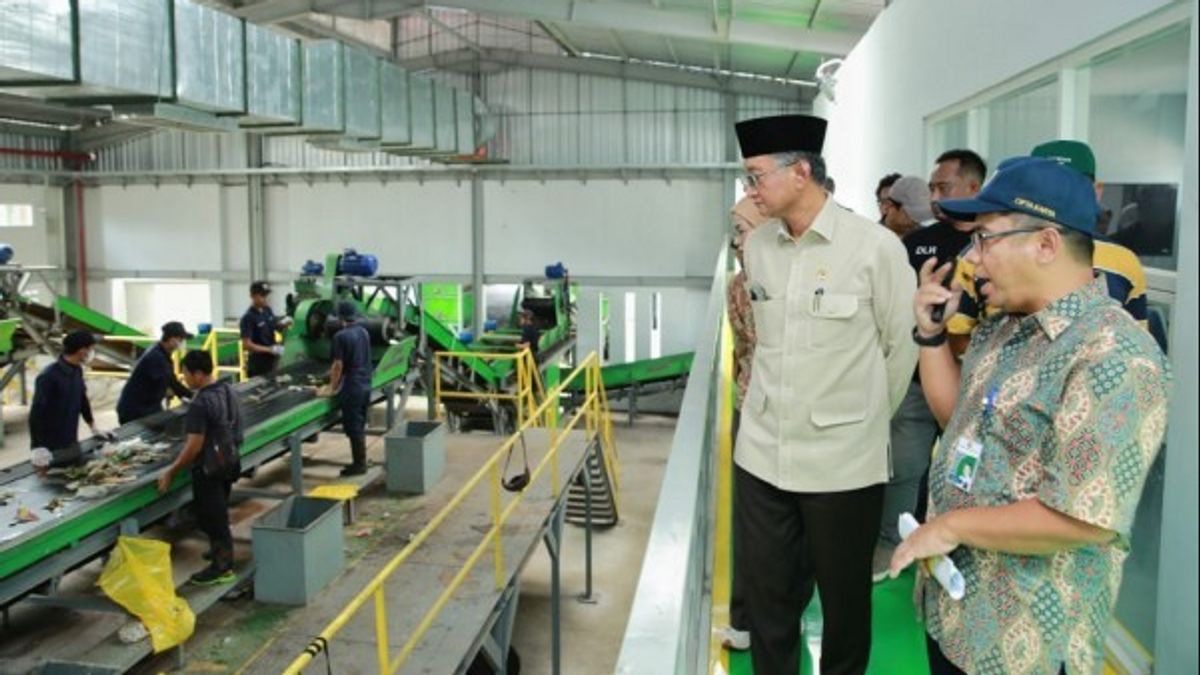


JAKARTA - The Ministry of Public Works (PU) has stated its commitment to supporting integrated, resilient and sustainable waste reduction and management by 2030.
The integrated waste management system is expected not only to be able to reduce environmental impacts, but also to support public health, climate resilience, and encourage circular economic application.
The Minister of Public Works, Dody Hanggodo, emphasized that the Government will continue to accelerate the transformation of waste management into clean and sustainable energy.
"The big challenge facing Indonesia today is that the volume of waste continues to increase every day," said Dody in a written statement, Saturday, June 14, 2025.
SEE ALSO:



To answer these challenges, the Ministry of Public Works encourages the acceleration of the construction of waste to energy (WTE) facilities in various regions and optimizes the application of reduced, reuse, recycle, recovery (4R) principles.
In addition, the Government is also trying to simplify regulations, adjust electricity rates from Waste Power Plants (PLTSa) in order to attract more private investment.
Then, the funding scheme is also expanded through a cooperation scheme between the Government and business entities (KPBU) so that waste management projects can run effectively without burdening the state budget excessively.
In a thematic discussion session entitled From Waste to Resources: Advancing Integrated Infrastructure for Waste Management at the 2025 International Conference Infrastructure (ICI) event in Jakarta, Thursday, June 12, 2025, the Director General of Human Settlements at the Ministry of Public Works, Dewi Chomistriana, conveyed a number of strategic steps that need to be taken to achieve the integrated and sustainable waste management target by 2030.
The move includes the development of circular economic-based waste infrastructure, digitization of waste management, utilization of financing innovation, and flexible and efficient institutional reforms.
"We continue to look for data-based systemic solutions. (With this approach) waste is no longer considered a burden, but as a valuable resource."
"Towards 2030, we still face big challenges, including waste management services that have only reached around 49 percent of settlements," said Dewi.
He added that of the approximately 137,000 tons of garbage transported daily, most of them were still immediately dumped to the final processing site (TPA) without going through the sorting process first.
The digitization of waste management systems also continues to be developed, including through the implementation of the E-Sampah platform and the use of the internet of things (IoT).
In addition, other innovative models, such as the Smart Waste Tracking System, the Extended Producer Responsibility (EPR) program, and the application of waste to energy (WTE) technology are also part of the 2030 roadmap.
To support financing, the Ministry of Public Works encourages innovative schemes, such as KPBU, business-to-business (B2B), and operational cooperation (KSO).
This approach aims to expand funding sources, reduce the burden on the state budget, and create an investment climate through multi-party collaboration.
"The synergy across stakeholders, including the private sector, to accelerate the realization of a national waste management system is more efficient, modern, and environmentally friendly," said Dewi.
The Ministry of Public Works has also implemented various programs related to waste management, both through regular programs and special programs.
Regular programs include the construction of regional TPA infrastructure, Reduce Waste Processing Sites, Reuse, Recycle (TPS-3R), and Community-Based Sanitation (Sanimas) through the Labor Intensive Program.
Meanwhile, special programs include the use of plastic for asphalt mixtures, the development of Waste Power Plants (PLTSa), and the application of waste derivative fuel (RDF) technology as part of an integrated waste management system.
The English, Chinese, Japanese, Arabic, and French versions are automatically generated by the AI. So there may still be inaccuracies in translating, please always see Indonesian as our main language. (system supported by DigitalSiber.id)


