

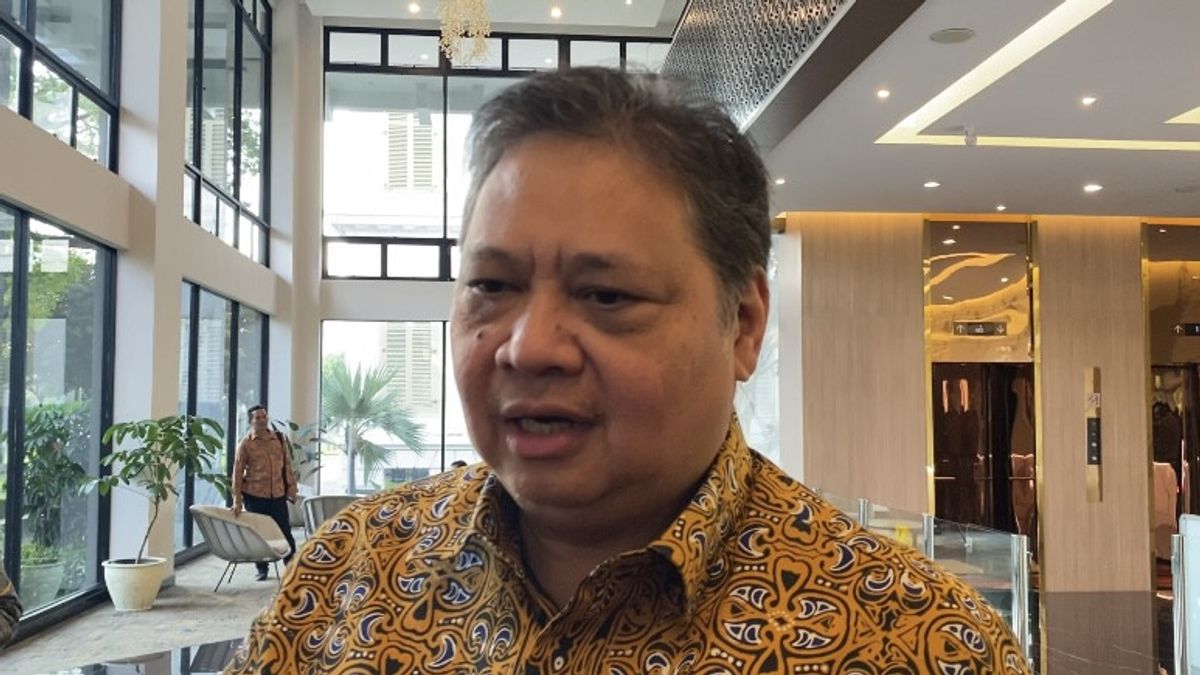


JAKARTA - The government continues to be committed to expanding export market access, strengthening domestic industries, and creating jobs through the completion of various strategic trade agreements.
One of these forms of commitment is through the efforts of Indonesia and the European Union which have reached an important agreement in completing the final stages of the Indonesia-European Union Comprehensive Economic Partnership Agreement (IEU CEPA) negotiations which are expected to bring concrete benefits to the community and national business actors.
Coordinating Minister for Economic Affairs Airlangga Hartarto stated that the current status of the negotiations shows that the negotiation process has been completed, with a number of technical issues successfully resolved in the last round at the Chief Negotiator level.
He added that this meeting reflected the Indonesian government's strong commitment to finalizing negotiations with strategic and potential partner countries.
"The goal is to open markets to increase trade and investment that are mutually beneficial and reduce barrier trade, both in the form of tariffs and non-tariff barriers," he said at a press conference related to the development of Indonesia-EU CEPA Negotiations in Brussels, Belgium, quoted Monday, June 9.
Furthermore, Airlangga said that the IEU-CEPA finalization discussion was discussed at a meeting between Coordinating Minister Airlangga and EU Commissioner for Trade and Economic Security Maro
Airlangga said that the agreement marks the end of a nine-year negotiation process and includes 19 main rounds as well as intensive dialogue in recent months.
He added that the negotiations were also declared ready to be announced and in the near future the results will be reported to President Prabowo Subianto and to the President of the European Commission.
Meanwhile, the European Union itself is the fifth largest trading partner for Indonesia, with a total trade value of 30.1 billion US dollars in 2024.
In addition, the trade balance continues to record a surplus for Indonesia, a significant increase from 2.5 billion US dollars in 2023 to 4.5 billion US dollars in 2024.
Airlangga said that Indonesia and the European Union have the same spirit to take advantage of momentum in the midst of a global situation full of uncertainty and difficult to predict.
He emphasized that the main commodities of both parties are complementary (complementary), so they do not compete directly with each other.
"Of course, this will both strengthen the supply chain or the world market supply chain so that the acceleration of this settlement becomes very important," he said.
Airlangga said that one of the main benefits of implementing the IEU-CEPA is the significant elimination of import rates where within 1 to 2 years after the agreement is enforced, as much as 80 percent of Indonesia's exports to the European Union will enjoy a rate of 0 percent.
In addition, superior commodities such as labor-intensive products (lates, textiles, garmen), palm oil, fisheries, as well as the renewable energy sector and electric vehicles will receive fairer preferential treatment.
Furthermore, Airlangga said that the European Union is focusing attention on several strategic issues, including in-depth discussions on the Domestic Component Level (TKDN), the automotive, critical minerals sector, as well as facilities that can be provided to investors when making investments.
In addition, Commissioner Maros also provided several notes that had been made into a mutual agreement and in principle the agreement became a matter for which both parties understood.
On this occasion, Airlangga also appreciated the agreement related to trade and sustainable growth.
"This agreement is considered of high value because it provides benefits for business actors in Indonesia and Europe, and this activity related to sustainability is important, including in various developments rather than policies in Europe related to sustainable products, and it is hoped that this policy can reduce our risk of the conditions being treated in the future," said Airlangga.
Then, Airlangga also emphasized the importance of developing the fisheries sector as Indonesia's strategic potential and requested that Indonesian fishery products receive export treatment that is equivalent to other ASEAN countries, such as Thailand and the Philippines.
Airlangga also said that the European Union had agreed to provide a level playing field specifically for the production and export of Indonesian fisheries with surrounding countries.
In addition, related to deforestation policies, Commissioner Maro Karya promised to provide special treatment to Indonesia which is believed to have a positive impact on exports of Indonesian forest products.
"Indonesia asks that facilities for fishery exports are not distinguished from other ASEAN countries such as Thailand or the Philippines, and Europe has agreed that we will be given a level playing field," said Airlangga.
관련 항목:
From a strategic point of view, Airlangga conveyed that the IEU-CEPA agreement would strengthen Indonesia's bargaining position in the global arena with market openings and removing tariff barriers, this agreement is an important momentum to increase national competitiveness.
Airlangga said the Government is optimistic that the implementation of the IEU-CEPA can encourage Indonesia's exports to the European Union to grow by more than 50 percent in the next three to four years.
In addition, he conveyed that the agreement also opened up strategic investment opportunities from Europe to Indonesia, along with increasing trust in the legal system and domestic policies.
Both parties have agreed to immediately resolve the material and legal processes. There is no omission left, concluded Airlangga.
The English, Chinese, Japanese, Arabic, and French versions are automatically generated by the AI. So there may still be inaccuracies in translating, please always see Indonesian as our main language. (system supported by DigitalSiber.id)
Most Popular Tags
#Prabowo Subianto #donald trump #firearm #8791 #giias 2026Popular


