
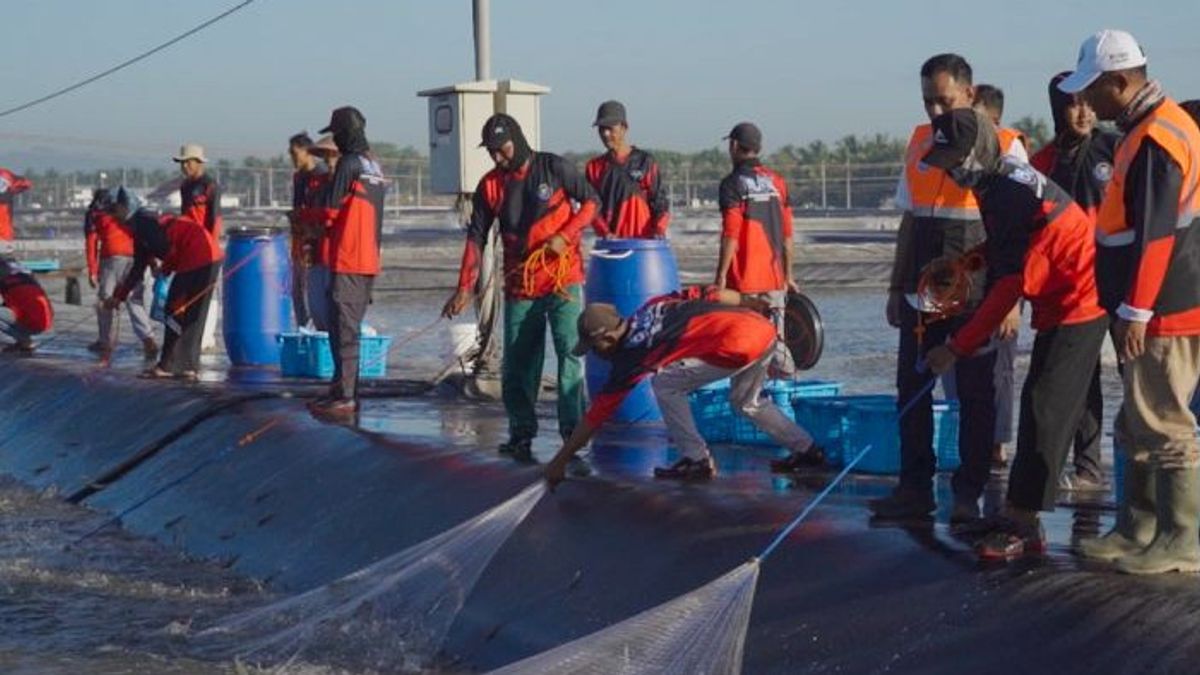


JAKARTA - The Ministry of Maritime Affairs and Fisheries (KKP) said that the role of young people is very potential in cultivating sustainable and competitive fisheries in various parts of Indonesia.
"The involvement of young people brings fresh air to the progress of aquaculture in Indonesia," said Director General of Aquaculture Budi Daya Tb Haeru Rahayu (Tebe) in a statement in Jakarta, Thursday.
Therefore, the KKP continues to encourage the younger generation to cultivate fisheries in an innovative and sustainable manner, as has been done by the Indonesian Young Petambak (PMI) community in various regions.
According to him, the involvement of young people brings fresh air to the advancement of fishery cultivation in Indonesia, especially with innovation and sustainability through a more creative and adaptive approach.
SEE ALSO:
"There arises various challenges in shrimp farming such as shrimp disease and product competitiveness. However, it actually becomes a trigger for young farmers to continue to improve quality and productivity," said Tebe.
He previously said that the KKP collaborated with the Indonesian Young Petambak to hold a Shrimp Aquaculture Conference (SAC) in Badung, Bali by involving hundreds of participants both from within and outside the country.
Tebe added that innovation and application of good fish farming methods (CBIB) not only have an impact on increasing productivity, but also on product quality and maintaining environmental sustainability.
The spirit of innovation from the younger generation can be an example for other cultivation business actors throughout Indonesia.
The KKP has built a Regional-Based Shrimp Cultivation Modeling (BUBK) in Kebumen Regency, Central Java.
The BUBK Kebumen is a pilot for modern shrimp ponds based on an area that prioritizes ecological balance.
"The BUBK in Kebumen is clear evidence of how shrimp cultivation can be carried out in an integrated and sustainable manner," explained Tebe.
Meanwhile, Director of Payau Water Fish, Directorate General of Aquaculture, Fernando J Simanjuntak, added that the Kebumen BUBK is an area-based shrimp pond with a potential land area of up to 100 hectares.
Currently, there are 189 pond plots with a size of 1,600 m2 each consisting of 139 plots of production ponds and the rest for water reservoirs.
"In addition to using modern, environmentally friendly technology, cultivation activities at BUBK Kebumen apply the principles of good fish farming," said Fernando.
He said the wastewater treatment plant (IPAL) carried out various treatments such as deposition and oxygenation so that the water quality returned to normal and even more fertile without causing damage to the surrounding environment.
He added that the KKP is also currently preparing an integrated shrimping (ISF) pond development program, which is planned to be located in East Sumba Regency, East Nusa Tenggara (NTT).
Like the BUBK Kebumen, the ISF pond program also applies a CBIB-based shrimp farming pond with an integrated approach from upstream to downstream.
Previously, Minister of Maritime Affairs and Fisheries Sakti Wahyu Trenggono expressed the importance of developing fishery cultivation to support food security, economic growth, and safeguarding the fishery population at sea.
By increasing the production of aquaculture, the intensity of fishing activities in nature can be reduced.
The English, Chinese, Japanese, Arabic, and French versions are automatically generated by the AI. So there may still be inaccuracies in translating, please always see Indonesian as our main language. (system supported by DigitalSiber.id)


