

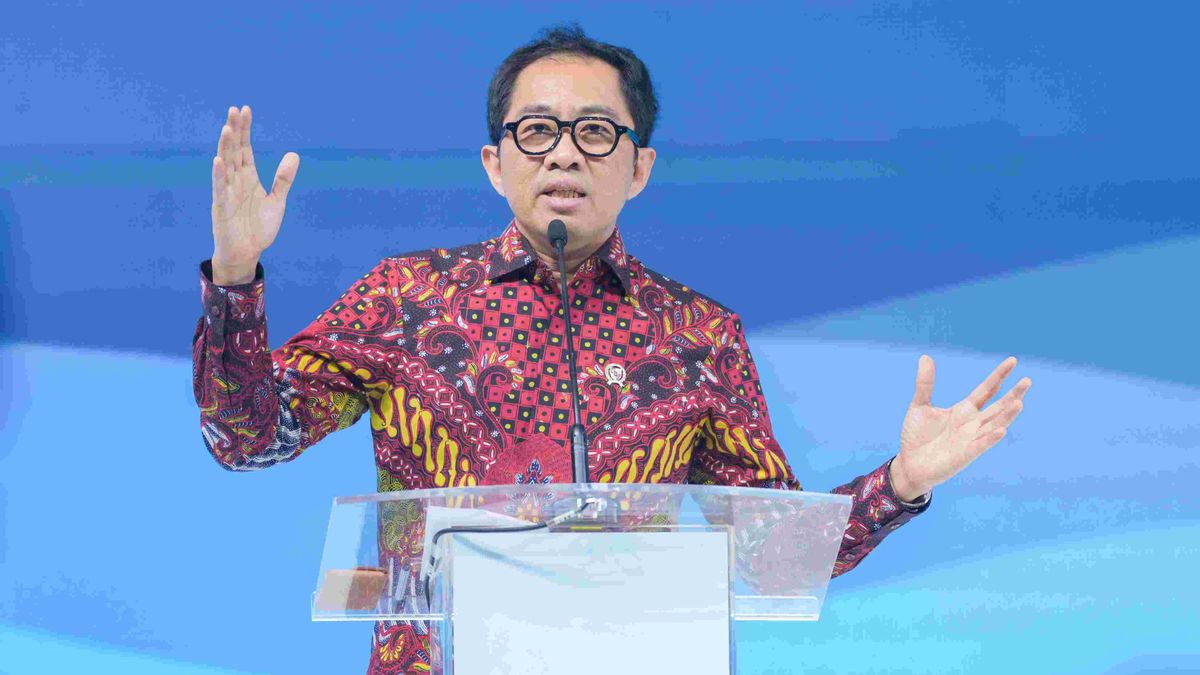


Deputy Minister of Industry (Wamenperin) Faisol Riza said the ability to innovate the national shipbuilding industry has now shown significant development.
For example, just by being able to produce various types of ships, such as commercial boats, fishing vessels, passenger ships, military ships or patrols as well as various other types of ships.
Currently, there are 342 active shipyards spread across 29 provinces with a building production capacity of 1 million deadweight tonnage (DWT) per year and a repair capacity of 12 million DWT per year.
This industry has absorbed more than 46.000 workers.
For example, PT PAL Indonesia has succeeded in producing the Fast Missile Ship (KCR) used by the Indonesian Navy and the Landing Platform Dock (LPD) ship that has been exported to the Philippines.
"This achievement shows the potential of the national shipbuilding industry to be able to meet the needs of high-quality vessels, both for the domestic and international markets," said Faisol as quoted from his written statement, Wednesday, May 28.
According to Faisol, the growth of the shipyard industry is inseparable from the support of the component sector which is also growing. This is because currently there are 127 marine class certified component companies and more than 560 Domestic Component Level (TKDN) certificates have been issued.
The local content in ship production has reached more than 40 percent for certain types of ships. "This is certainly a solid foundation for the transformation of the national shipping industry going forward," he said.
At the global level, the shipping industry is undergoing a structural transformation, where digital technology is starting to be adopted in the design and production process.
On the other hand, global commitment to decarbonization has begun to urge the world's shipping industry to transform towards environmentally friendly energy-based vessels.
"Indonesia must be at the forefront of adopting and developing this technology," he said.
Therefore, said Riza, his party will prepare a roadmap for developing a shipyard industry oriented towards increasing shipyard efficiency and productivity through digitization, low-emission ship design innovation, strengthening the TKDN-based component ecosystem and preparing high-competency human resources through international cooperation.
"We believe the future of the shipping industry is not only determined by the capabilities of each country, but by our ability to cooperate or collaborate," said Faisol.
Indonesia, he continued, is ready to take on the role of regional leadership in cooperation on joint standardization and certification among countries in the Asian region, regional supply chains for ship components, innovation and collaboration of cross-border technology as well as promotion of trade and export products of the intra-Asia maritime industry.
Faisol assessed that international ports in the country still need to be improved because global trade ratios need at least 25 international ports.
"If these international ports are increasingly opened, of course, it will also provide opportunities for business actors to develop the shipping industry," explained Febri.
In fact, the government wants to make Indonesia the center of medium ship production for the Southeast Asian region, as well as become a major player in the export market of commercial ships and fishing vessels for archipelagic countries in the Pacific and Africa.
SEE ALSO:



This target is in line with what President Prabowo Subianto conveyed in the Indonesia-Brazil Business Forum in Rio de Janeiro on November 18, 2024, that Indonesia as the country with the second or third largest fish reserves in the world has the need for around 40,000 fishing vessels measuring 150 gross tonnage (GT) to 300 GT.
"With current capacity and potential development, the national shipbuilding industry has a very large opportunity to meet these needs," he concluded.
The English, Chinese, Japanese, Arabic, and French versions are automatically generated by the AI. So there may still be inaccuracies in translating, please always see Indonesian as our main language. (system supported by DigitalSiber.id)
Most Popular Tags
#Prabowo Subianto #donald trump #2026 World Cup #Febrie Adriansyah #8791Popular


