

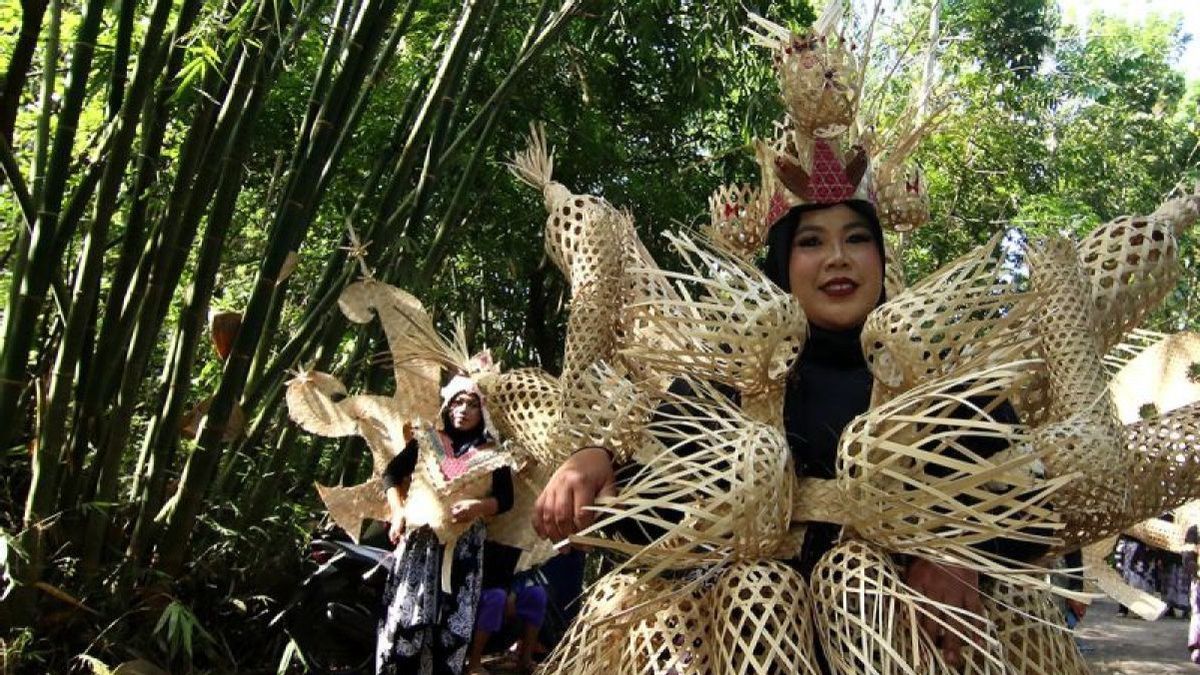


The Ministry of Industry (Kemenperin) stated that it is accelerating the development of an integrated bamboo industry ecosystem through the Bamboo Academy program, such as in Bambu Muara Beres District, Bogor, West Java.
"The bamboo industry has its own great prospects and uniqueness. Bamboo can grow anywhere, but cultivation and selection techniques are still needed in order to produce quality raw materials," said Minister of Industry (Menperin) Agus Gumiwang Kartasasmita as quoted from her written statement, Tuesday, May 27.
According to Agus, bamboo is not only functional material, but is also full of deep philosophical values.
This makes bamboo one of the most potential natural resources developed as a high competitive industrial base, especially in the handicraft, furniture, construction and bioindustry sectors.
The Ministry of Industry has also implemented various strategic programs to support the development of the national bamboo industry.
Some of its efforts include product design facilitation, production equipment assistance for small and medium industry players (IKM) as well as human resource training through the Bamboo Academy.
"We fully support the development of the national bamboo industry ecosystem through the Bamboo Academy initiative," he said.
This program is expected to be the locomotive of integrated and sustainable bamboo industry development, so that it will support national economic growth.
Even so, Agus also said, the development of the bamboo industry has challenges that are not easy.
"Just like building other industrial sectors, we are facing problems related to raw materials, quality and product standardization. But we must face this challenge together with innovation and sustainable productivity," said Agus.
For this reason, the Ministry of Industry is committed to overseeing all stages of the development of the bamboo industry as a whole and sustainable.
Synergy with stakeholders, ranging from the bamboo community, research institutions to the industrial sector is the key in realizing a strong and global competitive bamboo industry ecosystem.
Moreover, Indonesia has a huge potential for bamboo resources and is spread across various regions.
However, its utilization needs to be optimized so that this bamboo commodity can become a high value added product.
Indonesia is one of the countries with the most bamboo species in the world.
There are 162 types of bamboo in Indonesia, 124 of which are native Indonesian species.
From the regional side, Agus said, Indonesia is ranked sixth in the world in terms of the bamboo forest area, reaching 1.85 million hectares.
According to him, this is an extraordinary ecosystem strength and is an ecological and economic asset that should not be ignored.
"For this reason, it is important for me to make a visit to Bambu Muara Beres Regency as part of the government's efforts to build synergies with all stakeholders who have a mission in the development of the national bamboo industry," said Agus.
In addition, the Ministry of Industry also fully supports the role of the Bamboo Academy as the driving force for the birth of superior and innovative human resources in the national bamboo industry.
This program includes technical training, strengthening supply chains and developing high-value products so that the bamboo industry can compete globally.
Meanwhile, the Director General of Agro Industry at the Ministry of Industry, Putu Juli Ardika, explained that the Ministry of Industry also curated and facilitated partner assistance for prospective Bamboo Academy participants spread across the upstream, between and downstream sectors.
The Bamboo Academy program targets 250 people to participate in training within five years. These participants came from Banten, West Java, Yogyakarta, Bali and East Nusa Tenggara.
The implementation is through the Master Bambu program, with the aim of producing upstream and downstream master graduates. Master bamboo is also able to train other bamboo partners (Training of Trainer - ToT) as many as 50 people.
Master Bambu graduates will be able to become the Farmers Service Team and Youth Program Entrepreneur professions.
SEE ALSO:


Furthermore, there is the Bamboo-Based Industrial Incubation program. The graduates will produce various bamboo-based products according to the company's needs.
"To strengthen this ecosystem, the Ministry of Industry also supports the establishment of the Bamboo Industrial Logistics Center located in the raw material source area. This logistics center will become a node for distribution of raw materials and semi-finished products that are ready for downstream industry use," he explained.
Through a solid upstream-downstream ecosystem approach and supported by integrated training and logistics, the Indonesian bamboo industry will be able to grow as a new environmentally friendly and globally competitive economic force.
The English, Chinese, Japanese, Arabic, and French versions are automatically generated by the AI. So there may still be inaccuracies in translating, please always see Indonesian as our main language. (system supported by DigitalSiber.id)
Most Popular Tags
#Prabowo Subianto #donald trump #2026 World Cup #venezuela #konflik timur tengahPopular


