

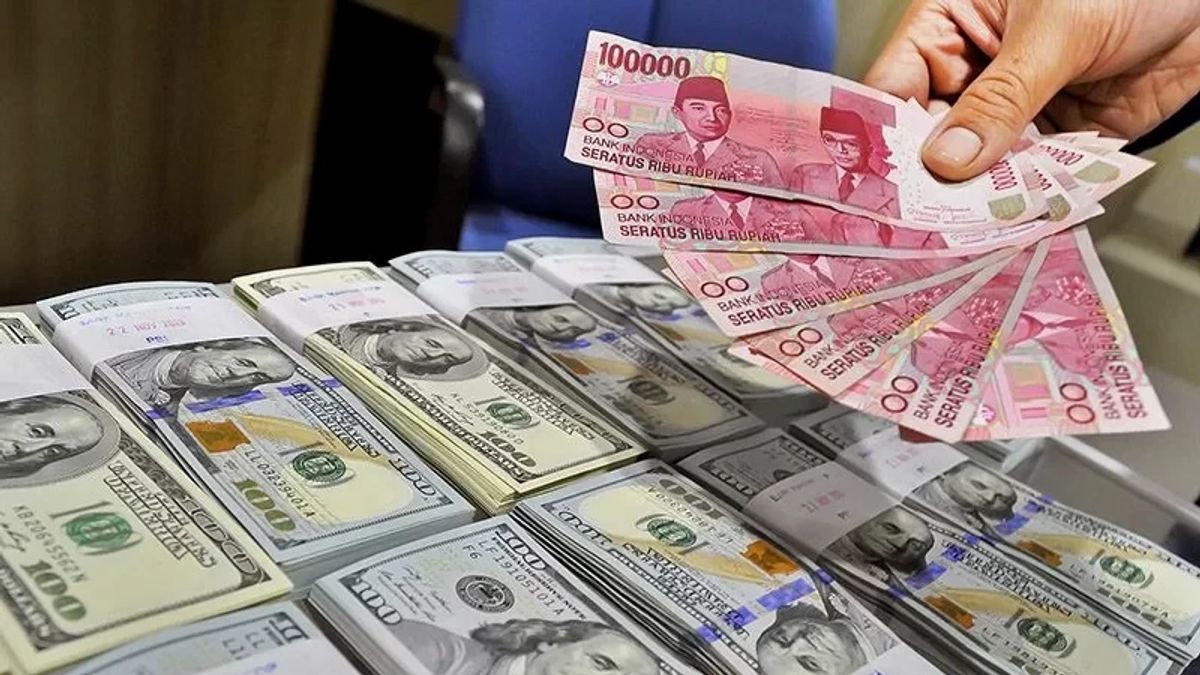


JAKARTA - Bank Indonesia (BI) noted that Indonesia's Foreign Debt (ULN) position in the first quarter of 2025 was recorded at US$430.4 billion, or an annual growth of 6.4 percent, higher than the growth in the fourth quarter of 2024 of 4.3 percent.
"The development of the external debt position comes from the public sector," said BI Communications Department Executive Director Ramdan Denny Prakoso in his statement, Thursday, May 15.
Denny said that in the first quarter of 2025 the government's external debt position was recorded at 206.9 billion US dollars, or grew by 7.6 percent (yoy), higher than the growth of 3.3 percent (yoy) in the fourth quarter of 2024.
Denny conveyed that the development of the external debt was influenced by the withdrawal of loans and the increase in foreign capital inflows in international Government Securities (SBN), along with investor confidence in Indonesia's economic prospects which were maintained amidst the increasingly high uncertainty in the global financial market.
"The government remains committed to maintaining credibility by managing external debt carefully, measurably, and accountably to realize efficient and optimal financing," he said.
Meanwhile, the position of private external debt in the first quarter of 2025 was recorded at 195.5 billion US dollars, or experienced a growth contraction of 1.2 percent (yoy), lower than the previous quarter's contraction of 1.6 percent (yoy).
According to him, this development was mainly driven by external non-financial corporation, which recorded a growth contraction of 0.9 percent (yoy), lower than the contraction of 1.7 percent (yoy) in the fourth quarter of 2024.
SEE ALSO:


Denny conveyed that the structure of Indonesia's external debt remains healthy, supported by the application of the precautionary principle in its management, this is reflected in the ratio of Indonesia's external debt to Gross Domestic Product (GDP) which is maintained at 30.6 percent, and dominated by long-term external debt with a share of 84.7 percent of total external debt.
Therefore, Denny explained that in order to keep the external debt structure healthy, Bank Indonesia and the Government continue to strengthen coordination in monitoring the development of external debt.
"The role of external debt will also continue to be optimized to support development financing and encourage sustainable national economic growth," he said.
According to him, these efforts were carried out by minimizing risks that could affect economic stability.
The English, Chinese, Japanese, Arabic, and French versions are automatically generated by the AI. So there may still be inaccuracies in translating, please always see Indonesian as our main language. (system supported by DigitalSiber.id)
Most Popular Tags
#Prabowo Subianto #donald trump #Febrie Adriansyah #8791 #giias 2026Popular


