

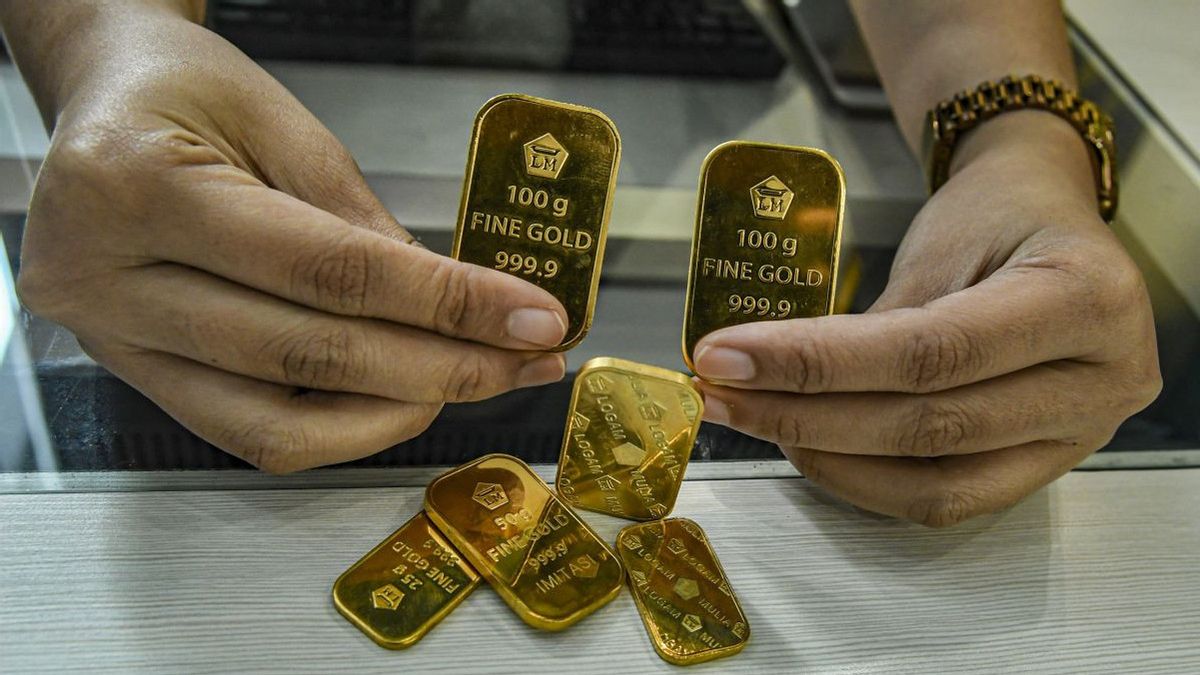


JAKARTA - Global and local gold prices throughout 2025 show a significant upward trend.
This condition reflects the status of gold as a safe haven asset or a safe storage area amidst economic and geopolitical uncertainty.
In trading in the global market, the price of gold bullion reaches 113.9 US dollars or around Rp. 1,919,908 (1 dollar exchange rate equivalent to Rp. 16,840) per gram.
In Indonesia, the trend of increasing global gold prices has an impact on domestic gold prices, even on April 17, Antam's gold price at Pegadaian reached IDR 2.04 million per gram, much higher than Gallery24 gold which was only IDR 1.942 million per gram and UBS which was only IDR 1.965 per gram.
One of the reasons for the skyrocketing price of gold, as quoted from the Financial Express, is that there is an announcement of Trump's tariff which has implications for high uncertainty in the global economy and increases the risk of recession, especially in the United States (US).
In addition, the heating up of trade conflicts between the US and China also makes people choose to buy gold.
Amid global uncertainty and risks, gold is considered the most sought-after asset class.
This is believed to be the reason gold prices continue to rise.
Gold has become one of the most preferred asset classes in the last 2 to 3 years by central banks, industries, global exchange-traded funds, and investors.
In relation to economic growth, especially for investors, the increase in gold prices often provides short-term benefits.
Those who have invested their money in gold before prices spiked can sell it at a higher price.
However, the sharp fluctuations in gold prices can also increase investment risks.
Therefore, investors need to consider this risk before deciding to buy gold as a long-term asset.
Meanwhile, in terms of macroeconomics, rising gold prices can affect certain sectors, especially industries that depend on gold as raw materials, such as jewelry and electronics.
The high price of gold makes production costs for these companies increase.
To maintain the profit margin, they may increase product prices, which have the potential to reduce consumer purchasing power.
This could lead to a decline in demand in the market.
Research by Bank Indonesia (2023) stated that gold prices have a significant effect on exchange rate volatility and core inflation, especially during a global crisis.
Impact on the economy
According to data from the Central Statistics Agency (BPS) and the Ministry of Energy and Mineral Resources (ESDM), Indonesia's gold production in 2023 reached around 90 tons, with the value of gold bullion exports reaching 5.7 billion US dollars.
Meanwhile, the mining sector itself contributes about 7 percent to the national GDP, and gold is one of the main contributors to the category of metal minerals.
The increase in gold prices has a positive impact, especially in terms of increasing exports and trade surpluses which encourage an increase in export value even though production volume is stagnant.
This contributes to the trade balance surplus, strengthening the rupiah exchange rate, and adding foreign exchange reserves.
For example, in 2024, Indonesia's gold exports will increase by 18 percent in value even though the volume will only increase by 3 percent, thanks to the increase in international gold prices.
Furthermore, the increase in gold prices also affected the increase in regional and central income, where the central government received additional revenue from taxes and royalties on gold commodities, and gold-producing regions, such as Papua and North Sulawesi, recorded a significant increase in local revenue (PAD).
Overall, high gold prices increase investor interest in investing in gold exploration and production, both from domestic investment (PMDN) and foreign investment (PMA) and will have an impact on increasing investment in the mining sector.
However, it is also necessary to address the negative impact of rising gold which can disrupt or even hinder national economic growth, namely, among others, the economic instability caused by gold prices often tends to rise when global uncertainty occurs, which can lead to a decrease in investor confidence in the capital market and an increase in demand for gold as a safe haven to replace productive investment.
Furthermore, the increase in gold prices will also put pressure on consumption and inflation because it triggers an increase in the price of jewelry and its domestic derivative products. This can reduce people's purchasing power and cause inflation in the non-food sector.
Overall, the negative impact of rising gold prices will also provide distortions to investment directions caused by the influence of community behavior and business actors who tend to shift funds to gold rather than to productive sectors such as MSMEs or industries, thus reducing real investment in the long term.
Government Policy
The government through Bank Indonesia and the Ministry of Finance have implemented several strategic steps to increase this gold price by adjusting Bank Indonesia's interest rate policy to remain competitive and maintain the stability of the rupiah exchange rate.
These strategic steps include raising the BI rate to 6.25 percent in the first quarter of 2025 to stabilize the rupiah exchange rate which had weakened due to global tensions, ensuring that the foreign exchange market intervention by Bank Indonesia was to keep the volatility of the rupiah under control, and carry out routine monetary operations to absorb liquidity excesses and keep inflation on target 2.5 percent (plus/minus 1 percent).
Furthermore, the Government also issued a fiscal incentive policy for investment in the downstream gold sector for investors and mining entrepreneurs by reducing the agency's Income Tax (PPh) by up to 50 percent for 5 years for investment in gold smelters and refinery, providing 0 percent exemption from import Duty for machinery and gold smelter project equipment, as well as the existence of a Tax Holiday facility for large investors who build gold processing facilities and derivative products such as industrial metals, jewelry, and technology components.
In terms of foreign exchange reserves, increased through asset diversification, including increasing gold ownership by Bank Indonesia by starting to add gold as part of foreign exchange reserves, from 3 percent in 2023 to about 5 percent in 2025, collaborating with PT ANTAM, PT Pegadaian, and PT CoFTRA for the establishment of a digital precious metal base as a monetary instrument, and Bank Indonesia also considering the formation of the "Digital Gold Reserve" as part of strengthening national hedge instruments.
SEE ALSO:
-
 | EKONOMI
Harga Emas Antam Hari Ini Naik Rp32.000, Nyaris Tembus Rp2 Juta per Gram
17 April 2025, 09:38 -
 | EKONOMI
Ekonom Imbau Investor Beli Obligasi Pemerintah saat Harga Emas Tinggi
17 April 2025, 16:42 -
 | EKONOMI
Antam Optimalkan Layanan Digital untuk Antisipasi Kelangkaan Emas Fisik
16 April 2025, 19:55
The increase in gold prices, if managed with the right policies, could be an opportunity to increase economic growth, state revenue, and investment.
The results of a research by the World Gold Council (2024) show that a 10 percent increase in gold prices can increase the GDP of gold exporting countries by 0.3 percent if fiscal policies are supportive.
However, if the increase in gold prices is addressed without careful risk management, the spike in gold prices could be a source of macroeconomic instability and a slowdown in long-term growth. D
The need for synergy between monetary, fiscal, and investment policies is key in responding to the dynamics of global gold prices.
The English, Chinese, Japanese, Arabic, and French versions are automatically generated by the AI. So there may still be inaccuracies in translating, please always see Indonesian as our main language. (system supported by DigitalSiber.id)


