
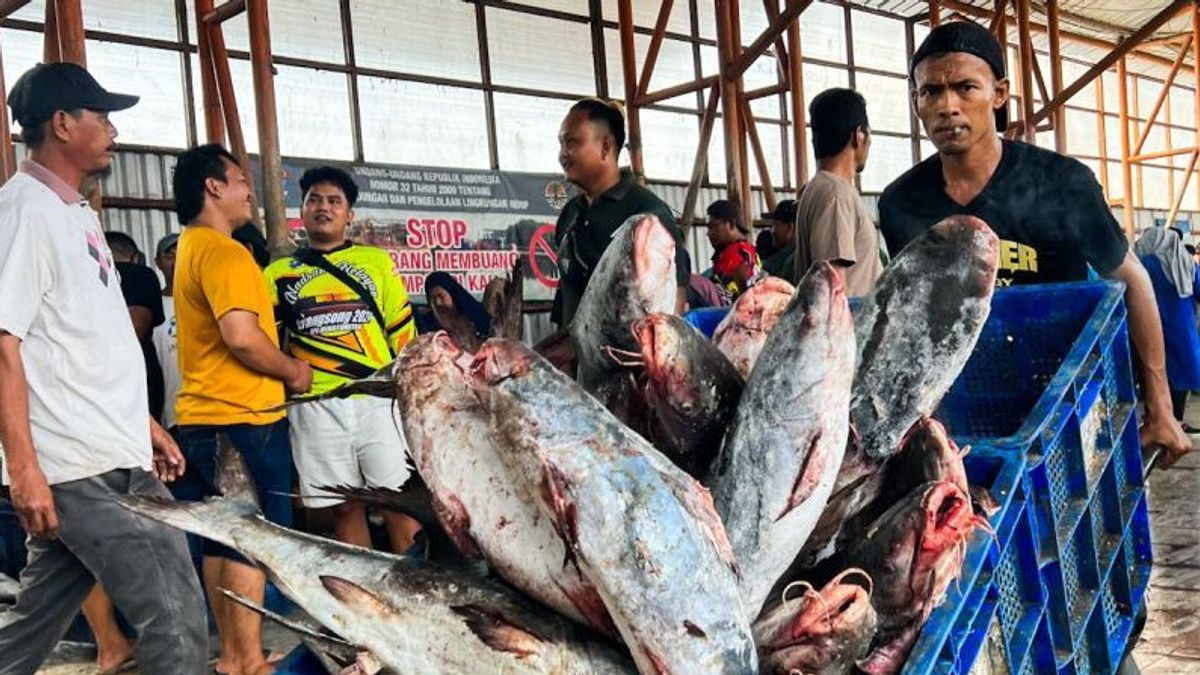


JAKARTA - The Ministry of Maritime Affairs and Fisheries (KKP) noted that 544 fish processing units (UPI) companies managed to penetrate the export market to China until March 2025, showing an increase in the performance of the Indonesian fisheries industry in the international market.
KKP stated that the competent authority General Administration of Customs of the People's Republic of China (GACC) and the competent authority of Indonesia KKP have a bilateral agreement Mutual Recognition Arrangement (MRA) in the field of quality assurance and safety of fishery products or aquatic products.
Head of the Marine and Fisheries Product Quality Control and Supervision Agency (Badan Mutu) KKP Ishartini said that through the MRA, the KKP managed to increase the number of UPIs that could export to China every year.
"In a row, since 2023, 2024 and 2025 (as of March 2025) the number of fish processing units (UPI) exporting to China is 386 (in 2023), 522 (in 2024) and 544 UPI (as of March 2025)," said Ishartini confirmed by ANTARA in Jakarta, Sunday.
He said the 10 most exported fishery commodities to the Bamboo Curtain Country were seaweed, squid, heur, sugar, sotong, quartics, vannama shrimp, baul, crabs, and tenggiri.
"To go to China, there are actually many types of fishery commodities exported, but they are still dominated by cephalopod, seaweed, demersal fish. We are currently always synergizing with the relevant domestic and Indonesian Embassy in Beijing to diversify export products and increase volume," explained Ishartini.
The KKP has succeeded in adding the number of Indonesian fisheries companies that can export to China, after negotiating with the local competent authority GACC.
"I have received an official notification from our GACC counterpart in China, they have already approved two of our fishery export companies and stated that the fishery product quality and safety guarantee system (SJMKHP) that has been implemented by the KKP Quality Agency is reliable, robust and consistent," said Jakarta.
SEE ALSO:
-
 | EKONOMI
H-9 Idulfitri 1446 H: Sebanyak 325 Ribu Kendaraan Tinggalkan Jabodetabek
23 Maret 2025, 20:00


Two UPIs that received approval were PT. Bahari Biru Nusantara and PT. Central Benoa Utama. During the last COVID-19 pandemic, the two companies were banned from exporting due to traces of the virus.
Ishartini said that the KKP Quality Body had so far established good communication with the Chinese competent authorities, so that the issue of export barriers could be unraveled.
He also explained that UPI is ready for export means that it has implemented SJMKHP consistently and operationally which is always supervised by the Quality Inspectors, the KKP Quality Body.
The KKP oversees fisheries companies that are ready to export to obtain approval in the destination country. UPI, which is ready to export, is given an official recommendation and submitted its registration to the competent authority in the destination country to get approval.
"The point is, if you want to export, it must be proven that you have also implemented HACCP, my team will help for that. If you have a HACCP, if you want to send it to the destination country, we will issue a Quality Certificate and Safety of Fishery Products," he added.
Previously, Minister of Maritime Affairs and Fisheries Sakti Wahyu Trenggono had encouraged increased production of aquaculture for several types of commodities that could become champions in the global market.
To meet the requirements for quality and food safety guarantees, KKP has formed the KKP Quality Board as the executor of the SJMKHP competent authority.
Meanwhile, in the fishery cultivation sub-sector, the KKP has built a modern cultivation modeling as a benchmark for the production of aquaculture according to international requirements and standards.
The English, Chinese, Japanese, Arabic, and French versions are automatically generated by the AI. So there may still be inaccuracies in translating, please always see Indonesian as our main language. (system supported by DigitalSiber.id)


