

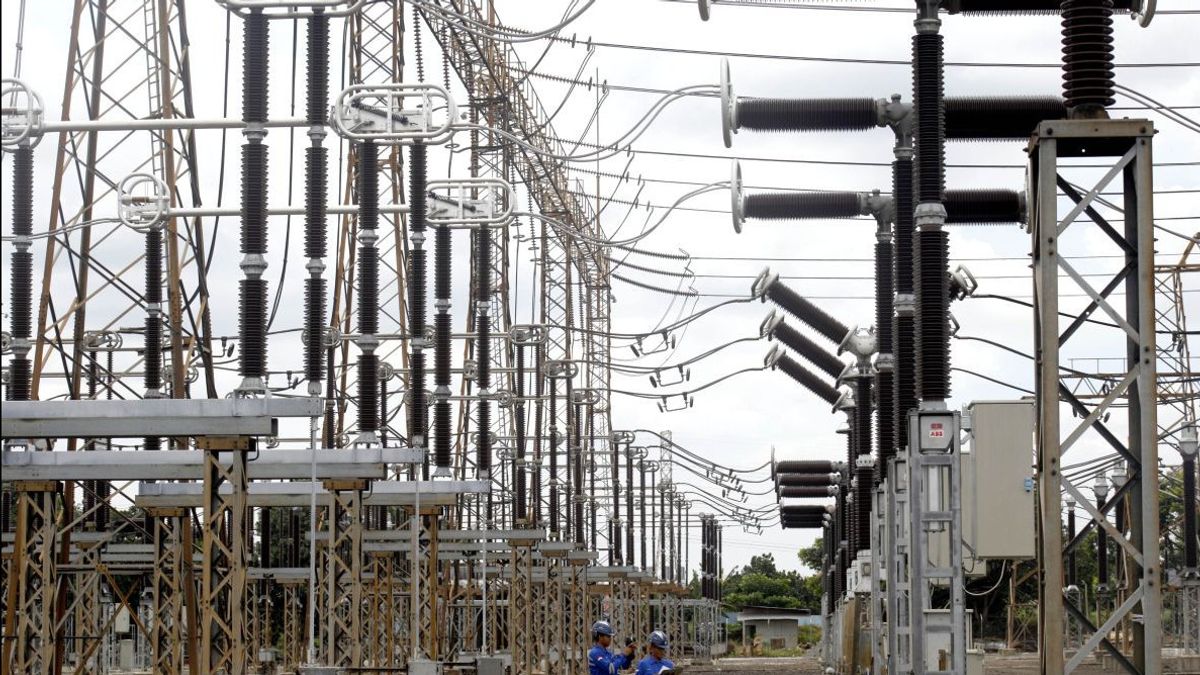


JAKARTA Indonesia's plan to export renewable energy electricity to Singapore is estimated to generate additional foreign exchange of up to 4.2 billion US dollars per year and income tax of 210 million to 600 million US dollars per year
Energy Finance Analyst Institute for Energy Economics and Financial Analysis (IEEFA), Mutya Yustika said, Indonesia needs to set special quotas and electricity rates to ensure these benefits are obtained.
"At the beginning of last month, Minister of Energy and Mineral Resources (ESDM) Bahlil Lahadalia withheld the issuance of an electricity export permit to Singapore because he felt there was no return that benefited Indonesia. However, the latest report "Maximizing Reciprocal Benefit from Indonesia's Green Electricity Export to Singapore" shows the opposite," he said, Thursday, March 6.
Referring to the report, he continued, Indonesia can get an additional foreign exchange of 4.2 to 6 billion US dollars and an income tax of 210 to 600 million US dollars annually by exporting green electricity to the Lion Country.
"This calculation is assuming an electricity export of 3.4 gigawatts (GW) with an agreed rate of around 14 cents to 20 cents per kilowatt hour (kWh)," he continued.
Indonesia can also apply royalties for any kWh of electricity exported to Singapore to further enlarge state revenue.
The electricity export plan to Singapore will result in significant additional foreign exchange and income tax, which can ultimately help Indonesia finance renewable energy projects to meet domestic needs. In addition, by charging renewable energy electricity financing to Singapore, this can ease the burden of the state budget," explained Mutya.
In addition, the construction of the power plant to support electricity exports will also strengthen the manufacturing and supply chain of Indonesia's renewable energy industry.
Just so you know, currently the growth in renewable energy capacity is only in the hundreds of megawatts (MW), which is inadequate in order to support manufacturing industry players who must operate large-scale factories so that they are economical.
He assessed that the 2 GW electricity export target would at least require a solar panel supply of up to 11 gigawatt peak (GWp) and a 21 gigawatt hour storage battery (GWh), which is a significant demand for the manufacturing industry of the two parts.
Furthermore, electricity exports to Singapore will open up new job opportunities in Indonesia. For example, PLTS Cirata 192 megawatt peak (MWp) employs 1,400 workers during construction and operation. With a solar panel capacity of 11 GWp, it is estimated that 80 thousand workers will be needed, excluding additional workers needed by the manufacturing industry," explained Mutya.
SEE ALSO:
-
 | EKONOMI
Masih Enggan Ekspor Listrik Hijau, Bahlil Minta Singapura Investasi
22 Februari 2025, 10:47 -
 | EKONOMI
Di Hadapan Komisi XII DPR, Amman Mineral Minta Relaksasi Ekspor Tembaga
19 Februari 2025, 16:44 -
 | EKONOMI
Dorong Pertumbuhan Ekonomi, Pemerintah Berikan Paket Stimulus Ekonomi
19 Februari 2025, 12:05
To ensure that Indonesia benefits from this electricity export, a number of things need to be resolved. First, the Indonesian government can set a quota of capacity and volume of renewable energy electricity to be exported to Singapore, while ensuring that domestic clean electricity needs are met.
Second, it is necessary to set a special electricity tariff for exports of renewable energy electricity that reflects market prices and agreements between the two parties, considering that the cost of transmitting electricity exports will be higher.
Third, Indonesia and Singapore must agree on a fair distribution of carbon credit benefits. Even though Singapore is the buyer, this position should not negate Indonesia's role considering that the renewable energy power plant is located in Indonesian territory.
The export of renewable energy electricity to Singapore will significantly increase Indonesia's renewable energy capacity. With the PLTS to dominate, Indonesia's renewable energy capacity will exceed 10 GW, which will strengthen Indonesia's energy portfolio," said Mutya.
The English, Chinese, Japanese, Arabic, and French versions are automatically generated by the AI. So there may still be inaccuracies in translating, please always see Indonesian as our main language. (system supported by DigitalSiber.id)


