


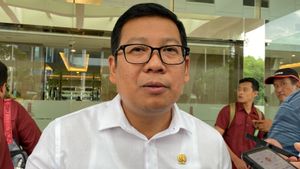
JAKARTA - Head of the National Food Agency (Bapanas) Arief Prasetyo Adi said innovation is very much needed in the development of Indonesia's food ecosystem. Especially in efforts to escalate domestic food production.
Arief said that with innovation, it would encourage increased production so that the realization of food self-sufficiency initiated by President Prabowo Subianto could be achieved quickly. Therefore, the innovation and interventions imposed by the Bogor Agricultural University (IPB) related to food security must be implemented collaboratively.
Earlier, the innovation presented by the Chancellor of IPB regarding food security was very good. There are superior rice varieties and have been collaborated with the Ministry of Agriculture. Even from the results of trials of implementing rice cultivation technology last year, we can increase productivity as well. We can be more optimistic that rice self-sufficiency can be achieved quickly," said Arief in an official statement, Wednesday, February 12.
Based on data on rice and rice productivity released by the Central Statistics Agency (BPS), in 2024 the rice harvest area will reach 10.05 million tons. With this area, farmers are able to produce 53.14 million tons of Dry Giling Grain (GKG) and 30.62 million tons of rice. Meanwhile, the annual amount of rice consumption in 2024 according to Bapanas is around 30.73 million tons.
Furthermore, in 2023, the rice harvest area will be at 10.21 million tons. As a result, GKG production sourced from domestic harvests can reach 53.98 million tons and rice up to 31.10 million tons. From that, annual rice consumption in 2023 is at 30.89 million tons.
"The existence of this rice innovation is certainly good news for the national economy. Moreover, the President is determined to pursue self-sufficiency as soon as possible," he explained.
If you look at the balance sheet prepared by Badanas, continued Arief, there are still strategic staple foods that are not yet scientific, so it is hoped that through innovation it can help accelerate domestic production.
Based on the National Food Balance Projection for 2025 update January 21, of the 12 strategic staple foods, most of them can be met from domestic production.
SEE ALSO:
-
 | BERITA
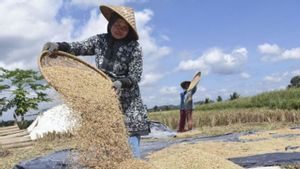
Mentan: Harga Gabah di Masa Panen Tidak Boleh Turun dari HPP Rp6.500
09 Februari 2025, 18:52 -
 | EKONOMI
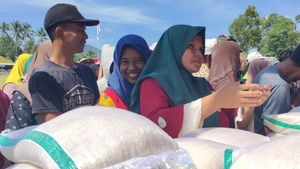
Penyaluran Bantuan Pangan Beras dan SPHP Dihentikan Sementara Mulai Hari Ini
07 Februari 2025, 17:04
Only soybeans, garlic, and beef/cash must continue to pay attention to the development of the supply. The government believes that it does not require procurement from outside Indonesia other than the three food commodities.
Meanwhile, IPB University Chancellor Arif Satria said the food security action program is being pursued in 2025.
"We have 10 IPB 2025 food security action programs. (Among other things) we will hold 3,156 tons of IPB-seeded rice varieties to the Ministry of Agriculture. So we have 15 varieties which we will increase mostly and distribute through the Ministry of Agriculture," he said.
In addition, he said, an expansion of the IPB Innovation Village for gogo rice fields will be carried out in 1,125 hectares by 2025 using the latest technology in the field of rice cultivation.
"From the results of research, the results of the 2024 trial can increase 32 percent of rice productivity in West Java. (Furthermore) the establishment of a rice innovation center at the IPB Campus," he explained.
The English, Chinese, Japanese, Arabic, and French versions are automatically generated by the AI. So there may still be inaccuracies in translating, please always see Indonesian as our main language. (system supported by DigitalSiber.id)


