
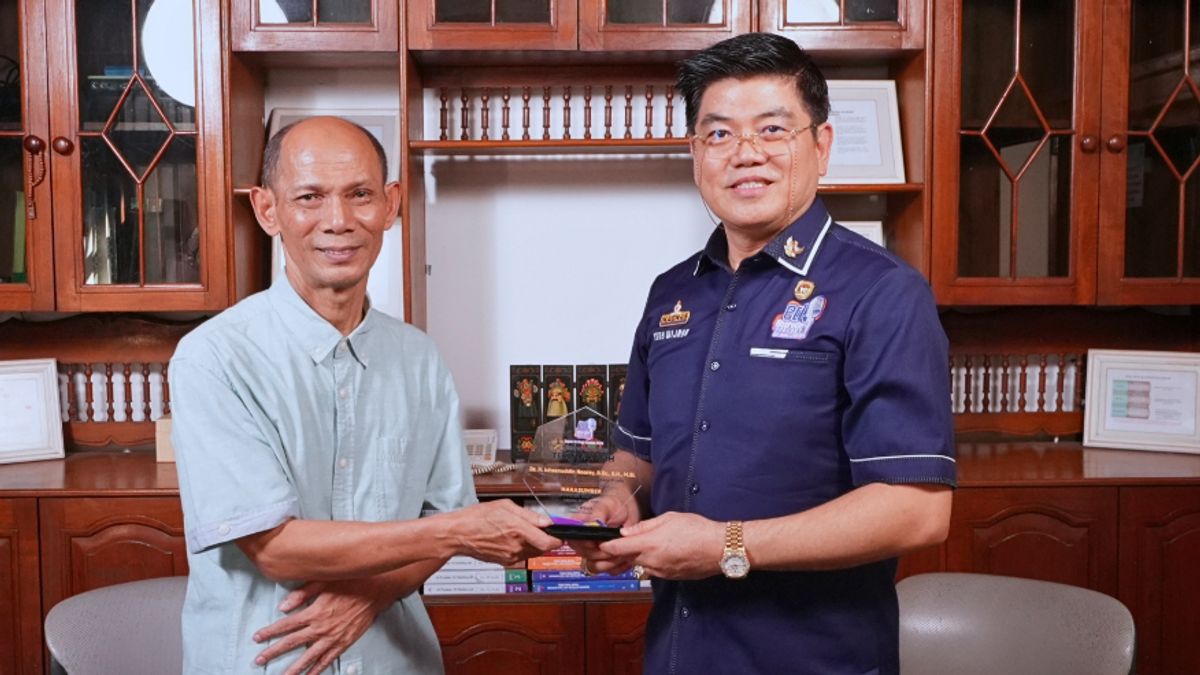


JAKARTA - Political economist Ichsanuddin Noorsy considers the Indonesian economic condition is not going well. One of the indicators is the weakening of the rupiah exchange rate against the US dollar. On May 27, 2026, the rupiah exchange rate against the US dollar reached Rp. 17,812.
"Indonesia is in a position of transition from yellow to red lights. This is actually what I predicted since 2024, the rupiah exchange rate will reach the psychological threshold of Rp. 17,500-18,000," he said when talking to Eddy Wijaya in the EdShareOn podcast which aired on Wednesday, May 27, 2026.
This condition has sparked discussion among netizens on social media, who are worried that Indonesia will repeat the 1998 monetary crisis. However, according to Noorsy, the economic conditions of 1998 are different from today.
In 1998, there was public distrust, which led to economic distrust and political distrust. The condition was exacerbated by weak supervision of banks - where there were bank officials who took advantage of the situation of the rupiah's fall.
Meanwhile, even though public distrust has emerged, political distrust has not occurred. However, Indonesia's monetary position is currently under pressure. For four consecutive months since January, Indonesia's foreign exchange reserves have continued to decrease. In addition, the reference interest rate was raised by Bank Indonesia to 5.25% as of May 20 to maintain the value of the Rupiah exchange rate from external shocks.
The weakening of the rupiah not only has an impact on the financial market, but also on the real sector. Sooner or later this condition can reduce people's purchasing power, as well as weaken MSMEs and business sectors due to rising prices of imported goods, industrial raw materials, energy, and food.
Noorsy said that the Indonesian Purchasing Managers Index (PMI) in mid-May was recorded as falling from 50.1 to 49.1, or below the neutral threshold (50). "This means that the wheels of our production engine are slowly stopping," he said.
Noorsy explained that Indonesian banks recorded undisbursed loans of Rp. 2,527.46 trillion. This means that entrepreneurs have received credit facilities but have not used them due to uncertainty in economic conditions.
"The uncertainty is because the raw materials are imported, and this has an impact on production costs," he said.
Noorsy assessed that the slowdown in economic growth and the withdrawal of liquidity were further squeezing the real sector, especially MSMEs. This condition can be seen from the high ratio of non-performing loans (NPL) of MSMEs which reached 4.61% or close to the maximum limit, while the NPL of corporations was only 1.6%.
On the other hand, when MSMEs are squeezed as they are now, investment credit, working capital, and consumption tend to flow more to large corporations. "That's why I say, compared to fiscal and monetary, the real sector is hit," he said.
According to Noorsy, the government is wrong in managing the economy, including in formulating policies that affect the rupiah exchange rate.
"Our big mistake is to be subject to foreign systems: regulations are drafted based on foreign interests, foreign standards, foreign accountability, as well as foreign-formed reputation and credibility," he said.
Noorsy added that this condition makes it difficult for the government to overcome external pressure because it has opened the door too wide for external forces. "That's why I say, colonizing Indonesia does not need to be with weapons, but with these five things."
Five Approaches to Improve the Indonesian EconomyEconomist Ichsanuddin Noorsy suggested five strategic approaches that can be used to strengthen the foundation of the national economy amid global economic pressures and domestic dynamics.
The five approaches were said by Noorsy to have been conveyed to the team of President of the Republic of Indonesia Prabowo Subianto. The first approach is a resource-based approach.
Then the second approach is the strengthening of national productivity (productivity approach).
"The key here is that we must reindustrialize the sector that concerns the livelihood of the masses," he told Eddy Wijaya in the EdShareOn podcast which aired on Wednesday, May 27, 2026. In that way, Indonesia is expected not only to rely on exports of raw materials.
The third approach, which is called Noorsy, is to improve the institution, in this case fully supporting MSMEs as a mainstay of the national economy. The fourth approach is to clearly separate the market structure, between commercial, controlled prices, and fixed prices.
This separation is considered important by Noorsy so that the government can distinguish which sectors are in the category of public facilities and services, with those that fully follow the market mechanism.
The fifth approach is to improve the governance of a clean, integrated, and transparent government. This accountability is important, one of which is to restore public and investor confidence.
"The management should not be 'leaking'. The government must be managed honestly and free from corruption," said Noorsy.
Who is Eddy Wijaya, this is his profile
Eddy Wijaya is a podcaster born on August 17, 1972. Through the YouTube account @EdShareOn, Eddy interviewed many national figures ranging from state officials, legal experts, political experts, national politicians, to local celebrities.
The man with a right cheek dimple is also a nationalist who is an activist for the marginalized and social observers by helping the community through the Wijaya Peduli Bangsa Foundation.
He is also active in the field of sports by serving as the Chairman of the Indonesian Equestrian Sports Association (Pordasi) Pacu and also served as Deputy General Chairman of the Indonesian Badminton Association (PBSI) East Jakarta. Eddy also served as an Advisor to the Indonesian Chinese Social Association, 2022-2026.
His ideas were formed because of his hard work to be independent from the age of 13 to be successful as he is now. For Eddy, the world of work is not as smooth as imagined, failure and rejection are common. This is what makes him hold on to the tagline "Success is just a matter of time". (ADV)
The English, Chinese, Japanese, Arabic, and French versions are automatically generated by the AI. So there may still be inaccuracies in translating, please always see Indonesian as our main language. (system supported by DigitalSiber.id)
Most Popular Tags
#Prabowo Subianto #donald trump #Febrie Adriansyah #8791 #giias 2026Popular


