

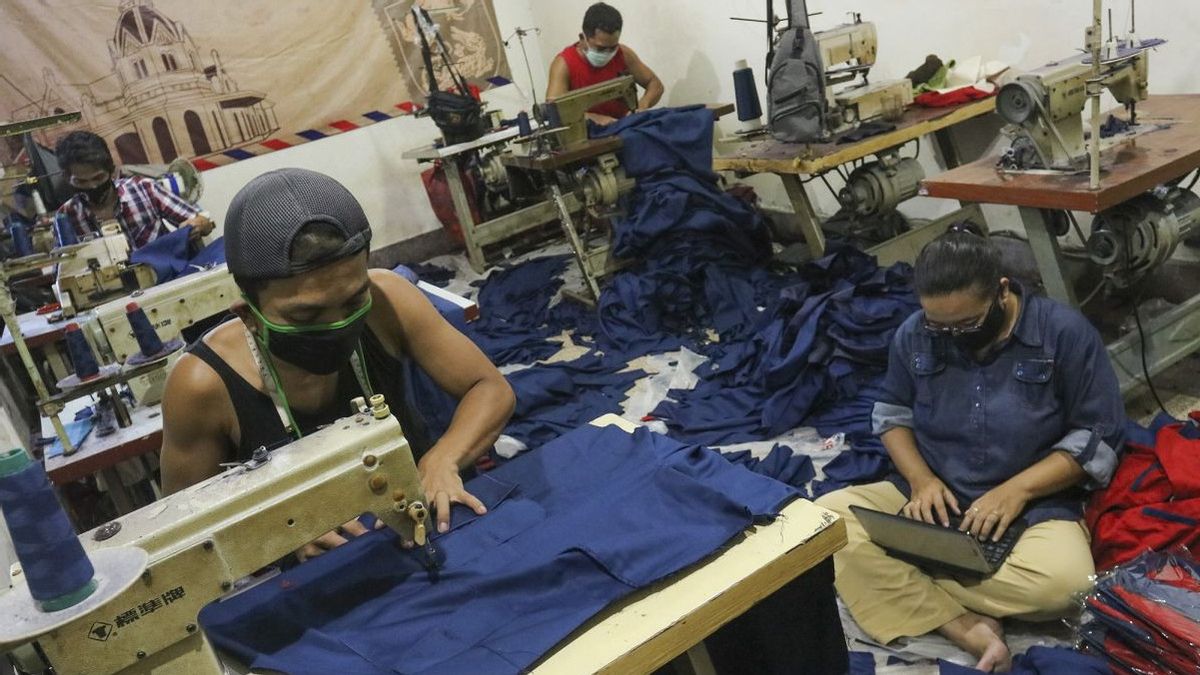


JAKARTA - The Association of Entrepreneurs of Conveying Work (IPKB) revealed that the small and medium-sized textile and textile products (IKM TPT) industry began to feel the impact of the weakening of the rupiah exchange rate today.
The General Chair of IPKB Nandi Herdiaman said that the structure of the TPT IKM is still import-dependent, so every weakening of the rupiah immediately hits production costs. On Wednesday, May 20, 2026, it was recorded that 1 US dollar was Rp17,743.
"The rupiah that broke through Rp. 17,000 per US dollar is not just a number on the Bloomberg screen. In the Bandung, Solo and Tegal convection centers, it means that yarn prices have increased by 15 percent to 20 percent. Orders are quiet and workers are threatened with layoffs," Nandi said in a written statement, Wednesday, May 20.
Meanwhile, on the other hand, he said, the domestic market is flooded with cheap illegal goods from abroad through e-commerce. These two pressures make IKM stuck from upstream to downstream.
"If it is left unchecked, what will happen is not only the price of clothes will rise, but small factories will close and mass layoffs," he said.
His party appreciates the government and Bank Indonesia (BI) who have intervened in the market and lowered interest rates to maintain stability. However, he assessed that this was not enough.
According to Nandi, the IKM sector needs concrete steps. IPKB recommends several steps.
First, strengthen the supply of local raw materials. The government is considered necessary to encourage the domestic textile upstream industry so that SMEs are not trapped by imports.
"Subsidies and incentives for local yarn/fabric factories must be accelerated," he said.
Second, facilitate the export of IKM. In this case, what can be done is to facilitate access to export programs, export KUR financing and certification assistance.
"A weak rupiah is a momentum, not just a threat," he explained.
Third, ease the operational burden.
Nandi encouraged the government to postpone or relax the import VAT on raw materials that have not been substituted and to provide industrial electricity relief for SMEs.
Fourth, protect the domestic market from illegal cheap goods. His party asked the government to tighten supervision and law enforcement against illegal imports, mislabeling and under-invoicing that flooded e-commerce.
"Without a healthy domestic market, the IKM has no room to grow even though the exchange rate is supportive," he explained.
The fifth step is to maintain policy communication.
According to Nandi, the official's statement affects the market.
"The consistent and data-based message makes business actors more calm," he said.
Nandi assessed that the IKM for convection did not ask the government to continue to provide subsidies, it only needed certainty and fair market protection.
"If the government is present at this point, IKM can be a storm stopper, absorb labor, maintain purchasing power and increase foreign exchange through exports," he concluded.
The English, Chinese, Japanese, Arabic, and French versions are automatically generated by the AI. So there may still be inaccuracies in translating, please always see Indonesian as our main language. (system supported by DigitalSiber.id)
Most Popular Tags
#Prabowo Subianto #donald trump #2026 World Cup #Febrie Adriansyah #8791Popular


