

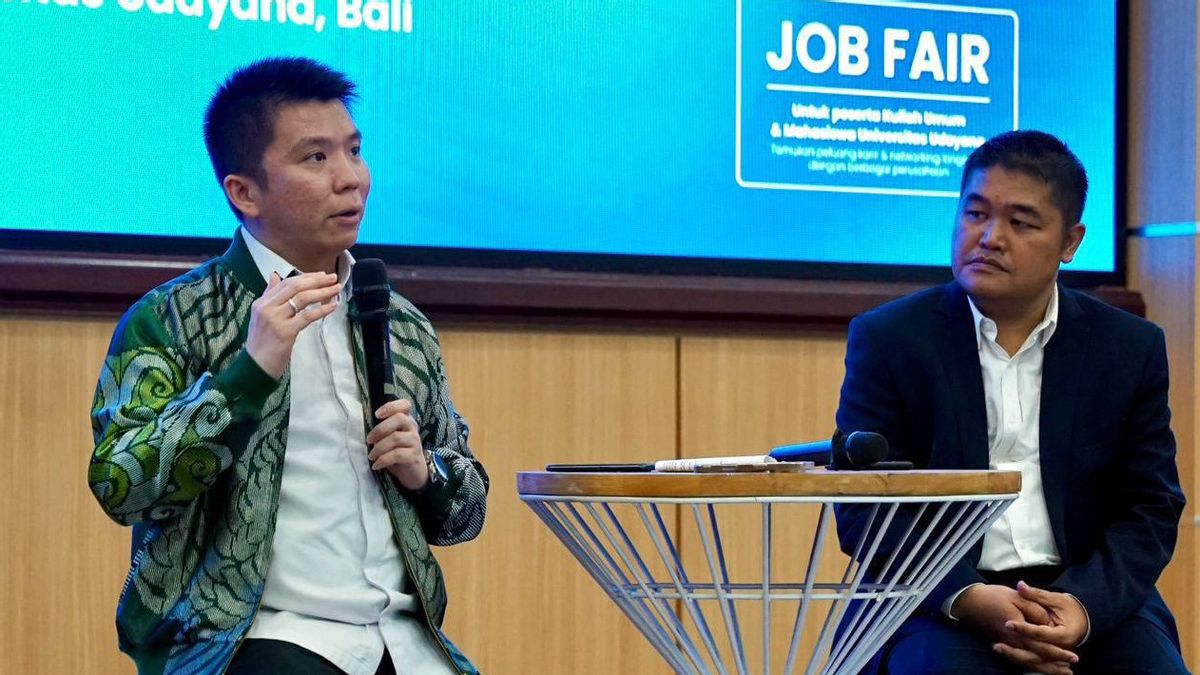


JAKARTA - The candidate for the General Chair of the Indonesian Young Entrepreneurs Association (BPP HIPMI) Anthony Leong, assessed that the thoughts of senior Indonesian economists, Soemitro Djojohadikoesoemo, known as the "Soemitronomics" concept, are still very relevant in the current development of the Indonesian economy.
According to him, this idea is important in encouraging national industrialization, strengthening the country's capacity, and producing national entrepreneurs who are able to compete in the midst of global economic dynamics.
This view was conveyed by Anthony when giving a public lecture at Udayana University, Bali. The event was also attended by the HIPMI Bali BPD, BPC HIPMI throughout Bali, HIPMI Higher Education (HIPMI PT), academics, and young entrepreneurs in Bali.
Anthony explained that Soemitronomics does not merely emphasize state intervention in the economy, but rather a development paradigm that places the state as the main driver of national economic transformation.
"The essence of Soemitronomics is the economic transformation from a commodity-based economy to a modern industrial economy through state planning, strengthening national capacity, and creating domestic entrepreneurs. In today's context, the idea is even more relevant," Anthony said in his statement.
He added that Soemitro's thinking was born from the belief that developing countries could not completely entrust the industrialization process to the free market mechanism.
Antony said that in the theory of economic development, this approach is known as the developmental state, namely a country that plays an active role in directing investment, protecting strategic industries, and building the foundation for long-term industrialization.
According to him, a similar approach has been successfully applied in a number of countries such as Japan, South Korea, and China in the early stages of industrial development.
"Markets are important for efficiency, but history shows that no major industrial country has grown without a strategic role for the state in the early stages of its industrial development," he said.
Anthony assessed that Indonesia is now facing challenges similar to the early days of post-independence development, such as dependence on raw material exports, low national industrial productivity, and foreign technology dominance in the global value chain.
Therefore, he assessed that the policy of the natural resource downstream that is being carried out by the government is a modern form of the spirit of Soemitronomics, which is to create added value in the country while strengthening the foundation of the national industry.
However, Anthony emphasized that industrialization should not stop at the stage of processing raw materials. Indonesia, according to him, must continue to transform towards technological mastery, research, and industrial innovation.
"In the perspective of modern economic development, the greatest added value is no longer in commodities, but in technology, intellectual property, data, and innovation. Therefore, Indonesia's industrialization must be upgraded," he said.
Anthony also highlighted the importance of producing national champions or global-scale national companies. According to him, Soemitro from the beginning understood that economic sovereignty can only be achieved through the strengthening of the national entrepreneur class, not solely relying on foreign capital.
He said that Indonesia's current challenge is not only to attract foreign investment, but also to ensure technology transfer, strengthening local industries, and the growth of domestic companies that are able to enter the global supply chain.
"If Indonesia only becomes a production base without technological mastery and national industrial ownership, then we will only increase statistically in the economy, but we are not really sovereign economically," he said.
In the context of digital economy, Anthony assessed that the concept of Soemitronomics is also relevant to be applied in the development of the national technology ecosystem, ranging from artificial intelligence (AI), data centers, semiconductors, financial technology, to other strategic digital industries.
According to him, the state needs to take a strategic role in building national digital infrastructure while creating regulations that can support domestic innovation without reducing global competitiveness.
"In the past, the country built the steel, fertilizer, and basic manufacturing industries. Today, the country also needs to think about data sovereignty, cloud infrastructure, AI ecosystems, and national digital resilience," he said.
Furthermore, Anthony assessed that Soemitronomics also emphasized the importance of social equity in economic development. He said that high economic growth without strengthening the middle class and the equalization of productivity would only create structural inequality.
Therefore, he encouraged that Indonesia's industrialization strategy should not be centered only in big cities, but rather be able to create new economic growth centers in the regions through the development of industrial areas, vocational education, and infrastructure connectivity.
"Economic transformation must not be exclusive. Industrialization must create social mobility and expand the economic participation of the community," he said.
Anthony added that Indonesia's biggest challenge today is to get out of the middle income trap.
According to him, countries that have managed to get out of the trap are those who are able to carry out industrial transformation and consistent technological mastery.
"Indonesia needs a consistent long-term development direction. Soemitronomics teaches that economic development cannot just follow short-term political cycles, but requires a sustainable vision of the country," said Anthony.
The English, Chinese, Japanese, Arabic, and French versions are automatically generated by the AI. So there may still be inaccuracies in translating, please always see Indonesian as our main language. (system supported by DigitalSiber.id)
Most Popular Tags
#Prabowo Subianto #donald trump #2026 World Cup #Febrie Adriansyah #8791Popular


