
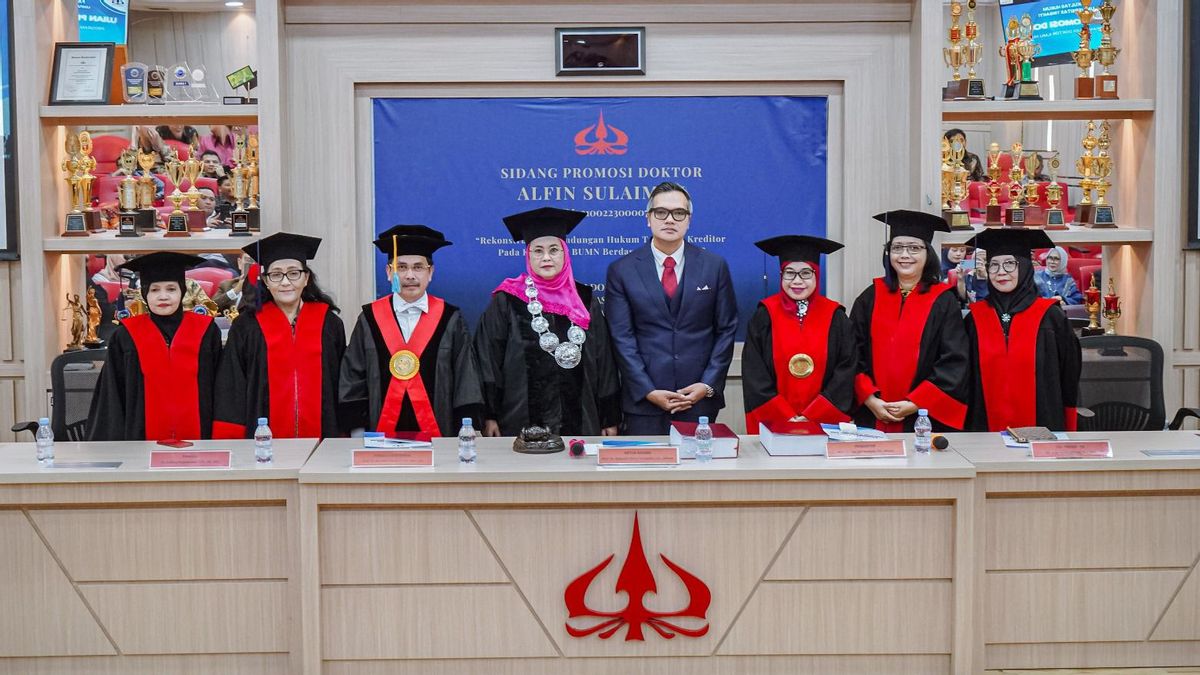


JAKARTA - Founding Partner Arkananta Vennootschap Alfin Sulaiman officially received the 288th Doctor of Law degree at the Faculty of Law, Trisakti University.
In his dissertation entitled "Reconstruction of Legal Protection for Creditors in Bankruptcy of SOEs Based on Justice", Alfin highlighted the weakness of creditor protection in the bankruptcy practice of State-Owned Enterprises (SOEs).
In his presentation, Alfin explained that SOEs or State Owned Enterprises are the dominant business actors in various developing countries, including Indonesia.
The capital structure of SOEs is not only sourced from state participation, but also from debt loans as stipulated in Law Number 19 of 2003 concerning SOEs.
The question arises when SOEs experience default which leads to bankruptcy, as happened to PT Kertas Kraft Aceh Persero, PT Merpati Nusantara Airlines Persero, and PT Istaka Karya Persero.
Alfin, who is also Deputy Secretary General of Peradi Suara Advokat Indonesia (Wasekjen Peradi SAI), revealed that the recovery rate in bankruptcy in Indonesia is still relatively low.
Based on data from the World Bank's Ease of Doing Business, the average recovery rate only reached around 20 percent for competitive creditors and 49 percent for separatist creditors. In fact, in the case of SOEs, the figure could be even lower.
"So the legal protection of creditors in bankruptcy is not optimal, even for state-owned enterprises, the recovery rate could be even worse," said Alfin Sulaiman in the Open Session of the Doctor of Law Promotion at the Trisakti University FH, Monday, April 4, quoted from a written statement.
According to him, the low rate of return is due to various factors, one of which is regulatory uncertainty which creates conflicts between the state financial regime and SOEs' finances. This has an impact on the obstruction of the asset disposal process, so that creditor positions are vulnerable and not optimally protected.
Alfin also highlighted that the bankruptcy regulation of SOEs in Indonesia is still very limited. Currently, the provisions are only regulated in Law Number 37 of 2004 concerning Bankruptcy and Debt Payment Suspension (PKPU).
Meanwhile, the SOE Law, which has been revised several times, including through Law Number 1 of 2025 and Law Number 16 of 2025, has not specifically regulated regarding the bankruptcy of SOEs or creditor protection.
The reconstruction of regulations includes adding special regulations regarding the bankruptcy of SOEs in the SOE Law, clarifying the asset execution mechanism, and drafting government regulations related to debt elimination and optimization of recovery rates in SOEs.
In his dissertation, Alfin proposed three main problem formulations, namely related to the form of legal protection for creditors, its implementation in practice, and the reconstruction of future legal protection based on justice.
Alfin Sulaiman defended his dissertation entitled "Reconstruction of Legal Protection for Creditors in Bankruptcy of SOEs Based on Justice".
To answer this question, he uses a number of theoretical approaches.
At the macro level, Alfin refers to the concept of the welfare state, which places the state as a protector of social and economic welfare of the community.
In this context, SOEs serve as a state instrument to realize people's prosperity.
At the intermediate level, he uses the legal certainty theory of Gustav Radbruch which emphasizes the importance of clarity and consistency of rules. Meanwhile, at the applied level, he refers to John Rawls' theory of justice in A Theory of Justice, especially the principles of justice as fairness, difference principle, and equal basic liberties.
This research also uses a normative method with a legal, comparative, historical, and conceptual approach. In the comparative study, Alfin highlights practices in France and Germany.
In France, bankruptcy arrangements are regulated in the Code de Commerce which also applies to SOEs. In practice, however, SOEs are rarely bankrupt due to state intervention through restructuring or recapitalization. This is known as the implicit state guarantee doctrine.
"SOEs in France are almost never foreclosed on even though there are rules about it. If SOEs experience financial difficulties, the settlement is carried out through administrative or political intervention rather than the bankruptcy legal channel," he explained.
The reconstruction of regulations includes adding special regulations regarding the bankruptcy of SOEs in the SOE Law, clarifying the asset execution mechanism, and drafting government regulations related to debt elimination and optimization of recovery rates in SOEs.
Meanwhile in Germany, bankruptcy is regulated in the Insolvency Ordinance (InsO) which has been reformed through the ESUG 2012. Although SOEs remain subject to the general regime, the state remains present through policies to prevent the bankruptcy of strategic entities.
Unlike the two countries, Indonesia is considered to have not yet had a comprehensive regulatory framework. The lack of harmonization of rules often creates obstacles in the execution of SOEs' assets, because there is a perception that the assets are part of the state's finances that must be protected.
"SOEs that have been liquidated have turned out to have a recovery rate of creditor receivables or recovery rate based on the results of research taken from the respective curators of the liquidated SOEs, where the average is only about 10 percent," he said.
In his conclusion, Alfin emphasized that Article 33 of the 1945 Constitution is the constitutional basis that places SOEs as state instruments for the welfare of the people. Therefore, the state has a responsibility to protect all parties that interact with SOEs, including creditors.
"The state has a special responsibility in managing and supervising SOEs, including when SOEs experience financial difficulties that have the potential to be bankrupt, including after bankruptcy in terms of protection for parties that interact with SOEs, including creditors who have legal rights," he said.
As a recommendation, Alfin proposed a reconstruction of regulations, including by adding special regulations regarding SOE bankruptcy in the SOE Law, clarifying the asset execution mechanism, and drafting government regulations related to debt elimination and optimization of recovery rates in SOEs.
He also encouraged the active role of the government, DPR, and state-owned enterprise management institutions such as Danantara and the State-Owned Enterprise Management Agency to strengthen governance, increase transparency, and implement the principle of prudence to minimize the risk of bankruptcy.
The English, Chinese, Japanese, Arabic, and French versions are automatically generated by the AI. So there may still be inaccuracies in translating, please always see Indonesian as our main language. (system supported by DigitalSiber.id)
Popular


