

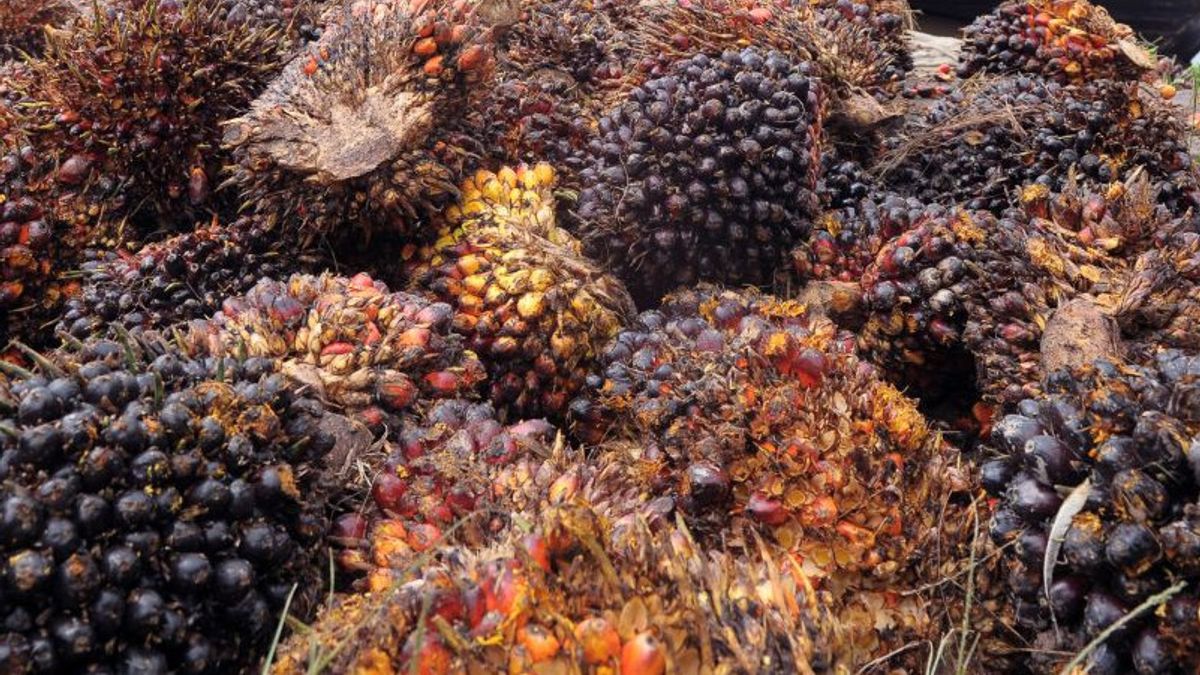


JAKARTA - The palm oil industry in Indonesia has great potential to implement a circular economic model.
Lecturer and researcher at the IPB University Palm Oil Study Center, Siti Nikmatin, said that the circular economy model could be applied in the national palm oil industry ranging from upstream to downstream sectors.
With this model, the palm oil industry can turn waste into products with added value and competitiveness.
"The circular economy model can be applied in the palm oil industry and must be implemented. How to implement all of that? Of course it requires science and technology," he said.
Palm oil is a crop that is categorized as a zero waste crop.
All parts of the oil palm plant, from fruit, seeds, leaves, empty bunches, to stems, can be processed into products that can be used to meet various human needs.
Siti Nikmatin gave an example, empty bunches of palm oil or TKKS can be optimized into biomaterial products such as helmets, bullet-proof vests, to shoes. As a researcher, he has conducted various innovative research that produces products based on TKKS waste.
Then the palm oil shell can be processed into various value-added products that contribute positively to the renewable energy transition. The utilization of palm oil shells includes boiler fuel in palm oil mills, concrete mixture materials and building materials, to raw materials for biobriquettes and biopellets.
"So, what I do to utilize empty palm oil bunches into biomaterial products is an effort to implement a circular economic model in the palm oil industry," he said.
This lecturer from the Department of Physics, Faculty of Mathematics and Natural Sciences (FMIPA) IPB University said that he received a lot of support from the Plantation Fund Management Agency or BPDP in conducting research that supports the implementation of a circular economy in the palm oil industry.
"There is already clear evidence that BPDP supports innovative research for the advancement of palm oil in Indonesia. I am one of the researchers who received palm oil research funding from BPDP," he said.
Nikmatin emphasized that the implementation of a circular economy model in the palm oil industry would have a positive impact on the environment and the economy. He explained that products derived from waste palm oil can support environmental sustainability while creating economic value.
In addition to the positive impact on the economy and the environment, the implementation of the circular economy model also has the potential to have a positive impact on the social sector.
He said the palm oil industry could involve the surrounding community of factories or plantations in processing waste into products with economic added value.
"If the company does not process everything itself, it can involve the community in the palm oil plantation environment. Of course, it will have a positive impact on the community," he concluded.
The English, Chinese, Japanese, Arabic, and French versions are automatically generated by the AI. So there may still be inaccuracies in translating, please always see Indonesian as our main language. (system supported by DigitalSiber.id)


