

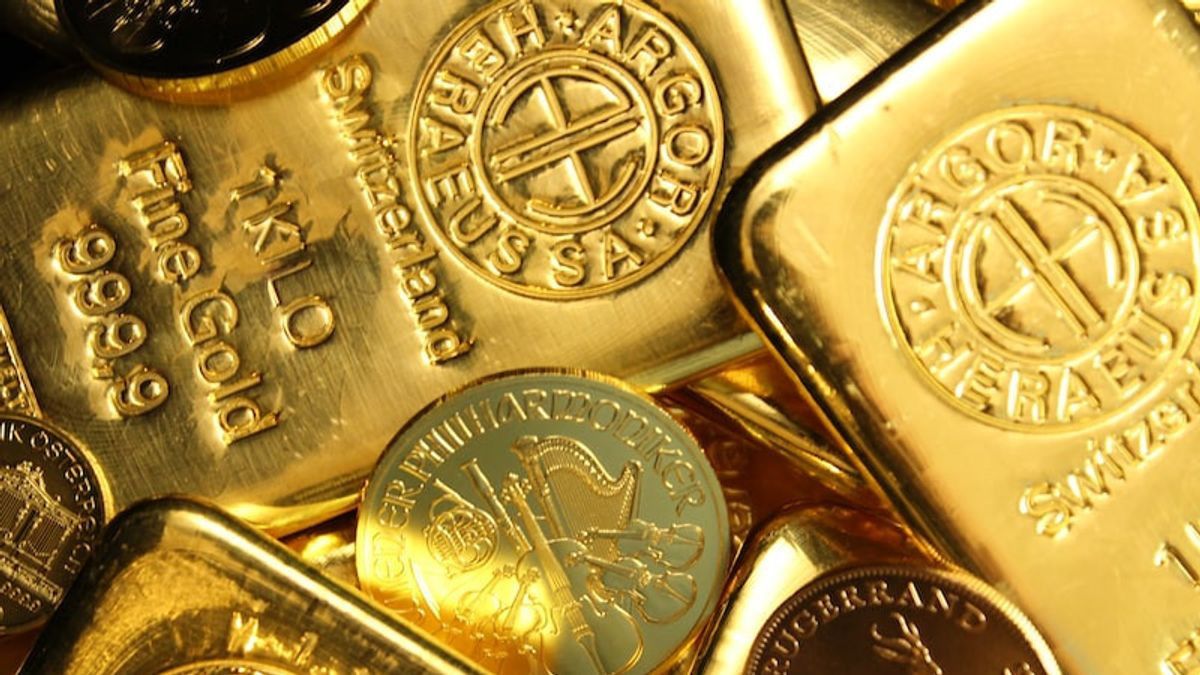


JAKARTA - Gold prices recorded the sharpest monthly decline in a long time. As reported by Anadolu Agency (AA) quoted Sunday, April 5, throughout March 2026, the price of gold per ounce fell 11.3 percent, amid a strengthening US dollar, rising bond yields, and increasing liquidity needs in the global market.
The AA report said tensions in the Middle East have added to pressure on gold. Rising energy prices due to geopolitical risks are driving global inflation and raising concerns that the US central bank, the Federal Reserve or The Fed, will maintain its tight interest rate policy for longer.
Amid this situation, gold prices fell to US$4,099.52 per ounce, the lowest level since November 2025. Pressure came from several sides at once: rising oil prices, rising bond yields, reduced chances of a Fed rate cut this year, and increased demand for the US dollar as a safe asset.
The financial market, according to AA, is still widely expected that the Fed will hold interest rates this year. Although some officials have given a looser signal, the chances of interest rate cuts are now getting thinner. The sale of gold by central banks also adds pressure.
In fact, gold started 2026 with a strong pace. In January, the price jumped 12.42 percent, the best monthly gain since November 2009. In February, gold still rose 8.9 percent. The increase extended a seven-month rally in a row, which was called the first in 53 years.
Pressure is also on silver. After hitting a record US$121.7 per ounce, up 17.2 percent in January and 12.6 percent in February, silver prices fell 19.9 percent in March to US$75.1 per ounce.
Head of commodity strategy at Saxo Capital, Ole Hansen, told AA that gold was pressured by a strong combination of macroeconomic factors that temporarily weakened its role as a safe asset. According to him, investors are actually turning to the US dollar.
Hansen explained that the decline in gold prices was triggered by a large adjustment to interest rate expectations, a surge in energy prices that triggered inflation concerns, and an increase in bond yields in the United States. In such conditions, the cost of holding assets that do not provide returns such as gold becomes higher, so investors tend to sell their holdings.
He also assessed that the current situation reflects inflation more from the supply side than the crisis that hit demand. Therefore, in times of market turmoil, gold is often treated as a source of liquidity, not just a safe asset.
The English, Chinese, Japanese, Arabic, and French versions are automatically generated by the AI. So there may still be inaccuracies in translating, please always see Indonesian as our main language. (system supported by DigitalSiber.id)


