

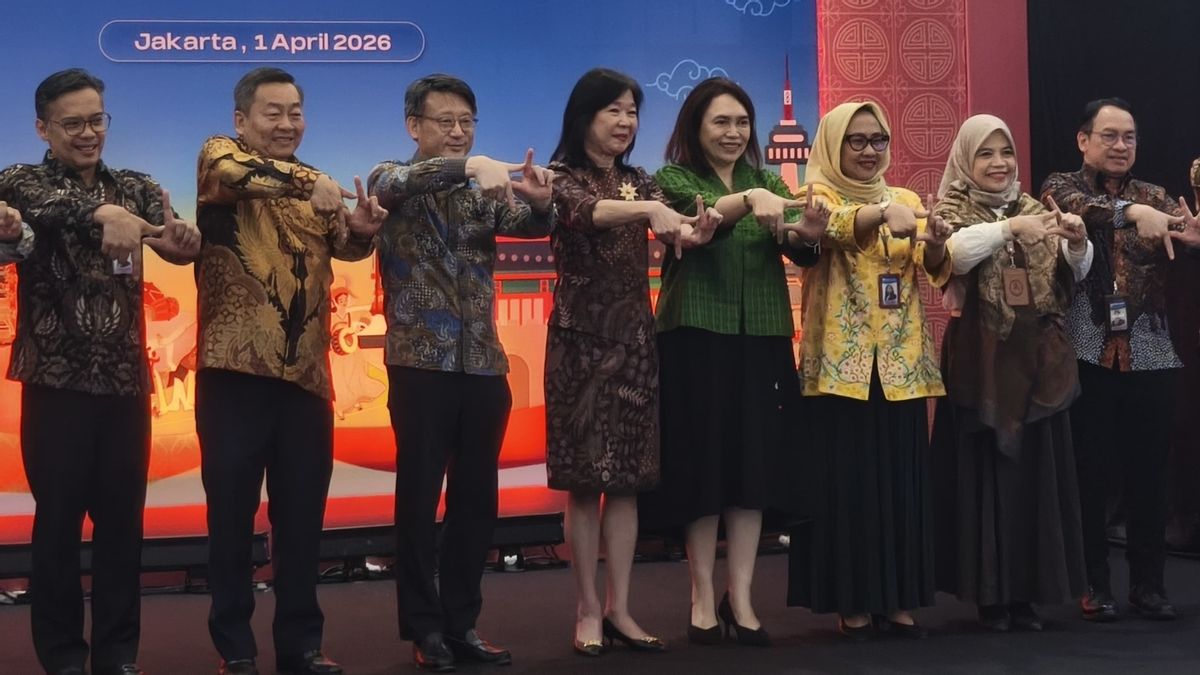


Bank Indonesia (BI) officially launched a cross-country Quick Response Code Indonesian Standard (QRIS) service with South Korea.
Through this cooperation, tourists from Indonesia and South Korea can now make transactions directly using QRIS through their respective mobile phones.
Deputy Governor of BI Filianingsih Hendarta emphasized that Indonesia not only wants to be a user in the global payment ecosystem, but also plays a role as a partner developer with central banks in the region to create a more inclusive and equitable system.
"The implementation of QRIS between countries between Indonesia and Korea is a concrete step in determining the agenda. This not only facilitates transactions, but also opens up wider business opportunities," said Filianingsih in the Launching of QRIS Cross Border South Korea, Wednesday, April 1.
Filianingsih added that the high mobility of tourists between Indonesia and South Korea is one of the factors that encourage the presence of this service.
The QRIS service is expected to facilitate tourist transactions, including when visiting various places such as cafes and restaurants.
"We know that many people in Indonesia go to South Korea, visit Korean cafes, and also Koreans who come to Indonesia, this can be realized. If you walk on Jalan Senayan or Jalan Wolter Monginsidi. You count how many Korean restaurants there. And Korean restaurants have started to be famous, competing with Japanese restaurants. We are used to Korean food, that's it, and others," he said.
He said that this cooperation also supports the development of the business sector, especially with the increasingly wide access of MSMEs to regional and global markets.
"Indonesia continues to strengthen its role in building efficient, inclusive, and nationally oriented cross-country payment connectivity," he explained.
Domestically, QRIS has developed into the backbone of the national retail payment system, especially for small value transactions which are now using QRIS more than credit cards.
According to him, with a wide adoption rate in various layers of society and business actors, QRIS is considered to have succeeded in creating standardization, interoperability, and efficiency in digital transactions.
Filianingsih said this also encouraged the increase in financial inclusion as well as strengthening the national economic structure.
"At the global level, QRIS between countries has also become a strategic step to connect Indonesia's payment ecosystem with partner countries, so that cross-border transactions are seamless, fast, easy, cheap, safe, and reliable," he said.
Filianingsih also revealed that currently cross-country QRIS has been implemented in several countries, namely with Thailand, Malaysia, Singapore, and Japan.
He added that with the addition of South Korea as a new partner, Indonesia is further strengthening the network of international payment connectivity that supports digital economic and financial integration in the region.
"This means that if in the past only Indonesians who went to Japan could use Qris and scan GPQR, now Japanese people who come to Indonesia can use their QR by scanning Qris so it is two-sided, so it is complete with Thailand, Malaysia, Singapore, Japan, and today we complete it with Korea," he said.
The English, Chinese, Japanese, Arabic, and French versions are automatically generated by the AI. So there may still be inaccuracies in translating, please always see Indonesian as our main language. (system supported by DigitalSiber.id)
Most Popular Tags
#Prabowo Subianto #donald trump #firearm #8791 #giias 2026Popular


