
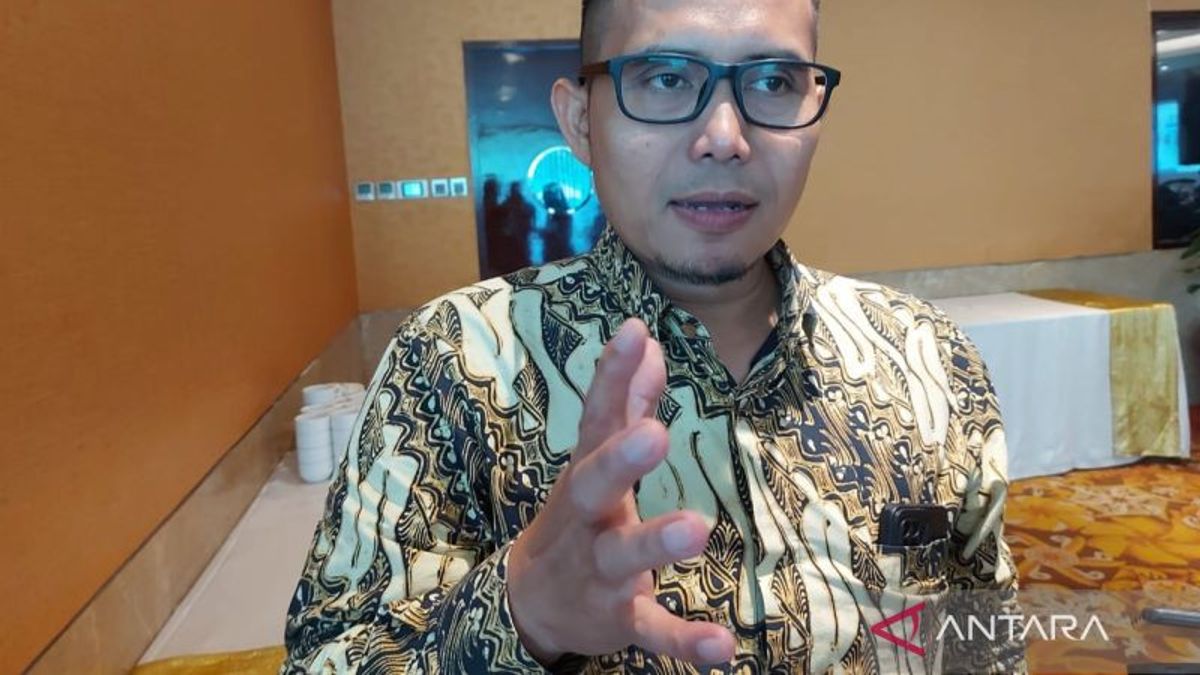


JAKARTA - Economist and Executive Director of the Center of Reform on Economics (CORE) Indonesia Mohammad Faisal reminded that the tariff agreement with the United States (US) should not conflict with the national downstream policy.
According to him, the exemption from the 19 percent tariff granted by the US to a number of Indonesian export commodities such as crude palm oil (CPO), cocoa, coffee, and tea, does bring short-term benefits, but risks weakening the direction of domestic industry policies if it only applies to raw commodities.
"Don't let us step back, re-export raw commodity materials," Faisal told ANTARA in Jakarta, quoted on Saturday.
Faisal also highlighted the US' desire to gain full access to Indonesia's critical minerals.
According to him, if what is meant is mining raw materials, the agreement is clearly contrary to Indonesia's downstream strategy which encourages processing in the country before export.
Furthermore, he explained that although the tariff exemption could maintain CPO exports to the US - which is now the world's fourth largest export destination - the pressure is still great for manufacturing products and processed industries that are still subject to high tariffs.
In fact, this sector is expected to be the engine for increasing export value added. For this reason, he emphasized the importance of stronger trade diplomacy so that Indonesia's interests are not sacrificed in negotiations with major partners who have strong influence such as the United States.
"Neighboring countries such as Vietnam, Taiwan and Malaysia can get better deals than us," he said.
Thus, although there is a positive space from the tariff exemption for certain commodities, Faisal emphasized that Indonesia must be careful.
Trade agreements with the US, he continued, must not sacrifice the direction of the downstream policy which is the main strategy to increase export added value and strengthen national competitiveness.
President Prabowo Subianto is scheduled to fly to the US on Thursday (19/2) to sign the final documents of the Indonesia-US reciprocal tariff agreement with US President Donald Trump after the drafting of the agreement was completed.
Coordinating Minister for the Economy Airlangga Hartarto said this reciprocal agreement is still in the process of finalization, so the amount of trade tariffs agreed by the two countries cannot be determined.
However, in this agreement, Indonesia is committed to opening market access for US products, overcoming non-tariff barriers, and strengthening cooperation in digital trade, technology, and security.
In contrast, the US will provide tariff exemptions for a number of Indonesian flagship commodities that are not produced in the Uncle Sam's country, such as palm oil, cocoa, coffee and tea.
The English, Chinese, Japanese, Arabic, and French versions are automatically generated by the AI. So there may still be inaccuracies in translating, please always see Indonesian as our main language. (system supported by DigitalSiber.id)
Most Popular Tags
#Prabowo Subianto #donald trump #firearm #8791 #giias 2026Popular


