

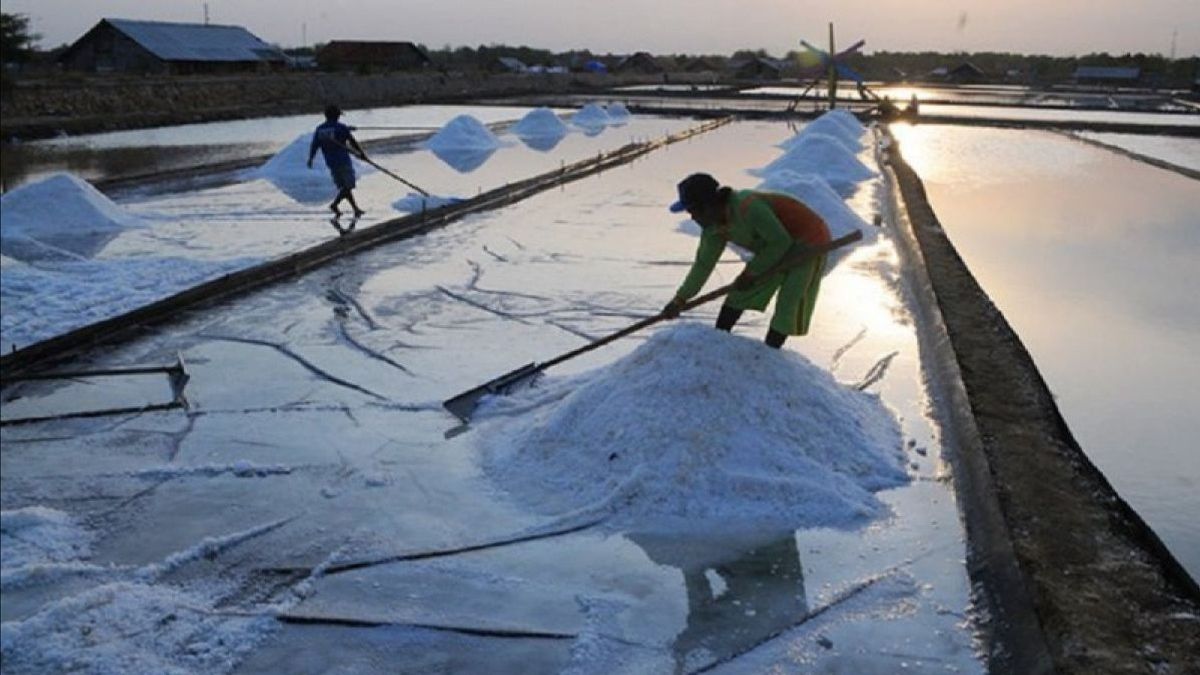


JAKARTA - The Indonesian Food and Beverage Entrepreneurs Association (Gapmmi) emphasized that the industry actually wants to absorb locally produced salt. However, the limitations of quality and quantity make the industry's needs not yet fully met from domestic supplies.
Gapmmi Chairman Adhi S, Lukman said, the use of local salt is more efficient in terms of distribution and logistics. Even so, the specifications of the salt needed by the industry, especially for certain products, are not yet fully available from domestic production.
"The food industry is very eager to use local salt because it is easier in terms of logistics. But, in reality, it cannot be met at all," said Adhi in the Talkshow Bincang Bahari entitled Salt Processing for Independent Indonesia: Challenges and Opportunities for National Industry at the KKP office, Jakarta, Thursday, February 12.
Adhi assessed that salt for industry is not just a seasoning, but also serves as a preservative and texture. Each type of industry requires different specifications. The soy sauce industry, for example, does not require too high specifications. However, the dry seasoning industry requires high quality salt with low water content.
In addition to having to meet the Indonesian National Standard (SNI), some industries require NaCl levels of up to 97 percent, even the pharmaceutical industry reaches 99 percent. Meanwhile, the average NaCl content of local salt is currently still in the range of 94 percent.
Adhi appreciated the issuance of Presidential Regulation (Perpres) Number 17 of 2025 concerning the Acceleration of National Salt Development which requires the industry to absorb domestic salt, while still opening up import space under certain conditions.
He added that the industrial salt needs grew by around 5 percent per year, so the challenge of meeting the supply would be greater.
"Well, this is our common challenge. Therefore, we want to work together to empower upstream, both salt farmers and so on so that our raw materials can be met," he said.
Meanwhile, the Director of Marine Resources of the Directorate General of Marine Management of the KKP, Frista Yorhanita, admitted that the national salt production, both in terms of quality and quantity, has not been able to meet the needs of the industry.
Currently, the national salt demand is estimated to reach 4.9-5.2 million tons by 2027, with about 50-60 percent still met through imports.
The average national production is only around two million tons per year. In addition to limited volume, quality is also a constraint because production is still very dependent on weather.
The government has also prepared an expansion strategy by opening new ponds, intensifying existing land, and developing technology to reduce dependence on weather factors.
"We and PT Garam will be intense, we will focus on technology. Because if it is for intensification it must require a large area and intensification also has limitations, so in the future in addition to expansion and intensification we have done, in the future we will also focus on technology development," said Frista.
The government plans to attract the private sector to develop more than 10,000 hectares (ha) of pond land, which is part of the national salt industrial area (K-SIGN) in Rote Ndao which covers an area of 12,597.69 ha.
The project started in 2025 and will continue this year. KKP will focus on developing Zone 1 with an area of 1,025 ha and Zone 2 with an area of 899.54 ha, while more than 10,000 ha will be offered to private investors.
"We can only work on 2 zones, while the other 8 zones will be handed over to investors. The rest will be offered to investors, including industrial users, such as Mr. Adhi (Chairman of Gapmmi), who have been relying on salt supplies. They are expected to be able to meet their own needs," he said.
The selection of Rote Ndao as an industrial location is supported by good weather and water quality in Rote waters, which are also very good for salt production. The government targets the area to produce up to 400,000 tons of salt per year.
"With a target of 200 tons per hectare, if the entire area is developed, we are optimistic that we can reach 400,000 tons per year," he added.
The English, Chinese, Japanese, Arabic, and French versions are automatically generated by the AI. So there may still be inaccuracies in translating, please always see Indonesian as our main language. (system supported by DigitalSiber.id)


