

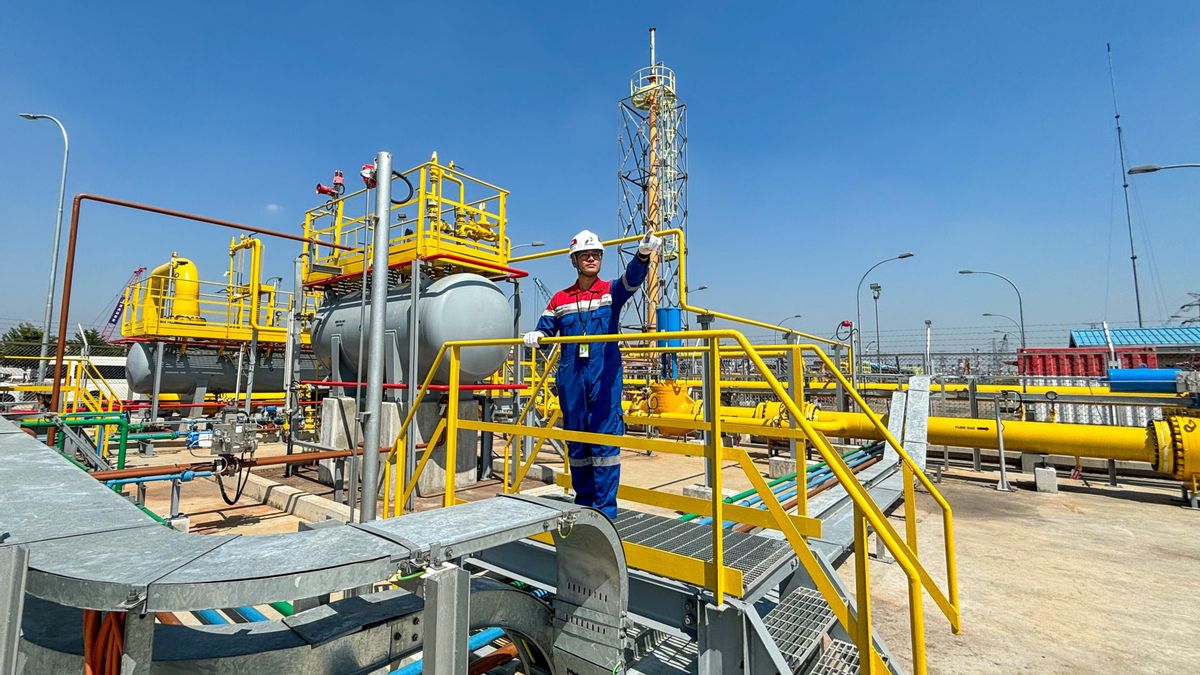


JAKARTA - The Cirebon-Semarang (Cisem) Phase II national strategic gas pipeline project is entering the final stage of construction.
The Committee of the Upstream Oil and Gas Regulatory Agency (BPH Migas) Fathul Nugroho said that this 245-kilometer infrastructure will be the backbone of the integration of the cross-Java natural gas network as well as strengthening the agenda of the national industry's downstream.
"We ensure that construction is carried out according to the target that has been set. This infrastructure is very crucial to create an integration of the natural gas pipeline network that is connected from East Java, Central Java, to West Java," he said, Wednesday, January 28.
Fathul emphasized the need to accelerate the completion of licensing and transportation tariff aspects so that the operation of the pipeline can run in parallel with the completion of the physical construction of the project. Regulatory coordination is the key to ensuring that the utilization of natural gas by industry can run optimally immediately.
The Phase II Cisem is designed to serve a number of major consumers, including the Batang Integrated Industrial Area (KITB), the Balongan Oil Refinery, and the Kujang Fertilizer industry. The existence of this pipeline is expected to strengthen the reliability of natural gas supply for the industrial, energy, and manufacturing sectors.
The construction of Cisem Phase II has recorded an important milestone since the first welding was carried out by the Minister of Energy and Mineral Resources (ESDM) Bahlil Lahadalia.
"This project can be completed on time, in line with the Government's commitment to accelerate the development of national energy infrastructure," he explained.
Fathul explained, through the utilization of natural gas as a cleaner and more efficient energy source, the Cisem Phase II project is expected to be able to drive the growth of value-added industries while strengthening national energy resilience.
The Expert of the Ministry of Energy and Mineral Resources for Monitoring and Evaluation of Oil and Gas Infrastructure Anggawira, who was also present in the monitoring, added that the physical progress that was almost completed needed to be followed by administrative and regulatory readiness, including the determination of the gas transportation tariff to be in line with the commissioning plan.
"This project is not only about infrastructure, but also an important foundation for the downstreaming of national industries. Reliable and competitive natural gas will be the main driver of industrial areas in Central Java and West Java," he concluded.
The English, Chinese, Japanese, Arabic, and French versions are automatically generated by the AI. So there may still be inaccuracies in translating, please always see Indonesian as our main language. (system supported by DigitalSiber.id)
Most Popular Tags
#Prabowo Subianto #donald trump #2026 World Cup #Febrie Adriansyah #8791Popular


